






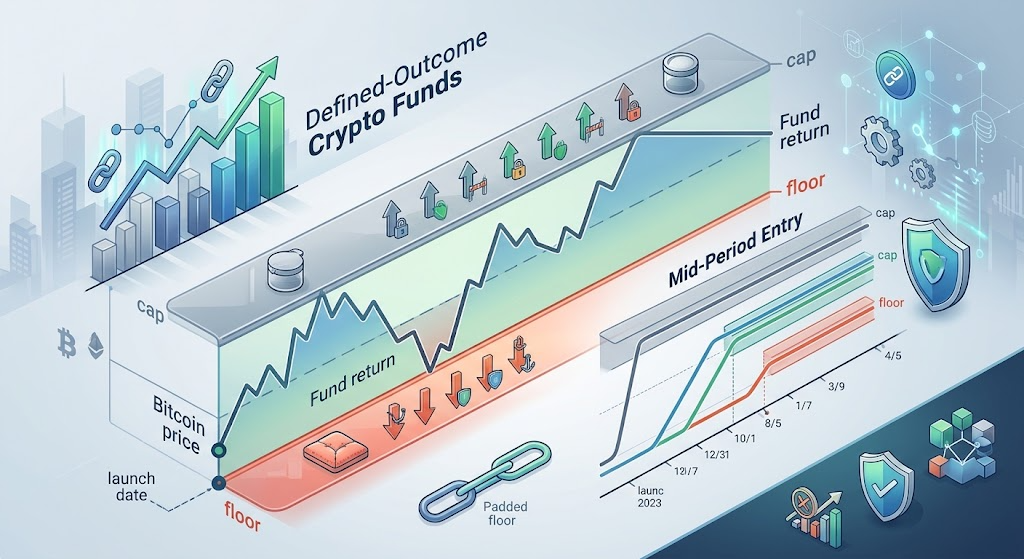
Defined-outcome crypto funds use preset payoff structures to establish boundaries around some investment outcomes over a specified period. These structures may include a cap on potential gains and a floor or buffer against certain losses.
For investors, the headline terms can appear straightforward: returns are limited above a certain threshold, while losses may be absorbed or reduced within a stated range.
The details become more complicated when an investor buys shares after the outcome period has already started. Defined outcome crypto funds are designed around a particular starting value, ending date and payoff formula. Someone entering mid-period purchases the fund at its current market price, not necessarily at the original reference value used to calculate the advertised outcome.
Understanding that distinction is essential. Caps and floors do not automatically reset when a new investor enters, and a stated buffer does not guarantee that a buyer will avoid losses. Fees, remaining time and the fund’s market value can all affect the result.
How Caps, Floors and Buffers Work
A defined-outcome structure sets a range of possible results over a specified measurement period. The underlying exposure might be Ether, Bitcoin or another crypto-linked asset, depending on the fund’s design. The outcome is typically created through financial instruments or a rules-based portfolio structure rather than through a simple promise to protect principal.
A cap limits the maximum return available under the defined payoff formula. If the underlying asset rises beyond the level associated with the cap, the fund may not participate in the additional appreciation.
A buffer absorbs some initial portion of a decline in the underlying asset over the defined period. For example, a 10% buffer might be structured to absorb the first 10 percentage points of an eligible loss at the period’s endpoint, subject to the fund’s terms. A buffer is not necessarily the same as a hard floor.
A floor establishes a lower boundary within the stated payoff design. However, investors must determine whether the floor applies to the fund’s calculated outcome, the underlying exposure, or another specified measure. It should not be interpreted as an unconditional guarantee that the fund’s market price cannot fall below a particular level.
These distinctions matter because two products with similar headline percentages may have different payoff formulas, reference values, expenses and settlement mechanics.
A Dated Example: How the Cap Limits Returns
Consider a hypothetical crypto-linked fund with a six-month outcome period running from January 1 through June 30, 2026. Its terms specify a 20% gross return cap and a 10% downside buffer. Assume the fund’s reference value and the underlying asset’s starting value are both 100 for illustration, with the payoff calculated from the underlying asset’s return.
The simplified model below assumes the fund is held from the beginning to the end of the period and excludes fees.
| Underlying return by June 30, 2026 | Illustrative fund outcome |
|---|---|
| +35% | +20% (cap applies) |
| +12% | +12% |
| −7% | 0% (buffer absorbs the decline) |
| −25% | −15% (loss beyond buffer) |
This illustration assumes a structure that passes through gains up to the cap and absorbs the first 10 percentage points of losses. Actual products may use different payoff formulas, and a buffer may not protect against every type of loss.
The cap limits participation when the underlying asset appreciates significantly. The buffer reduces the impact of a moderate decline over the measurement period, but losses exceeding the buffer remain with the investor. Neither feature establishes a guaranteed market value during the period.
Why Mid-Period Entry Changes the Calculation
Now suppose an investor buys the same hypothetical fund on April 1, 2026, when the underlying asset has already risen 15% from its January 1 reference value.
The original cap is still measured against the starting point established on January 1. It does not automatically reset to the investor’s April purchase price. If the fund’s value has already moved close to the payoff ceiling, the remaining potential return may be much smaller than the headline 20% cap suggests.
For example, assume the fund’s market price has risen from 100 to 115 by April 1. If its modeled endpoint value is 120 under the original payoff structure, a new investor paying 115 would earn approximately 4.35% before fees if the fund finishes at 120:
\[ \frac{120-115}{115}\times100 \approx 4.35\% \]
The headline cap is 20%, but that figure describes the maximum modeled return from the original reference point under the assumed terms—not the return available to every investor purchasing shares during the period.
The opposite situation can also create confusion. If the underlying asset has already fallen beyond the buffer by April 1, a buyer entering at the lower fund price does not necessarily receive a fresh 10% buffer measured from their own purchase.
The original outcome structure remains tied to its established reference levels. The fund’s current market price, the remaining time and the value of its underlying positions all affect the potential outcome.
Regulatory filings for existing defined-outcome ETFs warn that investors entering after an outcome period begins may experience substantially different results from investors who hold shares throughout the full period. Although these filings concern equity-linked products, the timing principle is relevant when evaluating a hypothetical crypto-linked structure.
Fees Reduce the Investor’s Realized Return
Even if a fund reaches its modeled payoff, investors receive results after applicable costs. These may include management fees, trading commissions, bid-ask spreads and other fund expenses. The effect depends on the fee schedule, holding period and transaction conditions.
Consider the hypothetical investor who buys at 115 on April 1 and sells at 120 on June 30. The gross return is approximately 4.35%. If the fund has a 0.75% annual management fee and the investor holds for 90 days, a simple prorated estimate of the fee drag is approximately 0.185% of the investment, assuming a constant asset value and a 365-day year. The estimated return would therefore fall to roughly 4.17% before trading costs, taxes or other expenses.
This is an approximation, not a statement of how any specific fund calculates fees. Actual management expenses generally accrue according to the fund’s documented methodology, while transaction costs depend on execution.
Fees also affect the original outcome. A 20% gross cap does not necessarily translate into a 20% net return. Similarly, a gross 10% buffer may offer less effective protection after expenses. Fund disclosures should clarify whether published outcome figures are shown before or after management fees and other costs.
What Investors Should Verify Before the Outcome Date
A fund’s stated cap, buffer and endpoint can provide a useful framework, but the details matter most when entry occurs mid-period. Review these items together:
- Outcome dates: Confirm the exact start and end dates and the reference value used for the payoff.
- Current remaining upside: Check the fund’s current value against its cap rather than relying on the original headline percentage.
- Remaining downside exposure: Determine where the underlying asset and fund currently sit relative to the buffer or floor.
- Fee treatment: Identify the management fee, transaction costs and whether published outcomes are gross or net.
- Early-exit conditions: Understand how the fund may trade before the outcome date and why its interim market price may differ from the modeled endpoint payoff.
These checks are particularly important in crypto-linked markets, where sharp price movements can change the relationship between an underlying asset’s current level and a fund’s remaining payoff range.

Evaluating Defined-Outcome Crypto Funds
Defined-outcome structures can make potential returns and loss thresholds easier to describe, but those figures only make sense within their measurement period. Caps limit modeled upside, buffers or floors apply according to specific rules, and fees reduce the return available to investors.
For anyone assessing defined outcome crypto funds, entry timing deserves as much attention as the headline terms. A fund purchased on the first day of its outcome period may have a different potential payoff from the same fund purchased three months later, even when both investors hold shares until the same endpoint.
Kenson Investments examines digital asset structures through their payoff mechanics, cost assumptions and risk boundaries. Reviewing dated outcome examples alongside current fund disclosures can help clarify how much upside remains, which losses may be absorbed and how expenses affect the final result—without treating a stated cap or buffer as a guarantee.
Join the tribe to find out more.
Disclaimer: The information provided on this page is for educational and informational purposes only and should not be construed as financial advice. Crypto currency assets involve inherent risks, and past performance is not indicative of future results. Always conduct thorough research and consult with a qualified financial advisor before making investment decisions.
“The crypto currency and digital asset space is an emerging asset class that has not yet been regulated by the SEC and the US Federal Government. None of the information provided by Kenson LLC should be considered as financial investment advice. Please consult your Registered Financial Advisor for guidance. Kenson LLC does not offer any products regulated by the SEC, including equities, registered securities, ETFs, stocks, bonds, or equivalents.”