


Liquidity management has always been the quiet architecture beneath financial markets. Cash buffers, collateral pools, intraday credit lines, and settlement queues determine whether markets function smoothly or fracture under stress. For decades, institutional liquidity frameworks were designed around batch processing, delayed settlement, and predictable operating hours.
That foundation is now under pressure.
As tokenized assets, stablecoins, and on-chain settlement assets enter institutional workflows, liquidity no longer moves in discrete windows. It moves continuously. Transactions settle atomically. Collateral can be mobilized instantly. Funding gaps appear and close in real time. These dynamics are forcing banks, asset managers, and market infrastructure providers to rethink how liquidity is measured, forecasted, and controlled.
This whitepaper examines how institutions are implementing tokenized liquidity management across treasury, risk, and operations. It explores how on-chain institutional cash flows are changing intraday funding models, collateral mobility, margin optimization, and liquidity stress management in environments where settlement is no longer deferred but continuous.
Rather than focusing on speculative use cases, this analysis draws from live pilots, regulatory initiatives, and production-adjacent deployments observed through 2024 and 2025. The emphasis is on operational reality.
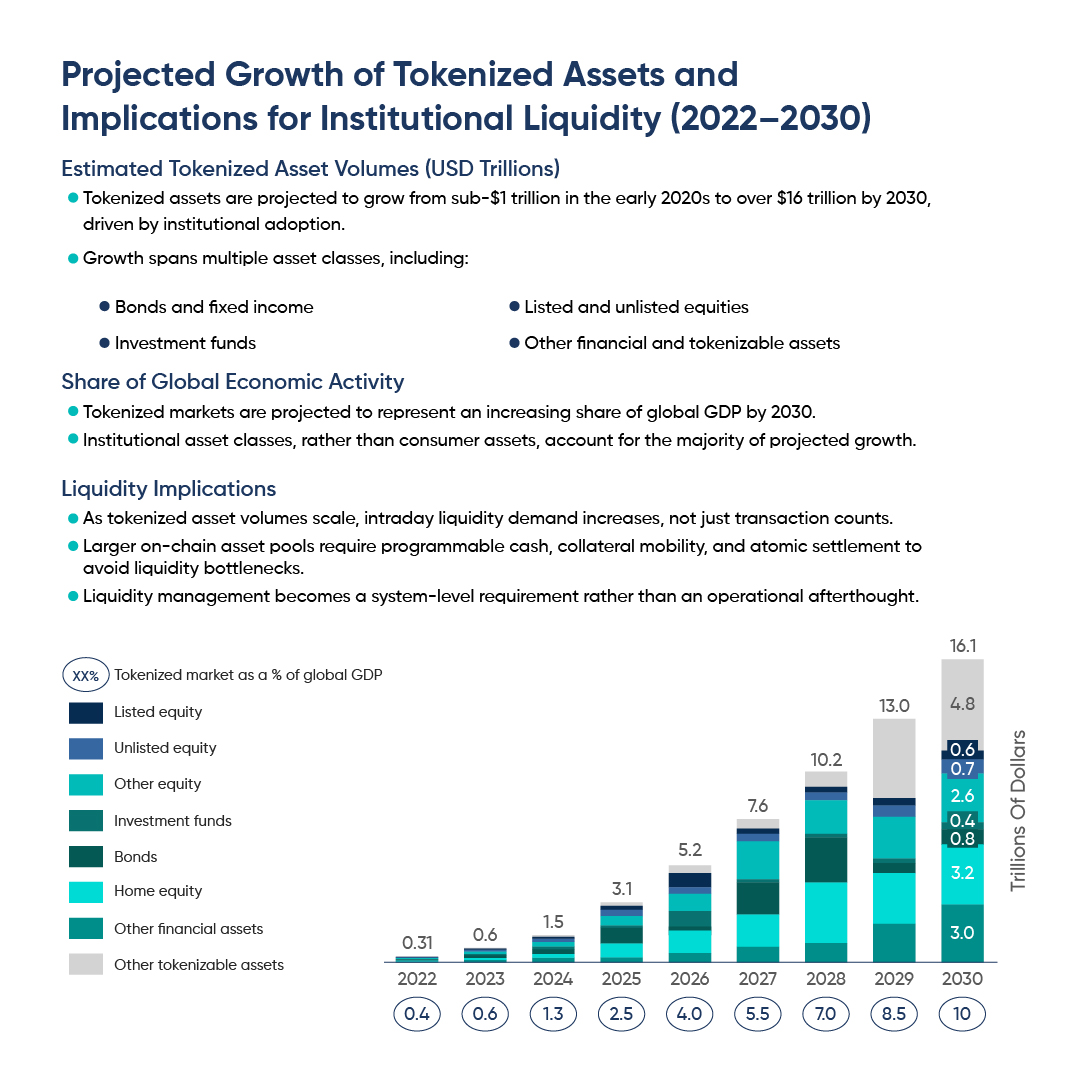
Why Legacy Liquidity Models Are Breaking Down
Traditional liquidity management assumes delay.Cash movements settle at defined intervals. Securities settle days later. Collateral substitutions require coordination across custodians, clearinghouses, and payment systems. Liquidity forecasts rely on end-of-day positions, with buffers sized to absorb uncertainty.These assumptions worked because the system moved slowly.
Tokenized markets challenge that premise. When assets and cash settle simultaneously on shared ledgers, liquidity conditions change intraday, not overnight. A collateral call can be triggered immediately. Margin can be recalculated continuously. Funding needs emerge within minutes rather than hours.
Institutions experimenting with on-chain settlement in 2024 and 2025 reported a paradox. Settlement risk declined, but liquidity volatility increased. Faster finality reduced counterparty exposure, yet compressed the time available to source funding or reposition collateral.This is not a technology problem. It is a liquidity design problem.
As a result, liquidity teams are increasingly engaging blockchain and digital asset consulting partners to reassess models built for deferred settlement. The goal is not to replicate legacy processes on-chain, but to redesign them for continuous execution.
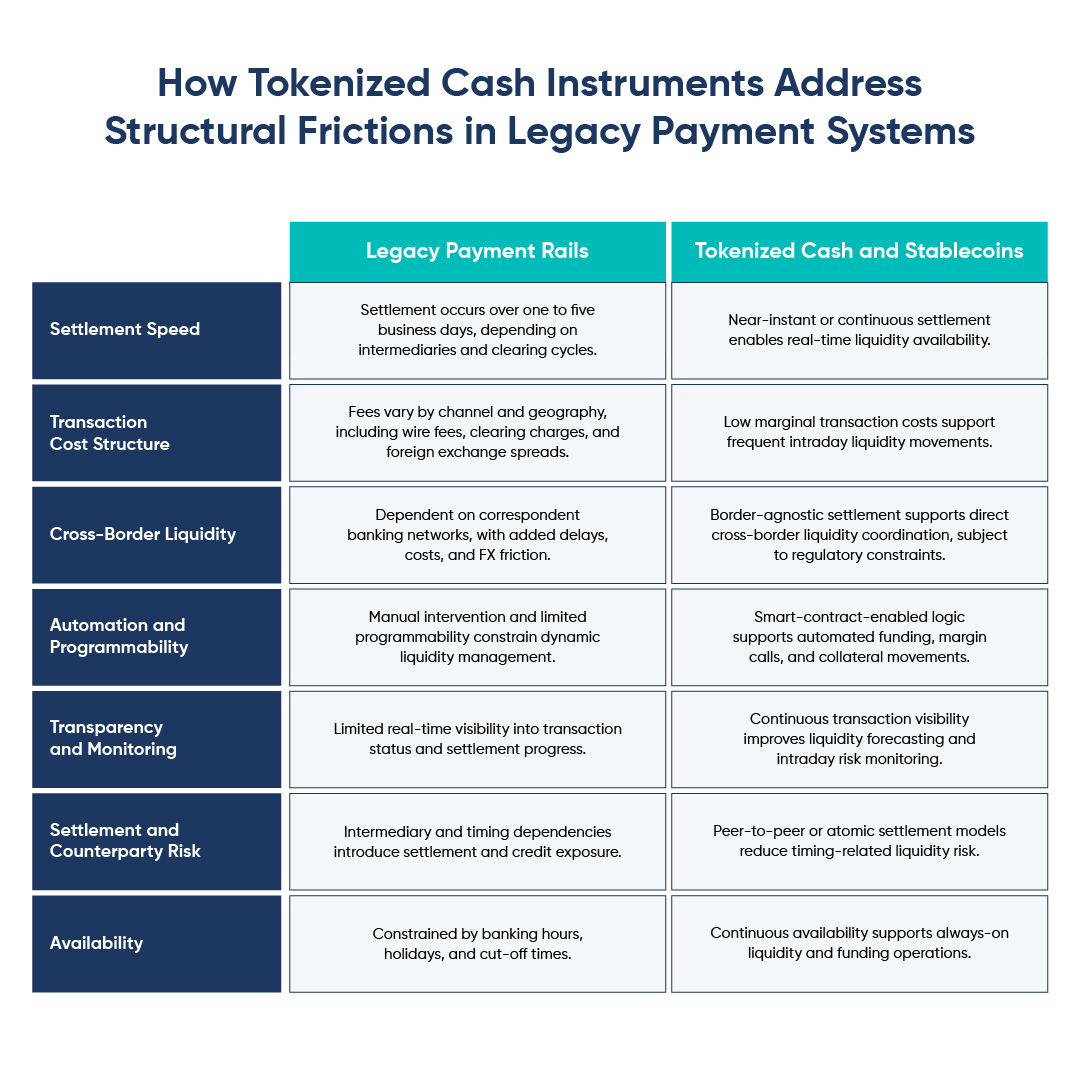
From Batch Liquidity to Continuous Liquidity
In legacy systems, liquidity is managed episodically. Treasury teams plan around known settlement cycles. Intraday credit facilities bridge timing gaps. Stress testing focuses on end-of-day shortfalls.
On-chain environments eliminate many of these buffers.When delivery-versus-payment is atomic, transactions either complete or fail instantly. There is no pending state. This forces liquidity to be available precisely when needed, not later.Institutions adapting to this environment are shifting from batch liquidity to continuous liquidity frameworks. These models focus on:
- Real-time cash position visibility
- Instant collateral eligibility verification
- Automated margin recalculation
- Dynamic intraday funding allocation
This transition requires coordination across treasury, risk, and operations functions that historically operated on different time horizons.Firms providing digital asset consulting services for businesses increasingly report that liquidity redesign, not asset issuance, is the most complex part of institutional tokenization.
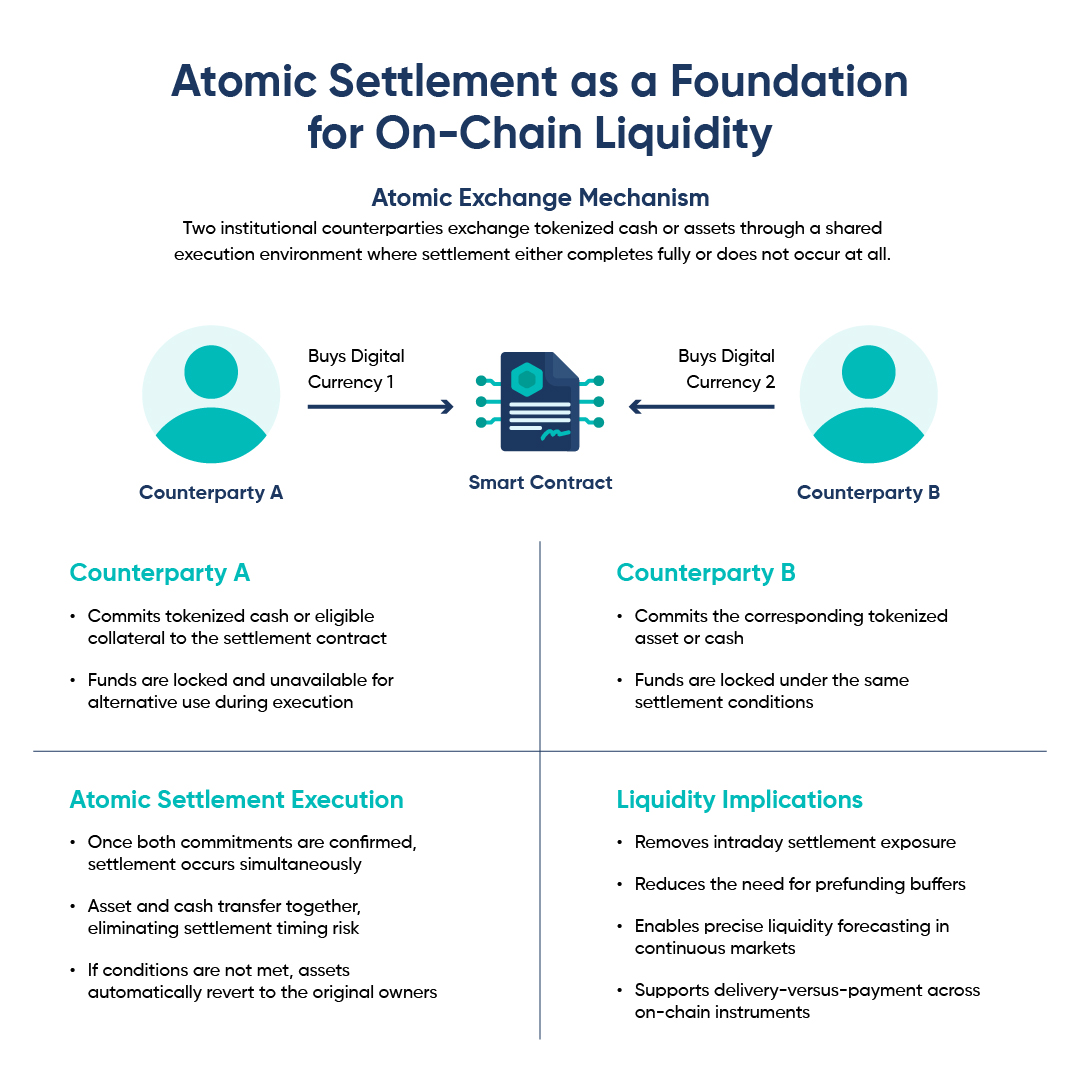
Tokenized Cash as a Liquidity Primitive
At the core of onchain liquidity management is cash itself.Tokenized cash instruments include regulated stablecoins, tokenized bank deposits, wholesale CBDCs, and onchain money market fund shares. While their legal structures differ, they share a key property: programmability.
Unlike traditional cash balances, tokenized cash can move, settle, and be restricted within the same execution environment as assets. This enables new liquidity behaviors.
In 2025, stablecoins used in institutional settlement exceeded $150 billion in circulation globally, according to public disclosures. While much of this volume supports payments and trading, a growing share is earmarked for treasury and collateral use.
Institutions are not adopting tokenized cash for yield. They are adopting it for control.
Tokenized cash allows treasury teams to predefine where liquidity can flow, under what conditions, and at what priority. These rules can be enforced automatically, reducing manual intervention.
This shift has elevated demand for digital asset consulting for compliance, as cash programmability introduces new governance questions. Who defines liquidity rules? How are overrides handled? How are exceptions audited?
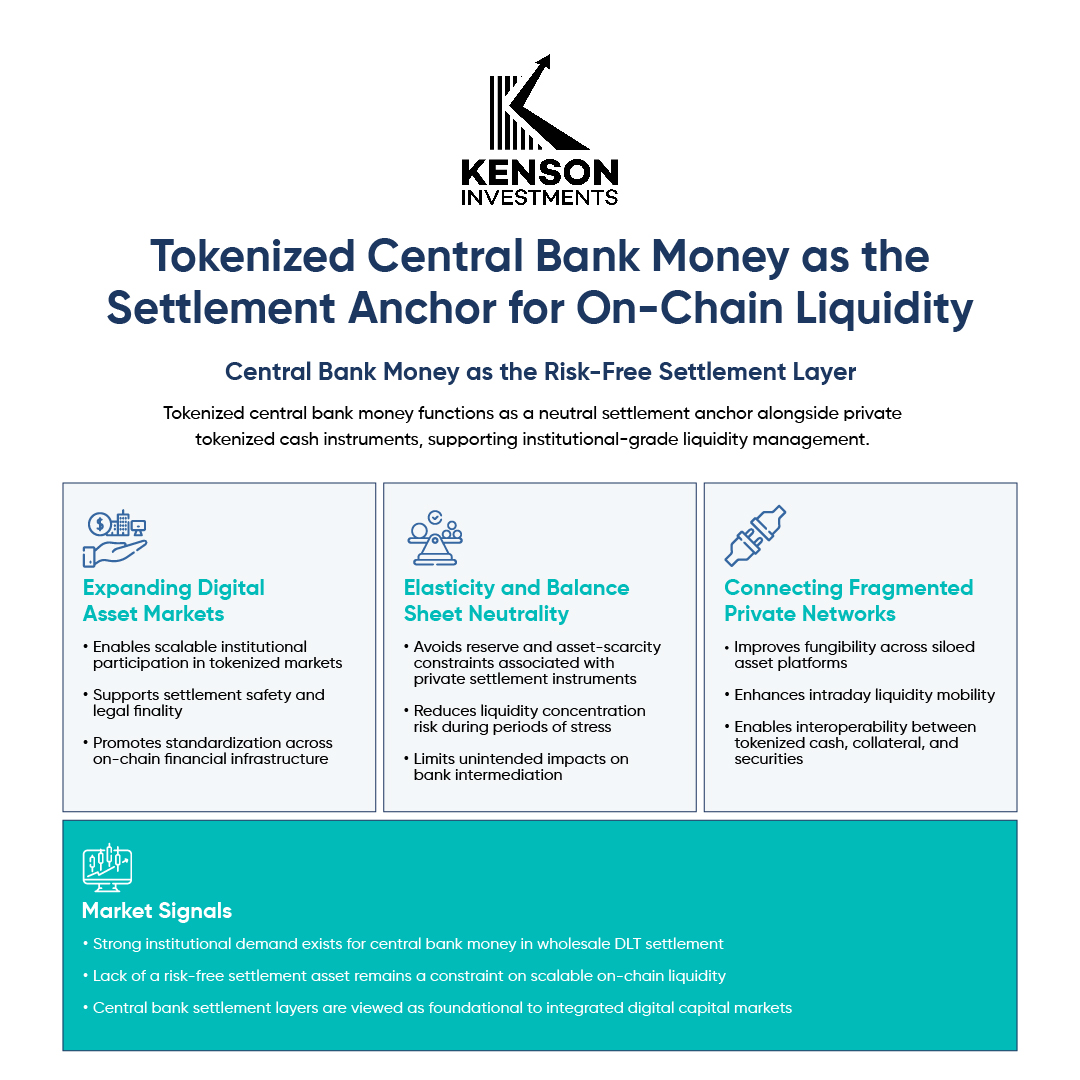
On-Chain Money Market Funds and Liquidity Stacking
Beyond cash, institutions are experimenting with tokenized money market funds as liquidity instruments.Tokenized fund shares allow institutions to hold yield-bearing assets that can be mobilized quickly for settlement or collateral. In some pilot environments, these instruments can be redeemed or pledged intraday, rather than at end-of-day.
This creates a concept sometimes referred to as liquidity stacking. Cash, money market fund shares, and eligible securities coexist within a unified execution environment. Liquidity can be sourced from multiple layers depending on urgency and cost.
For example:
- Stablecoins may be used for immediate settlement
- Tokenized funds may be redeemed for cash if balances fall
- Tokenized bonds may be pledged for margin if required
This hierarchy allows treasury teams to optimize liquidity usage without manual sequencing.
Advisors offering consulting on digital asset management note that this approach reduces idle cash buffers while preserving resilience. Liquidity is not eliminated. It is deployed more precisely.
Collateral Mobility as a Liquidity Lever
Collateral has always been central to institutional liquidity. What changes onchain is speed and granularity.In traditional markets, moving collateral between venues can take hours or days. Substitutions require coordination across multiple parties. Eligibility checks are often manual.
Onchain collateral mobility compresses these processes. Eligibility rules are embedded. Ownership is verified instantly. Transfers settle atomically.
This enables institutions to treat collateral as a fluid liquidity resource rather than a static reserve.In pilot repo and margin environments observed in 2024, institutions demonstrated near-instant collateral reallocation across trading venues. This reduced intraday credit usage and lowered funding costs.
However, this efficiency introduces new risks. Faster collateral movement can amplify liquidity shocks if not governed carefully.As a result, secure digital asset consulting solutions increasingly focus on control design. Institutions are embedding throttles, buffers, and priority rules into collateral logic to prevent runaway feedback loops.
Intraday Funding in Always-On Markets
Intraday funding has traditionally relied on predictable patterns. Payment systems open and close. Clearing cycles are known. Central bank facilities provide daylight credit.Onchain markets do not sleep.
This forces institutions to rethink intraday funding availability. Liquidity must be accessible across time zones and operating hours.
Some institutions are addressing this by maintaining tokenized liquidity pools dedicated to intraday needs. Others are experimenting with automated funding triggers that source liquidity when thresholds are breached.
These systems blur the line between treasury operations and automated execution. Funding decisions that once required human approval may now be rule-driven.
This shift places new demands on governance and oversight. It is one reason evaluating digital asset consulting firms increasingly includes scrutiny of their operational risk frameworks, not just technical capability.
Early Lessons from Institutional Pilots
Across multiple pilots, several themes have emerged.
First, liquidity visibility improves dramatically. Onchain systems provide real-time insight into positions that previously required reconciliation.
Second, liquidity volatility increases. Faster settlement compresses reaction time.
Third, governance matters more than optimization. Institutions that over-optimize liquidity usage without safeguards experience instability during stress scenarios.
These lessons are informing best practices in digital asset consulting, particularly for treasury and risk teams navigating the transition.
Margin Optimization in Atomic Settlement Environments
Margin models were built for delay. Initial margin, variation margin, and intraday calls assume a lag between exposure recognition and settlement. This lag allows time to source collateral, activate credit lines, or rebalance portfolios.
Atomic settlement compresses that window.When trades settle instantly, margin requirements can update continuously. Exposure is recalculated in near real time. This has two effects. First, margin accuracy improves. Second, margin volatility increases.
Institutions operating onchain are discovering that traditional margin buffers are often oversized for atomic systems. When settlement risk is removed, some margin components become redundant. At the same time, liquidity buffers must be reallocated to handle rapid margin movements.
Several 2024 and 2025 pilots involving tokenized repos and derivatives demonstrated margin reductions of 10 to 30 percent when delivery-versus-payment was guaranteed. However, these gains were only sustainable when liquidity sourcing was automated and collateral eligibility rules were tightly controlled.
This is where tokenized liquidity management becomes inseparable from margin strategy. Margin optimization without liquidity automation increases failure risk. Liquidity automation without margin discipline increases systemic feedback.
Firms providing digital asset management consulting services increasingly advise institutions to redesign margin frameworks in parallel with liquidity controls, rather than treating them as sequential steps.
Continuous Margin Calls and Liquidity Timing
In batch systems, margin calls are discrete events. They occur at set times, often once or twice per day. Treasury teams plan around them.
In onchain systems, margin calls can be continuous.
This does not mean institutions are issuing margin calls every minute. It means the system is capable of doing so if thresholds are breached. Many institutions address this by defining margin bands rather than fixed triggers.
For example, rather than issuing a call at a single exposure point, the system may tolerate movement within a predefined range. Only when exposure moves outside that band does a liquidity action trigger.
These designs reduce noise while preserving responsiveness.
Institutions implementing these models report fewer operational interruptions and smoother liquidity flows. They also report improved transparency for risk teams, who can observe exposure trajectories rather than point-in-time snapshots.
This approach reflects a broader trend in innovative solutions in digital asset consulting, where rule-based controls replace discretionary intervention without eliminating human oversight.
Liquidity Forecasting Without End-of-Day Anchors
Liquidity forecasting has traditionally relied on end-of-day positions. Cash inflows and outflows are aggregated. Stress scenarios assume defined settlement cycles.
Always-on markets break this anchor.When liquidity moves continuously, forecasts must operate at higher frequency. Treasury teams must anticipate intraday liquidity peaks and troughs rather than daily net changes.
Institutions adapting to this reality are adopting rolling liquidity forecasts. These models ingest real-time transaction data, pending obligations, and collateral eligibility to project near-term funding needs.Some firms are integrating machine-assisted forecasting tools, but most remain cautious. Predictive models are only as reliable as their governance frameworks.
This caution reflects institutional culture. Liquidity forecasting errors are tolerated less than missed trading opportunities.As a result, many institutions are combining conservative forecasting with automated safeguards. Liquidity buffers remain, but they are deployed dynamically rather than statically.
Advisors offering consulting on digital asset management note that successful implementations treat forecasting as a decision-support tool, not an execution engine.
Stress Testing in Continuous Markets
Stress testing has always been central to liquidity management. What changes in onchain environments is the speed at which stress propagates.
In batch systems, stress unfolds over days. Institutions have time to respond. In atomic systems, stress can propagate within minutes.
This forces institutions to rethink stress scenarios.
Traditional stress tests assume delayed settlement, funding gaps, and manual intervention. Onchain stress tests must account for instantaneous feedback loops. For example, rapid collateral liquidation can trigger margin recalculations, which trigger further liquidity demands.
Institutions addressing this risk are building circuit breakers into liquidity logic. These include:
- Rate limits on collateral movement
- Temporary settlement throttles
- Priority hierarchies for liquidity usage
- Emergency pause mechanisms
These controls are not designed to halt markets arbitrarily. They are designed to slow processes long enough for governance intervention.
This reflects a broader emphasis on security in digital asset management, where resilience is prioritized over theoretical efficiency.
Collateral Eligibility and Dynamic Haircuts
Collateral eligibility rules are another area undergoing transformation.In legacy systems, eligibility lists and haircuts are updated periodically. Changes require coordination across counterparties and infrastructure providers.
Onchain environments allow these parameters to be updated programmatically. Haircuts can adjust dynamically based on market conditions, volatility metrics, or liquidity signals.This capability improves risk sensitivity, but it also introduces complexity. Dynamic haircuts can amplify market moves if not governed carefully.
Institutions experimenting with these models are limiting their scope. Dynamic adjustments are often capped. Extreme changes require human approval.This hybrid approach balances responsiveness with stability.
Firms offering digital asset consulting for compliance emphasize the importance of documenting these controls clearly. Regulators and internal audit teams expect transparency around how automated risk parameters operate.
Treasury Operations in Programmable Environments
Treasury teams are often the most affected by onchain liquidity changes.Historically, the treasury operated on predictable schedules. Funding decisions were made during business hours. Overnight liquidity was managed through buffers.
Always-on markets disrupt this rhythm.Some institutions are responding by restructuring treasury coverage models. Rather than extending human coverage indefinitely, they are automating routine liquidity actions while reserving escalation for exceptional events.
This approach requires clear rule definition. Treasury must specify acceptable liquidity sources, priority order, and escalation thresholds.These rules are then encoded into systems that execute automatically within defined bounds.This shift does not eliminate human responsibility. It changes where judgment is applied.
As a result, strategic digital asset consulting partners increasingly engage directly with treasury leadership rather than only technology teams.
Operational Risk and Failure Scenarios
Operational risk takes new forms in tokenized liquidity environments.
Failures may arise from smart contract errors, oracle delays, or integration mismatches between onchain and offchain systems. While settlement finality reduces some risks, it amplifies others.
Institutions mitigating these risks are adopting layered defenses. Critical liquidity logic is isolated from experimental components. Upgrade paths are controlled. Rollback procedures are defined in advance.
Importantly, institutions are rehearsing failure scenarios. Simulated outages, delayed feeds, and governance interventions are tested regularly.
This discipline mirrors practices in payment systems and market infrastructure.
Advisors providing digital assets consulting emphasize that operational resilience is not a feature. It is an ongoing process.
Regulatory Perspectives on Onchain Liquidity
Regulators are increasingly engaged with onchain liquidity models. Central banks, market authorities, and prudential supervisors are observing pilots closely.Their focus is not on innovation narratives. It is on systemic stability.
Key regulatory questions include:
- How are liquidity shocks contained?
- Who has the authority to intervene?
- How is transparency maintained across participants?
Institutions that engage regulators early report smoother progress. Transparency around control design builds confidence.This engagement reinforces the role of a global digital asset consulting firm’s capabilities that understand regulatory expectations across jurisdictions.
Institutional Mindset Shifts
Perhaps the most significant change is cultural.Liquidity management teams accustomed to delayed settlement must adapt to immediacy. Risk teams must accept continuous measurement. Operations teams must coordinate across systems that never close.
Institutions navigating this transition successfully emphasize training and cross-functional collaboration.Tokenized liquidity management is not owned by a single department. It sits at the intersection of treasury, risk, operations, and technology.
This reality is shaping how institutions approach investment analysis and portfolio management in onchain environments. Liquidity considerations increasingly influence asset selection and trading strategies.
Interim Takeaways
Several conclusions emerge from early institutional experience.First, atomic settlement improves precision but demands discipline. Second, liquidity automation must be governed carefully. Third, stress scenarios unfold faster, not necessarily harder.
Institutions that respect these dynamics are rebuilding liquidity frameworks suited to continuous markets.Those whoattempt to force batch assumptions onto always-on systems encounter friction.
Collateral Mobility as the Core Liquidity Multiplier
In traditional markets, collateral mobility is constrained by custody silos, settlement delays, and operational handoffs. Assets pledged in one venue are often unavailable elsewhere, even when excess value exists. Liquidity efficiency is therefore limited by fragmentation rather than scarcity.
Onchain environments challenge this constraint.
When assets and cash share a programmable settlement layer, collateral can be mobilized rapidly across functions. A tokenized bond used as margin in one context can be released, substituted, or redeployed elsewhere with minimal delay, provided eligibility rules permit it.
Institutions piloting onchain repo, margin lending, and secured funding structures in 2024 and 2025 consistently reported one outcome. Collateral velocity increased. The same pool of assets supported more activity without increasing balance sheet size.
This dynamic is central to tokenized liquidity management. Liquidity efficiency improves not because institutions hold less collateral, but because collateral is no longer trapped.
However, this efficiency introduces governance challenges. Unrestricted mobility can propagate stress if controls are insufficient. As a result, institutions are embedding prioritization logic into collateral frameworks, ensuring that critical obligations are always funded before discretionary activity.
Cross-Venue Liquidity Coordination
Liquidity rarely exists in a single venue.Banks, asset managers, and market makers operate across exchanges, clearinghouses, bilateral trading relationships, and payment systems. In legacy markets, coordination across these venues relies on forecasting and buffers.
Onchain infrastructure enables tighter coordination, but only if systems interoperate.Institutions addressing this challenge are adopting liquidity orchestration layers. These systems monitor positions across venues and route liquidity according to predefined priorities. For example, if margin requirements increase on one platform, liquidity may be sourced automatically from another, subject to risk limits.
This orchestration does not eliminate decision making. It automates execution within boundaries defined by treasury and risk teams.Advisors offering digital asset management consulting note that this approach reduces reliance on intraday credit while improving responsiveness. Liquidity is repositioned before shortages become critical.However, orchestration requires standardized data and messaging. Without consistent representations of assets, cash, and obligations, automation introduces risk rather than reducing it.
Interoperability as a Liquidity Requirement
Interoperability is often framed as a technology problem. In practice, it is a liquidity problem.When assets cannot move across systems, liquidity becomes siloed. Tokenization alone does not solve this. Interoperability must extend to identity, compliance status, and settlement conditions.
Institutions pursuing interoperability are focusing on controlled integration rather than open connectivity. The goal is not to allow unrestricted transfers, but to preserve liquidity optionality under defined rules.
Several models are emerging:
- Messaging interoperability, where systems exchange settlement instructions without sharing execution environments
- Asset portability frameworks, where tokens can be represented across compatible ledgers
- Liquidity bridges, where assets are temporarily re-represented to enable settlement
Each model carries tradeoffs. Messaging preserves control but limits speed. Portability improves efficiency but increases governance complexity.As a result, innovative solutions in digital asset consulting increasingly emphasize interoperability design choices rather than platform selection.
Identity, Eligibility, and Liquidity Friction
Liquidity is not only about assets and cash. It is also about who can transact.Eligibility rules determine whether liquidity can be deployed at all. In onchain environments, identity and compliance status are evaluated at the moment of transfer.This has two implications.
First, liquidity planning must account for eligibility constraints. An asset may be liquid in theory but unavailable to a specific counterparty.Second, identity systems become part of liquidity infrastructure. Delays or failures in identity verification can create artificial liquidity shortages.
Institutions addressing this risk are investing in reusable identity frameworks. Once an entity is approved, that approval can be leveraged across multiple venues and instruments.This reduces onboarding friction and improves liquidity predictability.
Firms providing digital asset consulting for compliance stress that identity reuse must be governed carefully. Revocation, updates, and jurisdictional differences require clear procedures.
Cross-Border Liquidity and Jurisdictional Boundaries
Cross-border liquidity has always been complex. Different currencies, regulations, and settlement systems introduce friction.Onchain settlement reduces some frictions but exposes others.When assets and cash move across borders instantly, regulatory expectations collide. Capital controls, reporting requirements, and eligibility rules may differ by jurisdiction.
Institutions managing cross-border onchain liquidity are adopting layered controls. Settlement may be atomic within a jurisdiction but conditional across borders. Liquidity can be pre-positioned in regional pools to avoid last-minute constraints.
These designs reflect a pragmatic approach. Institutions are not attempting to eliminate jurisdictional boundaries. They are embedding them into execution logic.This approach aligns with regulatory expectations observed in 2025, where authorities emphasized control over speed.Advisors acting as strategic digital asset consulting partners often help institutions map jurisdictional rules into executable constraints rather than policy documents.
Liquidity Fragmentation in Multi-Chain Environments
As institutions experiment with multiple onchain environments, liquidity fragmentation can reappear.Different platforms may support different assets, identities, or settlement models. Liquidity becomes trapped if bridges are unavailable or restricted.Institutions mitigating this risk are limiting the number of execution environments used for core liquidity functions. Experimental deployments are isolated. Production liquidity flows are consolidated.
This discipline mirrors practices in legacy infrastructure. Institutions rarely distribute core liquidity across unconnected systems.This lesson is shaping best practices in digital asset consulting, particularly for large institutions with complex operating models.
Collateral Transformation and Liquidity Chains
Tokenized environments also enable collateral transformation.Assets can be converted, re-represented, or combined programmatically. For example, tokenized bonds may be wrapped into a liquidity token representing a collateral pool.These structures allow institutions to abstract underlying assets and manage liquidity at a higher level.However, abstraction introduces opacity. If transformation chains become complex, risk visibility declines.
Institutions addressing this tradeoff are limiting transformation depth. Collateral chains are kept shallow. Transparency is prioritized over composability.
This reflects institutional risk culture. Liquidity reliability matters more than theoretical efficiency.
Operational Coordination across Functions
As liquidity becomes programmable, coordination across treasury, risk, and operations intensifies.Decisions once made sequentially must now be aligned in advance. Treasury defines liquidity priorities. Risk defines exposure limits. Operations ensure system readiness.
These definitions are then encoded into execution logic.Institutions that succeed in this coordination often establish cross-functional liquidity committees. These groups oversee rule changes, review stress scenarios, and approve enhancements.This governance model mirrors oversight of payment systems and clearing infrastructure.Firms offering consulting on digital asset management increasingly emphasize organizational design alongside technology.
Lessons from Early Failures
Not all pilots succeed.Some institutions attempted to maximize liquidity efficiency without sufficient safeguards. Others underestimated integration complexity. A few encountered governance gaps that delayed recovery during incidents.These failures provide valuable lessons.
Liquidity automation must be gradual. Controls must precede optimization. Governance must be explicit.Institutions that internalize these lessons progress steadily. Those whoignore them face setbacks.
Interim Conclusions
Collaboration, not speed, defines success in onchain liquidity.Collateral mobility improves efficiency but requires control. Interoperability expands options but introduces complexity. Cross-border execution demands discipline.
Institutions rebuilding liquidity management onchain are not seeking frictionless markets. They are seeking predictable ones.This perspective distinguishes institutional adoption from speculative experimentation.
Liquidity Data as Market Infrastructure
Liquidity management has always depended on data. What changes in onchain environments is not the importance of data, but its velocity and granularity.Legacy liquidity systems rely on aggregated snapshots. Positions are reconciled periodically. Risk metrics update at scheduled intervals. Decision-making assumes incomplete information by design.
Onchain liquidity environments reverse that assumption.Every transfer, pledge, release, and settlement event generates immediate, observable data. Liquidity states are continuously updated rather than inferred. This transforms liquidity data from a reporting artifact into active market infrastructure.
Institutions adapting to this shift are redesigning how liquidity data is collected, validated, and consumed. Rather than treating liquidity metrics as downstream outputs, they are treating them as inputs to execution logic.This transformation is central to both tokenized liquidity management and on-chain institutional cash flows. Without reliable real-time data, continuous settlement introduces risk rather than resilience.
From Reconciliation to State Awareness
One of the most significant changes is the reduced need for reconciliation.In traditional systems, reconciliation bridges the gap between internal records and external reality. It is a necessary response to fragmented ledgers and delayed settlement.
Onchain systems compress this gap. When ownership and settlement states are shared or synchronized, reconciliation becomes less about correction and more about verification.Institutions observing this shift are reallocating resources. Teams once focused on resolving breaks are now focused on monitoring state changes.
This does not eliminate reconciliation entirely. Offchain systems still exist. Accounting, reporting, and regulatory filings remain external. However, the frequency and severity of breaks decline.This shift frees capacity for higher-value analysis. Liquidity teams can focus on patterns rather than exceptions.
Advisors offering digital asset consulting services for businesses increasingly note that data architecture decisions determine whether institutions realize these benefits or recreate legacy fragmentation onchain.
Designing Liquidity Dashboards for Continuous Markets
Liquidity dashboards built for batch systems emphasize end-of-day balances, net inflows, and settlement queues. These views are insufficient for continuous markets.
Institutions redesigning dashboards for onchain liquidity are prioritizing:
- Real-time cash and collateral availability
- Pending obligations and conditional triggers
- Eligibility-constrained liquidity
- Stress indicators based on velocity rather than volume
These dashboards are not intended for constant human monitoring. They support situational awareness and escalation.Some institutions are layering alerting systems on top of dashboards. Threshold breaches generate notifications. Trend deviations trigger review.This design acknowledges human limits. No team can monitor continuous data indefinitely.As a result, innovative solutions in digital asset consulting increasingly focus on signal design rather than raw data presentation.
Liquidity Signals Versus Liquidity Noise
Continuous data introduces a new challenge: noise.In always-on markets, minor fluctuations are constant. Not every movement warrants action. Distinguishing meaningful signals from background noise becomes critical.
Institutions addressing this challenge are defining materiality thresholds explicitly. Liquidity actions are triggered by sustained trends or threshold breaches rather than momentary spikes.This approach mirrors practices in market surveillance. It reduces false positives while preserving responsiveness.Importantly, these thresholds are not static. They evolve based on market conditions, asset volatility, and institutional risk appetite.
Governance over threshold changes is therefore essential. Uncontrolled adjustments can destabilize systems.Firms providing digital asset consulting for compliance often emphasize auditability here. Regulators expect clarity around how automated decisions are triggered.
Integrating Onchain and Offchain Liquidity Data
Despite advances, no institution operates entirely onchain.Liquidity data must be integrated across onchain and offchain systems. Payment systems, custodians, clearinghouses, and internal ledgers all contribute.This integration presents challenges. Data formats differ. Update frequencies vary. Latency introduces discrepancies.
Institutions addressing this challenge are adopting layered data architectures. Onchain data feeds provide high-frequency signals. Offchain systems provide contextual anchors.Rather than forcing synchronization at all times, institutions define acceptable divergence windows. Liquidity decisions account for known delays.This pragmatic approach avoids brittle systems that fail when perfect alignment is impossible.
Advisors offering consulting on digital asset management stress that integration strategy matters more than tool selection.
Liquidity Analytics and Predictive Models
With richer data, institutions are exploring more advanced analytics.Some are deploying predictive models to anticipate liquidity needs. These models ingest transaction flows, collateral movements, and historical patterns.
However, adoption remains cautious.Liquidity failures carry high consequences. Institutions are reluctant to delegate funding decisions entirely to models.As a result, predictive analytics are often used for scenario exploration rather than execution. Models inform planning, not automatic action.
This reflects institutional risk culture. Automation supports decisions but does not replace accountability.This balance aligns with best practices in digital asset consulting, where automation is bound by governance.
Governance of Liquidity Data and Models
As liquidity data becomes operationally critical, governance becomes essential.Institutions are formalizing data ownership. Who defines liquidity metrics? Who approves model changes? Who validates data sources?
These questions are not new, but they gain urgency in continuous environments.Institutions that neglect governance risk subtle failures. Incorrect data feeds can trigger inappropriate liquidity actions. Model drift can go unnoticed until stress occurs.
To mitigate this, institutions are implementing:
- Formal approval processes for metric definitions
- Regular validation of data sources
- Independent review of predictive models
- Clear escalation paths for anomalies
These controls mirror practices in risk modeling and financial reporting.Firms acting as strategic digital asset consulting partners often help institutions adapt existing governance frameworks rather than invent new ones.
Transparency and Internal Trust
Liquidity decisions affect multiple stakeholders. Treasury, risk, trading, and senior management all rely on consistent information.Onchain liquidity environments improve transparency, but only if data is shared appropriately.Institutions are addressing this by creating shared liquidity views. While access may differ by role, the underlying data is consistent.This reduces internal disputes.
Decisions are grounded in observable states rather than competing reconciliations.This transparency also supports accountability. Automated actions can be reviewed against defined rules.In this sense, onchain liquidity data strengthens institutional discipline rather than undermining it.
Regulatory Reporting and Liquidity Data
Regulators remain interested in liquidity data, particularly during stress.Onchain environments offer the potential for more timely reporting. However, regulators do not expect raw data streams. They expect structured, interpretable information.Institutions are therefore mapping onchain liquidity metrics to regulatory reporting frameworks. Reports remain periodic, but the underlying data is more precise.This mapping requires careful design. Over-reporting creates noise. Under-reporting raises concerns.Institutions engaging regulators early report smoother acceptance. Transparency around methodology builds confidence.This reinforces the importance of global digital asset consulting firm capabilities that understand regulatory expectations across regions.
Cultural Adaptation to Data-Driven Liquidity
Beyond systems and governance, institutions face a cultural shift.Teams accustomed to periodic reports must adapt to continuous insight. Decision-making timelines compress. Accountability increases.Training becomes essential. Liquidity teams must understand onchain mechanics. Technology teams must understand liquidity implications.
Institutions investing in cross-functional education report better outcomes. Misinterpretations decline. Escalations improve.This cultural adaptation is often underestimated, yet it determines success.
Interim Synthesis
Liquidity data in onchain environments is not just faster. It is foundational.Institutions that treat data as infrastructure build resilience. Those whotreat it as reporting struggle.As tokenized liquidity management matures, data architecture becomes as important as asset design.
Institutional Operating Models in Always-On Liquidity Environments
As liquidity becomes continuous, institutional operating models must adapt. Legacy structures were designed around market hours, batch settlement, and periodic intervention. Always-on liquidity requires a different posture.
Institutions rebuilding liquidity management onchain are converging on hybrid operating models. Routine liquidity actions are automated within predefined limits. Exceptional scenarios trigger human oversight.
This approach preserves accountability while acknowledging that human response times cannot match continuous execution.
Key characteristics of emerging operating models include:
- Predefined liquidity priorities embedded into systems
- Automated execution for routine funding and collateral movements
- Human approval required for boundary breaches and governance changes
- Formal escalation paths for anomalies and stress events
These models are not technology-driven. They are governance-driven.Firms engaging digital asset consulting services for businesses increasingly emphasize operating model design as a prerequisite for technical deployment.
Treasury, Risk, and Operations Alignment
One of the most consequential shifts is organizational.In batch environments, treasury, risk, and operations could operate semi-independently. Timing differences absorbed misalignment. Continuous markets eliminate that buffer.Liquidity decisions now affect risk instantly. Operational readiness determines whether funding is available at the moment it is needed.
Institutions addressing this reality are formalizing cross-functional coordination. Liquidity rules are defined jointly. Risk limits inform execution logic. Operations validate system readiness continuously.Some institutions have established dedicated liquidity governance forums. These groups review rule changes, assess stress scenarios, and approve enhancements.This structure mirrors oversight of systemically important market infrastructure.Advisors offering consulting on digital asset management report that institutions with clear governance outperform those relying on informal coordination.
Governance Frameworks for Programmable Liquidity
Programmable liquidity introduces new governance questions.Who can modify liquidity rules? How are changes tested? How are errors corrected?Institutions implementing tokenized liquidity frameworks are adopting governance controls similar to those used for core banking systems. Changes require documentation, approval, testing, and audit trails.Emergency powers are defined explicitly.
Rather than relying on ad hoc intervention, institutions predefine who can pause systems, under what conditions, and for how long.This clarity is essential for regulator confidence.It also supports internal trust. Automated systems are accepted when governance is visible and predictable.This emphasis aligns with best practices in digital asset consulting, where control design precedes optimization.
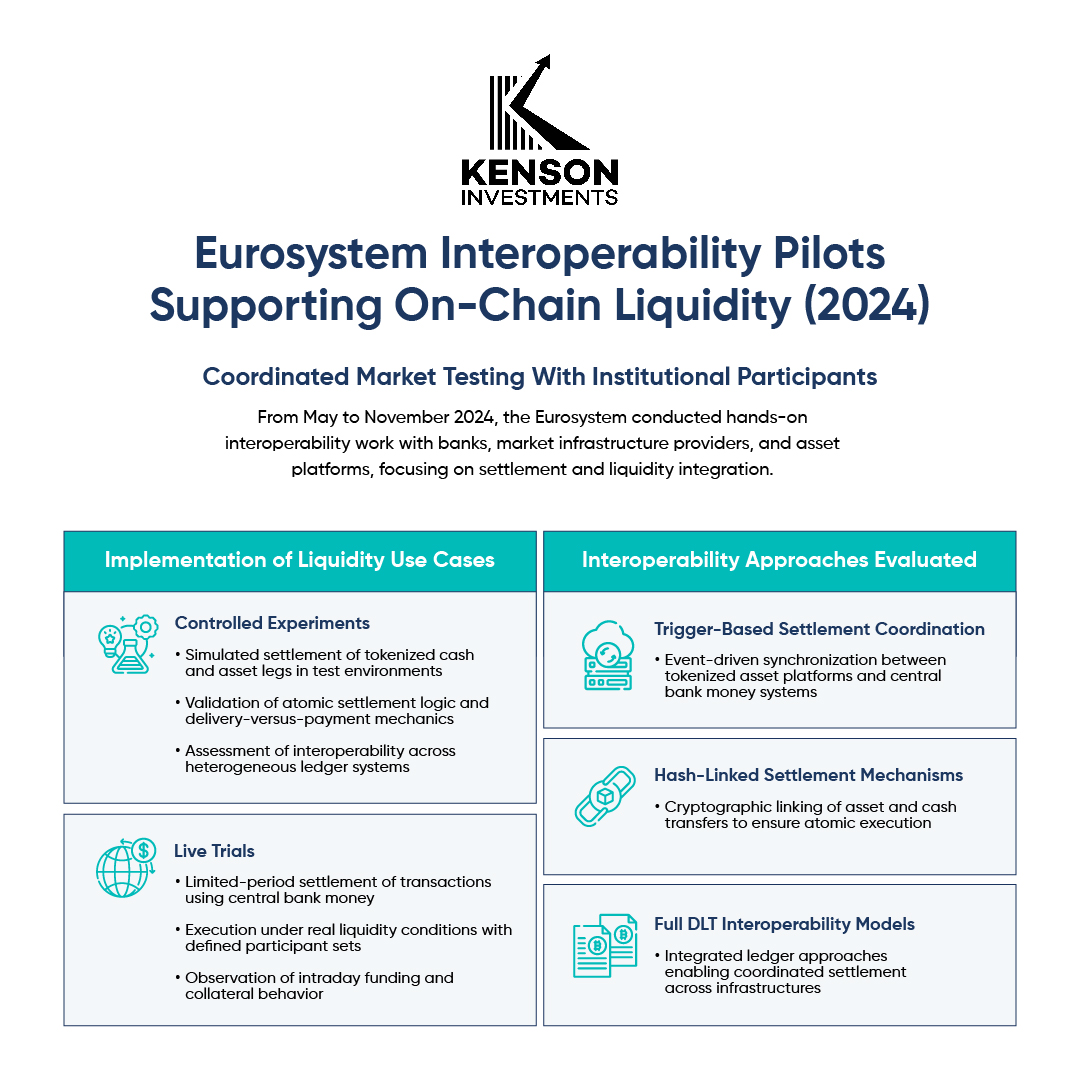
Failure Management and Recovery Planning
No system is failure-proof.Institutions operating onchain are planning for failures explicitly. Scenarios include:
- Smart contract defects
- Data feed delays or inaccuracies
- Integration failures between onchain and offchain systems
- Governance process breakdowns
Recovery planning focuses on containment and restoration rather than perfection.Institutions are defining rollback procedures, alternative funding paths, and manual overrides. These plans are tested regularly.This discipline reflects lessons learned from payment system outages and clearing failures in traditional markets.Firms providing secure digital asset consulting solutions emphasize that recovery planning is a core component of liquidity resilience.
Long-Term Implications for Market Structure
As tokenized liquidity management matures, its implications extend beyond individual institutions.Market structure itself begins to shift.When settlement is atomic and liquidity is programmable, intermediaries perform different roles. Liquidity provision becomes more transparent. Collateral efficiency improves.However, these changes do not eliminate risk. They redistribute it.
Market-wide stress may propagate faster, but it may also be detected earlier. Transparency improves, but complexity increases.Institutions that embrace discipline rather than speed are better positioned to navigate this transition.This perspective differentiates institutional adoption from speculative narratives.
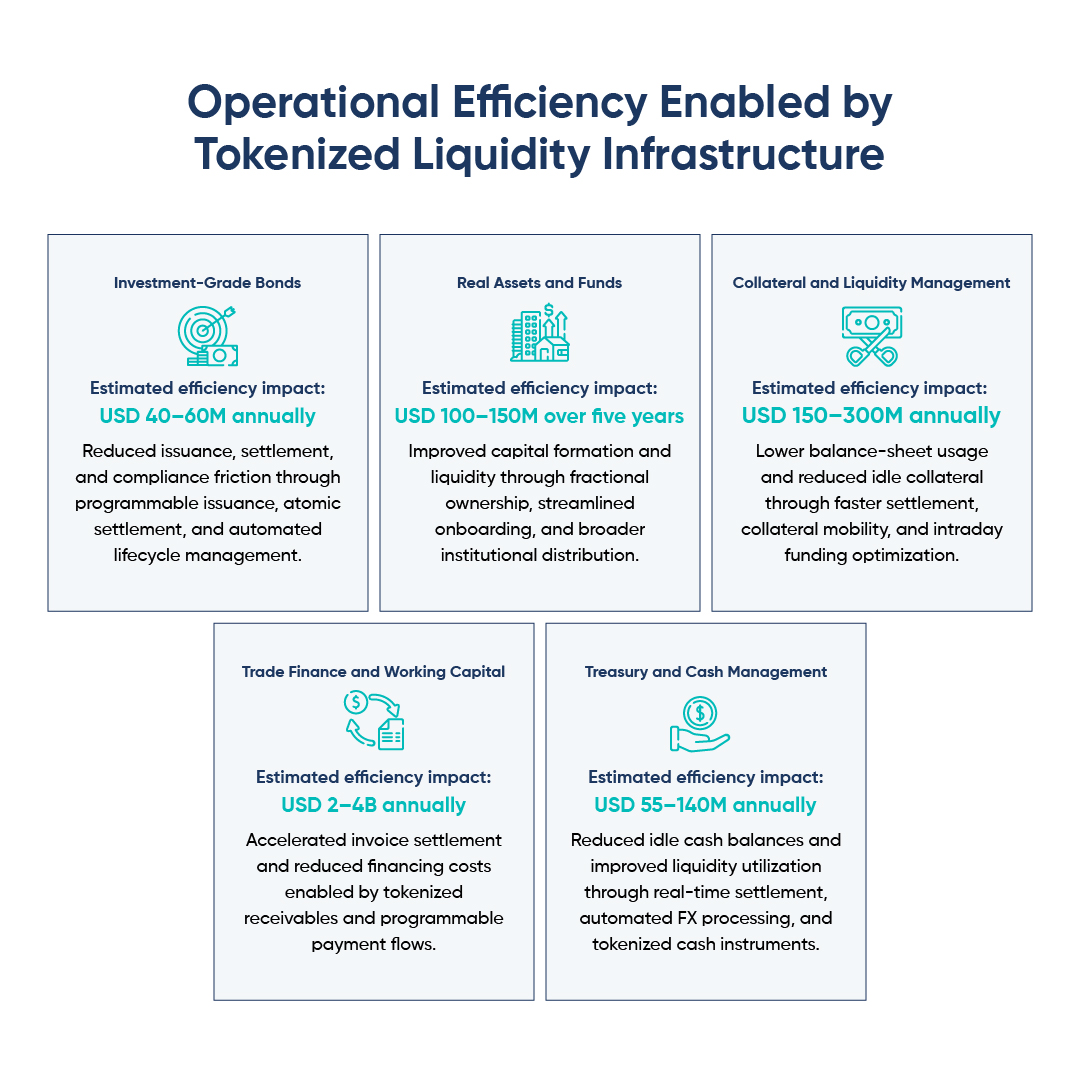
Implications for Asset Classes and Investment Activity
Tokenized liquidity management affects how assets are evaluated.Assets that integrate well with programmable liquidity frameworks become more attractive. Eligibility, transferability, and settlement behavior influence demand alongside yield and risk.This dynamic influences investment analysis and portfolio management in subtle ways. Liquidity characteristics become first-order considerations.
For institutional investors, this reinforces the importance of understanding infrastructure, not just instruments.This is particularly relevant for long-term allocations. Long-term investment in digital assets depends on liquidity reliability, not just price appreciation.
The Role of Advisory and Research
As liquidity frameworks evolve, institutions increasingly seek an external perspective.This demand is not for tactical execution. It is for clarity.Institutions engage leading digital asset consulting specialists to understand how peers are approaching liquidity redesign, what governance models are emerging, and where regulators are focusing attention.
This research-driven approach reduces uncertainty. Institutions move forward informed rather than reactive.
Regulatory Trajectory and Institutional Confidence
Regulators continue to engage with tokenized liquidity models cautiously.
Their focus remains consistent:
- Systemic stability
- Clear governance
- Transparency and auditability
Institutions that align with these priorities report smoother engagement.Importantly, regulators are not requiring institutions to abandon legacy safeguards. They are assessing whether new systems replicate or improve existing protections.
This creates space for innovation within defined bounds.Institutions that approach liquidity redesign as infrastructure modernization rather than disruption build confidence across stakeholders.
Strategic Considerations for Institutions
Several strategic considerations emerge from early experience.First, liquidity redesign should be incremental. Institutions benefit from piloting within controlled environments before scaling.Second, governance must precede automation. Rule clarity enables safe execution.Third, data architecture is foundational. Without reliable data, continuous settlement increases risk.Finally, cross-functional alignment is non-negotiable. Liquidity is no longer a single-team responsibility.Institutions that internalize these principles progress steadily.
Looking Ahead
Tokenized liquidity management is not a destination. It is an ongoing process.As infrastructure evolves, institutions will continue refining models, controls, and governance. New instruments will emerge. Regulatory expectations will adapt.
What remains constant is the institutional need for predictability.Liquidity management has always been about trust, trust that obligations will be met, that funding will be available, that systems will function under stress.
Onchain infrastructure does not replace that trust. It reshapes how it is earned.Institutions that approach this transition with discipline, transparency, and humility are rebuilding liquidity frameworks suited to always-on markets.
Advancing Institutional Understanding of Onchain Liquidity
Kenson Investments conducts in-depth research on institutional tokenization, liquidity infrastructure, and market structure evolution. Through analytical whitepapers and educational briefings, Kenson supports informed engagement with onchain financial systems and programmable market infrastructure. Reach out to us today.