








In financial markets, activity is usually framed as intelligence. Screens refresh, portfolios rebalance, positions rotate. Action signals control. In digital assets, this instinct is amplified. Twenty-four-hour markets, constant price discovery, and public performance metrics reward engagement.

Yet when survival is measured over full market cycles rather than months, a different pattern emerges. The investors who endure are rarely the most active. They are often the most bored. This is not a romantic notion. It is a behavioral reality supported by data across equities, commodities, and increasingly, digital assets. Studies of traditional markets have long shown that lower turnover portfolios outperform after fees and behavioral errors. In crypto markets, where volatility and narrative churn are more extreme, the gap appears even wider.
This article explores how long-term crypto behavior is shaped less by optimization and more by restraint, and why boredom is not a weakness but a stabilizing force in environments designed to provoke reaction.
Volatility Rewards Reaction, Survival Rewards Restraint
Digital assets are structurally stimulating. Price moves are large. Information arrives constantly. Social signaling is built into the market itself. This environment activates what behavioral economists call action bias. When uncertainty rises, humans prefer doing something over doing nothing, even when inactivity produces better outcomes. In crypto markets, this bias is reinforced by visibility. Wallets move. Trades are public. Inactivity feels like negligence.
Data from onchain analytics platforms consistently shows that wallets with lower transaction frequency tend to outperform over multi-year horizons. One widely cited metric, coin dormancy, tracks how long assets remain unmoved. Periods of high dormancy often precede stronger long-term returns, while spikes in transaction activity frequently align with local tops and bottoms. This does not suggest that inactivity guarantees success. It suggests that excessive engagement increases the probability of behavioral error.
For institutions providing investment analysis and portfolio management, this insight reframes risk. Volatility is not just a pricing phenomenon. It is a psychological stress test.
The Cost of Constant Optimization
Modern crypto participation is framed as optimization. Yield is compounded. Positions are rotated. Exposure is adjusted based on narratives, protocols, and short-term signals. While optimization sounds rational, it often hides fragility.
Each decision introduces execution risk, timing risk, and cognitive load. In fast-moving markets, the cumulative impact of small errors can outweigh the benefit of tactical adjustments. Fees, slippage, tax friction, and opportunity cost compound quietly. This is one reason why many institutional frameworks now emphasize simplification. Firms offering digital asset management consulting services increasingly encourage fewer, more deliberate decisions rather than continuous repositioning.
From a psychological standpoint, boredom acts as a filter. When nothing appears urgent, fewer decisions are made. When fewer decisions are made, fewer mistakes accumulate. This principle aligns with what behavioral finance calls decision fatigue. As engagement increases, decision quality declines. In markets that never close, fatigue becomes structural.
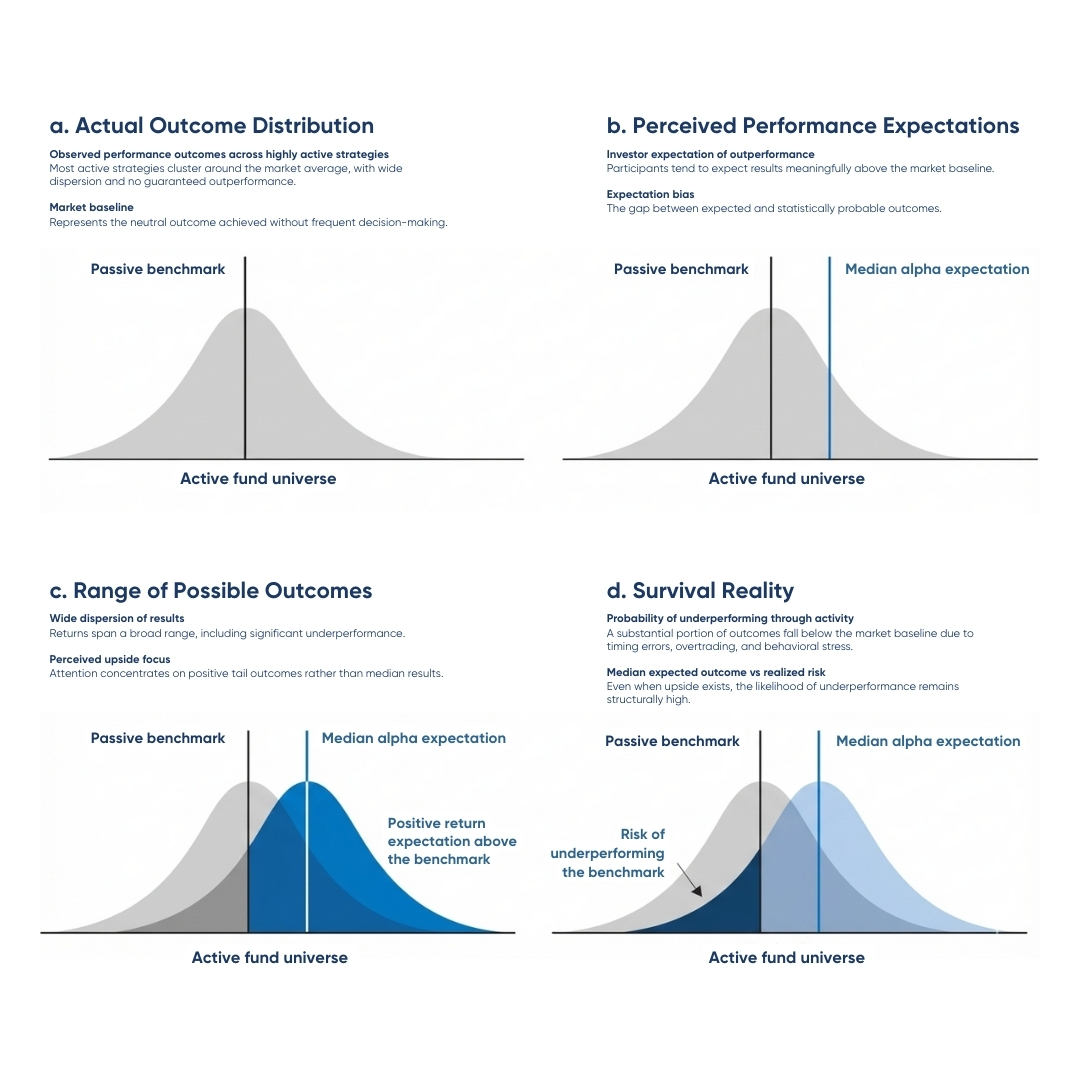
Filename: activity-bias-vs-survival-outcomes-investor-behavior
Alt Text: Behavioral finance diagram showing how investor expectations of outperformance differ from the actual distribution of outcomes, highlighting underperformance risk from excessive activity.
Caption: Investor behavior often overestimates the benefits of activity, while the true distribution of outcomes shows a high probability of underperformance, reinforcing the value of patience and inactivity.
Boredom as an Asset Allocation Tool
Boredom is often framed negatively, as disengagement or lack of curiosity. In investing, it can serve a different function. A boring portfolio is one that does not demand attention. Its rules are clear. Its exposure is intentional. Its time horizon is defined. Nothing about it invites constant adjustment.
This does not imply passivity. It implies design. Institutional allocators understand this intuitively. Large endowments and pension funds prioritize stability over excitement. They rebalance infrequently. They avoid narrative-driven churn. Their survival depends on not reacting.
In digital assets, this mindset is still emerging. Many participants confuse engagement with competence. Yet some of the most resilient outcomes observed across cycles come from simple structures held through long periods of inactivity. This is where investment discipline psychology becomes central. Discipline is not about resisting panic once. It is about building systems that minimize the need for resistance altogether.
Why Inactivity Is Misunderstood in Crypto Markets
Crypto culture rewards visibility. Builders ship. Traders post. Wallets move. Silence is interpreted as absence. This creates a bias against inactivity. Holding without action feels unsophisticated in a market that celebrates innovation. But innovation at the protocol level does not require innovation at the behavioral level. In fact, constant behavioral innovation often undermines exposure to long-term outcomes.
Research on traditional markets shows that the average investor underperforms the assets they invest in, largely due to mistimed entry and exit. Early crypto data suggests similar patterns, amplified by higher volatility. For those engaged in digital assets consulting, this presents a challenge. The hardest advice to communicate is often the most effective: do less.
The Quiet Advantage of Time Compression
Another overlooked factor is time compression. Digital assets experience in years what traditional markets experience in decades. Entire cycles play out rapidly. This compression magnifies the impact of behavior. Those who trade frequently are exposed to more decision points in less time. Those who remain inactive experience fewer behavioral tests.
Over multiple cycles, this difference compounds. Investors who treat crypto exposure as a long-duration allocation rather than a continuous project often display higher survival rates. Their returns may not look impressive in short windows, but their probability of remaining solvent and invested is higher.
For institutions evaluating long-term investment in digital assets, survival is the prerequisite for return. No strategy compounds if it cannot endure boredom, drawdowns, and narrative silence.
Boredom as a Market Structure Filter
Markets do not reward all forms of participation equally. They reward participation that aligns with structure. In digital assets, structure is defined by liquidity cycles. Periods of intense attention are followed by long stretches of silence. Capital floods in quickly and leaves just as fast. During these quieter phases, price action compresses, volumes thin, and narratives fade.
This is where boredom becomes selective. Assets that depend on constant engagement, incentives, or promotional momentum struggle to survive inactivity. Development slows. Communities fracture. Liquidity evaporates. By contrast, assets with durable utility, conservative design, or institutional relevance often persist quietly, even when no one is watching.
Data from multiple market cycles shows that a significant share of crypto assets that reach high market capitalization during peak attention phases fail to recover after prolonged drawdowns. Meanwhile, a smaller subset of assets, often those associated with core infrastructure, payments, or settlement layers, retain liquidity even during extended periods of low interest.
For analysts focused on investment analysis and portfolio management, this suggests that boredom is not just psychological. It is structural. Quiet markets expose which assets can function without constant stimulation.
Liquidity, Inactivity, and Survival Bias
Liquidity itself behaves differently during boredom. In active markets, liquidity is abundant but unstable. During quiet markets, liquidity is scarce but honest. Spreads widen. Volumes drop. Price discovery slows.
Assets that rely on speculative liquidity often collapse under these conditions. Assets with consistent demand, whether from payments, treasury usage, or infrastructure needs, retain a baseline level of activity. This distinction matters for investors evaluating altcoins vs. major cryptocurrencies. The difference is not simply market capitalization. It is the ability to sustain liquidity without narrative reinforcement.
Institutional participants increasingly factor this into allocation decisions. Exposure is assessed not only during bull phases, but during dormant ones. Assets that remain functional and liquid during boredom are more likely to survive future cycles.
This perspective is also shaping how digital asset consulting services for businesses frame risk. Volatility is expected. Liquidity disappearance during boredom is not.
Narrative Exhaustion and Behavioral Attrition
Every market runs on stories. Crypto markets run on them faster. Narratives accelerate adoption, attract capital, and justify valuation. But narratives exhaust themselves. When they do, participants face a choice: endure boredom or exit.
Most exit. Onchain data consistently shows wallet attrition during prolonged sideways markets. Addresses go inactive. Participation declines. This is often interpreted as weakness. In reality, it is a cleansing process.
The remaining participants are those aligned with longer horizons or lower engagement needs. Their presence stabilizes the asset’s base. When attention eventually returns, the structure is intact. This dynamic mirrors patterns seen in traditional markets, but at a faster pace. In crypto, boredom compresses the filtering process.
For those providing consulting on digital asset management, this insight reframes due diligence. Evaluating an asset during peak attention reveals little. Evaluating it during boredom reveals almost everything.
The Institutional View of Quiet Markets
Institutions tend to be comfortable with boredom. Large allocators operate on long horizons. They expect periods of low activity. Their governance structures discourage frequent action. Silence is not a signal to trade.

As institutional participation in digital assets increases, this mindset becomes more influential. Assets that accommodate inactivity, through stable governance, predictable issuance, and conservative risk profiles, align more naturally with institutional behavior. This does not mean institutions avoid volatility. It means they avoid constant engagement. For firms positioning themselves as strategic digital asset consulting partners, helping clients understand this distinction is critical. Engagement is not a proxy for resilience.
Why Boredom Amplifies Discipline
Discipline is easy when markets are active. Signals are clear. Feedback is immediate. Discipline is tested when nothing happens. During boredom, the absence of reinforcement exposes decision-making frameworks. Investors either default to their process or invent new reasons to act. This is where investment discipline psychology becomes visible. Those with clear rules, defined exposure, and long horizons experience boredom without distress. Those without structure experience it as anxiety.
Over time, this difference compounds. Fewer impulsive decisions lead to fewer irreversible mistakes. Survival becomes more likely.
When Doing Nothing Becomes a Strategy
In digital asset markets, boredom is often misread as disengagement. In reality, it is a signal that a system no longer demands constant intervention to justify itself. Assets that survive long periods of low attention tend to do so because their value proposition does not rely on momentuma principle often emphasized in crypto asset management.
For long-term participants, this reframes success. Survival is not about identifying the most active opportunity. It is about avoiding behaviors that introduce unnecessary fragility. Inactivity, when intentional, reduces exposure to timing errors, emotional decision-making, and narrative-driven churn, which is why investment analysis and portfolio management is critical for guiding disciplined strategies.
As institutional participation increases, this mindset becomes more visible. Frameworks are being designed to absorb volatility without demanding reaction. Exposure is structured to persist through silence, not just excitement. Over time, boredom becomes an ally, filtering out noise and reinforcing discipline, often implemented by a crypto investment company and through structured RWA tokenization investment approaches.
Understanding this dynamic is central to navigating digital assets beyond short cycles. Markets will continue to evolve, but behavioral fundamentals change slowly. The investors who last are often the ones most comfortable waiting, particularly when strategies enhance ROI with digital asset consulting.
Understanding Long-Term Behavior in Digital Asset Markets
Kenson Investments examines how market structure, investor psychology, and institutional design intersect in digital assets. Through research and analysis, Kenson helps organizations interpret long-term dynamics shaping market survival, discipline, and resilience.
Disclaimer: The information provided on this page is for educational and informational purposes only and should not be construed as financial advice. Crypto currency assets involve inherent risks, and past performance is not indicative of future results. Always conduct thorough research and consult with a qualified financial advisor before making investment decisions.
“The crypto currency and digital asset space is an emerging asset class that has not yet been regulated by the SEC and the US Federal Government. None of the information provided by Kenson LLC should be considered as financial investment advice. Please consult your Registered Financial Advisor for guidance. Kenson LLC does not offer any products regulated by the SEC, including equities, registered securities, ETFs, stocks, bonds, or equivalents.”