









Digital assets and other alternative investments are creating new questions for retirement plan committees. As blockchain-based financial products, cryptocurrency-linked options, and alternative investment structures attract institutional attention, fiduciaries must determine whether a proposed option can be evaluated, administered, and monitored within the plan’s existing governance framework.
The central issue is not whether digital assets belong in every retirement portfolio. It is whether a committee can demonstrate a prudent, well-documented process for assessing a particular investment option in the context of its plan, participants, objectives, and operational capabilities.
A retirement plan digital asset fiduciary review therefore begins with governance rather than market enthusiasm. Committees must identify the purpose of a proposed option, establish the evidence needed to evaluate it, examine risks and costs, document their reasoning, and define the conditions that would prompt further review or removal.
This process also helps distinguish transparent investment solutions from products that provide limited visibility into their underlying structure. It gives committees a disciplined way to assess cryptocurrency investment strategies without turning an institutional decision into a personal allocation recommendation. Effective digital asset management within a retirement plan requires clear accountability, reliable information, and ongoing oversight.
For plan sponsors and investment committees, the challenge is to evaluate emerging opportunities using established fiduciary principles while recognizing that digital infrastructure may introduce additional operational, legal, and market considerations.
Why Fiduciary Review Matters More Than the Asset Label
An investment option should not be accepted or rejected solely because it is described as a cryptocurrency product, tokenized security, or alternative investment. The label identifies a category, but it does not explain the actual exposure, legal rights, fee structure, liquidity conditions, or administrative requirements.
Two products associated with the same asset class can have materially different characteristics. A direct cryptocurrency exposure may differ substantially from a regulated investment vehicle holding digital assets, while a tokenized interest in a conventional security may present different risks from an instrument whose value depends on a cryptocurrency market.
The committee must understand what participants would actually access through the plan menu.
This requires examining the investment’s structure, the responsibilities of the provider, the role of custodians and intermediaries, and the mechanisms used to value, transact, and maintain records. A familiar product wrapper does not automatically eliminate the risks of its underlying exposure. Likewise, the use of blockchain technology does not independently establish that an investment is inappropriate.
The objective is to assess the complete arrangement rather than make a judgment based on terminology.
The Regulatory Context: Neutrality Does Not Mean Automatic Approval
In the United States, the Employee Retirement Income Security Act of 1974 (ERISA) establishes fiduciary duties for covered retirement plans. These include acting in participants’ and beneficiaries’ interests, exercising prudence, following applicable plan documents, diversifying plan investments, and paying only reasonable expenses.
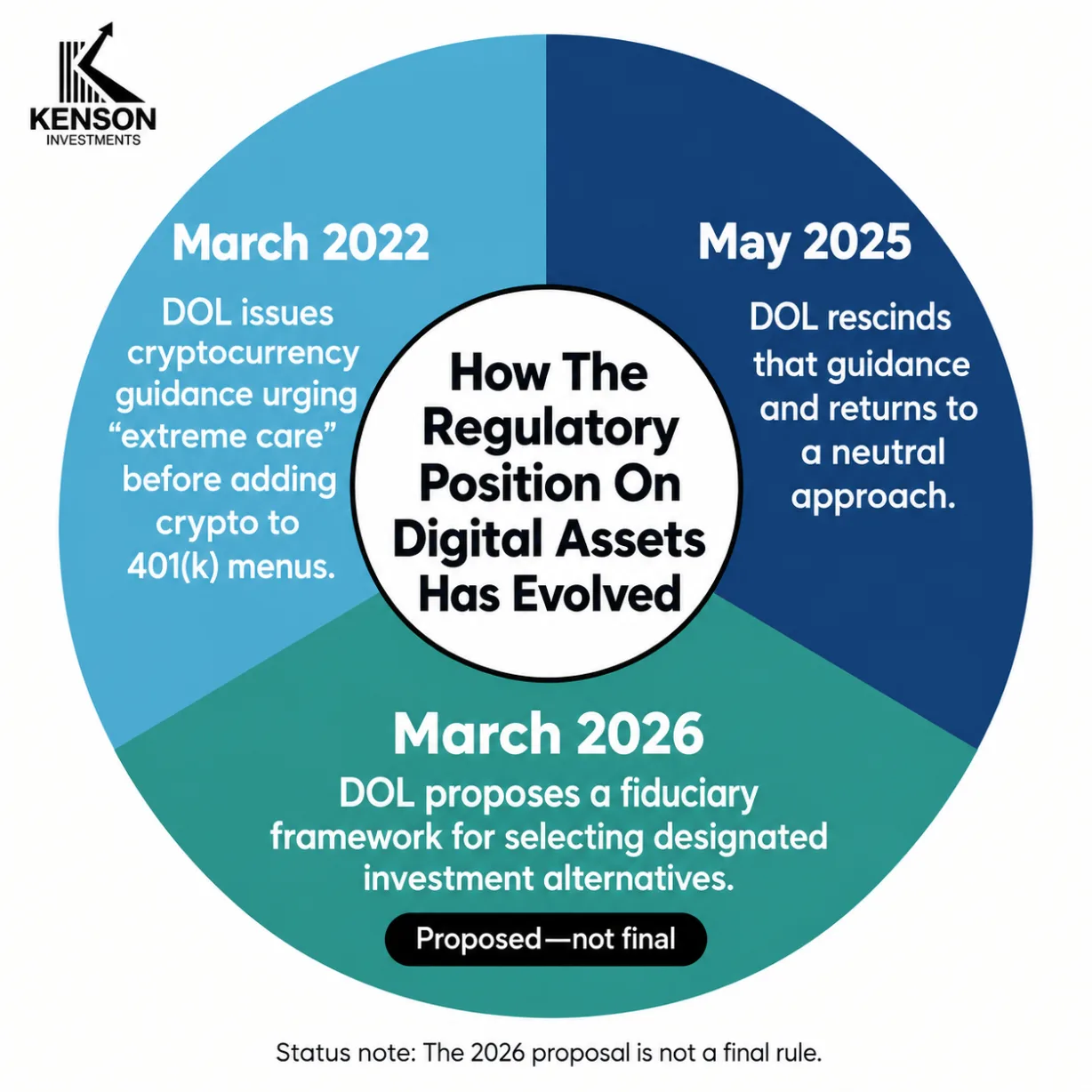
The regulatory context for cryptocurrency options in 401(k) plans changed in May 2025, when the Department of Labor rescinded its 2022 Compliance Assistance Release on cryptocurrency investments. The earlier release had urged fiduciaries to exercise “extreme care.” The rescission restored a more neutral approach in which the department neither endorses nor disapproves of fiduciaries who determine that cryptocurrency exposure is appropriate for their plans.
That change did not remove ERISA’s underlying duties or provide blanket approval for digital asset investments. The Department of Labor stated that investment decisions remain dependent on relevant facts and circumstances.
For committees, the distinction is important. Regulatory neutrality is not a substitute for due diligence. A decision to include an option still requires a prudent process, an assessment of relevant risks and returns, and appropriate monitoring.
Stage One: Define the Candidate Investment and Its Purpose
A retirement plan digital asset fiduciary review should begin by establishing why an option is being considered. Without a defined purpose, committees can become distracted by product novelty, market attention, or a provider’s claims about future adoption.
The initial review should establish the candidate’s intended role within the plan menu. Is the proposal intended to provide exposure to a particular asset, offer access to a different investment structure, or introduce a product that uses blockchain-based administration? These are distinct objectives and should not be treated as interchangeable.
The committee should also clarify whether the proposal concerns a core menu option, a specialist investment option, or a different arrangement permitted by the plan’s governing documents. Its role affects the scope of the review, although it does not remove the obligation to assess prudence.
A candidate screening process should establish the following:
- Investment objective: What exposure does the option provide, and what is it designed to accomplish?
- Structure: Does it hold digital assets directly, invest through another vehicle, or represent an interest in a conventional asset?
- Eligibility: Can the option be offered within the plan’s legal, administrative, and contractual framework?
- Intended role: How would the option fit within the existing menu and its overall investment design?
- Provider responsibilities: Which entities manage, safeguard, administer, and report on the investment?
- Evidence availability: Can the committee obtain sufficient information to conduct and document a meaningful assessment?
These questions establish whether a candidate merits deeper analysis. They are not a scorecard that automatically determines acceptance.
Establish Screening Criteria Before Reviewing Proposals
Predefined criteria help committees apply a consistent process across providers and asset categories. Without them, a compelling presentation may receive more attention than a less polished proposal containing stronger evidence.
Criteria should reflect the plan’s circumstances, including participant needs, existing investment options, governance resources, administrative capabilities, and relevant costs. A committee may also establish minimum information requirements before advancing a candidate to detailed review.
This approach supports transparent investment solutions by making the basis for consideration clear. It also creates a record of why certain proposals proceed, require further information, or are excluded.
Importantly, screening should not become a shortcut for assessing complex products. A candidate that passes an initial review must still undergo substantive due diligence.
Stage Two: Assess the Quality of the Evidence
Once a candidate advances, the committee needs an evidence framework. Marketing materials and product summaries can introduce an investment, but they cannot replace independently assessable information about its structure, risks, and operating arrangements.
The quality of the evidence matters as much as its quantity. Documents should be current, attributable to identifiable sources, consistent with one another, and sufficiently detailed to support the questions under review.
A provider’s description of its controls, for example, should be considered alongside relevant policies, contractual responsibilities, independent reports where available, and explanations of how exceptions are handled. Where information cannot be independently verified, the limitation should be recorded rather than overlooked.
The committee should distinguish facts from projections, assumptions, and unresolved questions. It should also determine whether important claims depend on third-party systems or service providers outside the candidate’s direct control.
The objective is not to eliminate every uncertainty. It is to establish whether the remaining uncertainty can be understood and assessed within a prudent decision-making process.
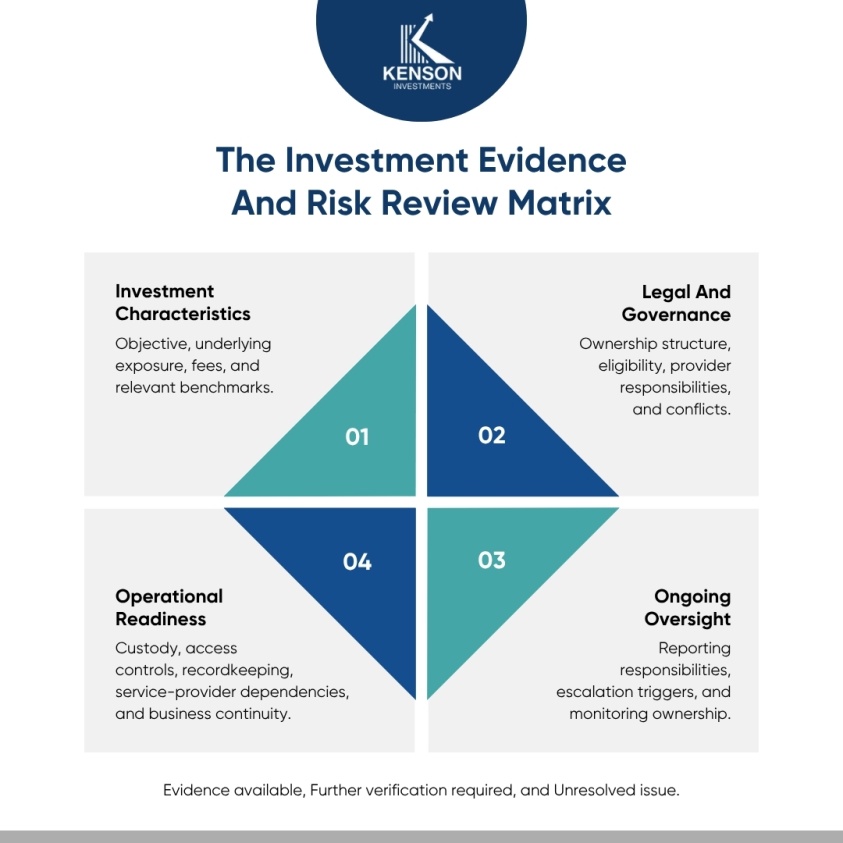
Review the Main Risk Categories
Digital and alternative assets can introduce overlapping risks. A structured review helps prevent attention from concentrating on market exposure while overlooking operational dependencies.
| Review area | Questions for the committee | Governance objective |
|---|---|---|
| Investment structure | What does the option hold or represent? Which rights attach to it? | Establish the actual exposure and legal arrangement. |
| Market risk | What factors may affect value, volatility, or correlations? | Understand potential effects on plan objectives and risk exposure. |
| Liquidity | How are transactions, withdrawals, or redemptions handled? What restrictions apply? | Assess whether liquidity arrangements align with plan requirements. |
| Custody and control | Who safeguards assets or controls access? What happens if a provider fails? | Understand operational dependencies and recovery arrangements. |
| Fees and expenses | What direct and indirect charges apply? Are all material costs identified? | Evaluate costs relative to the services and investment structure. |
| Legal and regulatory status | Which laws, rules, contracts, and eligibility conditions apply? | Identify obligations, restrictions, and unresolved legal questions. |
| Administration and records | How are holdings, transactions, and exceptions recorded and reconciled? | Assess whether the option can be administered reliably. |
| Conflicts of interest | Do providers or related parties have financial incentives that affect their roles? | Identify and address conflicts relevant to the decision. |
This framework provides a starting point, not an exhaustive checklist. The committee should adapt it to the particular product and document why additional areas of inquiry are necessary.
The Kenson Perspective: Governance Before Exposure
At Kenson Investments, we view digital asset management through the principles of structure, evidence, operational clarity, and disciplined oversight. Institutional participation requires more than understanding a technology or recognizing a market trend. It requires a clear account of how an asset or product operates, who is responsible for its administration, and what evidence supports claims about its design and controls.
This perspective is particularly relevant to retirement plans, where investment decisions operate within formal fiduciary responsibilities. A product may be technically innovative yet difficult to evaluate if its documentation is incomplete, responsibilities are fragmented, or important operating assumptions remain unclear.
Kenson’s educational approach emphasises the distinction between understanding an emerging asset category and determining whether a particular investment option meets an institution’s requirements. Research into cryptocurrency investment strategies can explain market structures and exposure mechanisms, but it does not replace a committee’s assessment of its own plan circumstances.
Likewise, transparent investment solutions require more than accessible marketing materials. Transparency should help relevant decision-makers understand the product’s structure, limitations, governance, costs, and dependencies.
This is the basis for a process-led approach: identify the question, establish the evidence, assess the risks, document the conclusion, and maintain the ability to revisit it.
Stage Three: Evaluate Providers and Operational Readiness
A committee can understand an investment’s intended exposure and still face uncertainty about how it would operate within the retirement plan. Provider review addresses that gap.
Digital asset arrangements may involve investment managers, custodians, trading venues, administrators, recordkeepers, and other service providers. Their responsibilities can overlap, and important processes may depend on arrangements outside the primary provider’s direct control.
The committee should identify the parties involved and determine which entity is accountable for each material function. This includes transaction processing, asset safeguarding, record maintenance, incident response, reporting, and the handling of errors or disputes.
Operational review should also consider business continuity. What happens if a key provider becomes unavailable? How would the plan establish the status of its holdings or transactions? Are recovery procedures documented, tested where appropriate, and consistent with contractual responsibilities?
For digital assets, custody arrangements deserve particular attention because access controls, key management, and the separation of duties may differ from conventional investment administration. The committee should establish what protections are provided, what they exclude, and which risks remain with the plan or another party.
Cybersecurity statements should also be evaluated carefully. The existence of security policies or technical safeguards does not prove that every risk is covered. The review should examine governance, incident reporting, access management, third-party dependencies, and relevant independent assurance.
Fees Must Be Assessed Alongside Service Quality
Comparing headline expense ratios alone may not reveal the full cost of an option. Depending on the structure, relevant expenses may include management fees, custody, administration, transaction processing, underlying vehicle charges, and other direct or indirect costs.
The committee should establish which charges apply, how they are calculated, who receives them, and whether the overall expense is reasonable in light of the services provided.
It should also examine whether the fee structure creates incentives that could affect provider behaviour or complicate oversight. Where comparisons with existing options are difficult, the reasons should be documented.
The goal is not necessarily to select the cheapest option. It is to assess cost, service quality, and operational complexity in a manner consistent with the plan’s fiduciary responsibilities.

Stage Four: Document the Decision and Its Rationale
Documentation is a central component of fiduciary governance. It allows a committee to explain what it considered, what evidence it relied on, how it addressed material concerns, and why its decision was reasonable under the circumstances at the time.
A record stating only that a product was approved after discussion provides limited insight into the actual process. A stronger record identifies the candidate, the committee’s criteria, the information reviewed, the unresolved issues, and the reasoning behind the conclusion.
Documentation should capture both affirmative findings and limitations. If a provider could not supply requested information, the committee should record what was missing and how that gap affected the assessment. If competing options were considered, the record should explain the relevant points of comparison without relying solely on rankings or marketing claims.
The following table illustrates a practical documentation structure.
| Record component | Information to retain |
|---|---|
| Candidate summary | Product structure, purpose, provider, and proposed role in the menu |
| Screening record | Initial criteria, eligibility findings, and reasons for advancing or excluding the candidate |
| Evidence inventory | Documents reviewed, source dates, independent reports, and identified information gaps |
| Risk assessment | Material market, legal, operational, liquidity, custody, and cost considerations |
| Deliberation record | Committee questions, specialist input, disagreements, and outstanding issues |
| Decision rationale | Reasons for approval, rejection, deferral, or requests for additional evidence |
| Monitoring plan | Review frequency, responsible parties, escalation criteria, and reporting requirements |
The record should reflect the actual process rather than reconstruct a justification after the outcome is known. Meeting minutes, supporting analyses, provider documents, and follow-up actions should tell a consistent story.
Use Specialists Without Outsourcing Accountability
Complex products may require legal, investment, cybersecurity, custody, or operational expertise. A committee can obtain specialist assistance when its own knowledge is insufficient to assess an important issue.
However, appointing a service provider or delegating a function does not necessarily remove the committee’s responsibility for selecting and monitoring that provider. The scope of delegated authority, contractual responsibilities, and continuing oversight obligations should be clear.
Committee members should understand the conclusions presented to them well enough to evaluate their relevance and limitations. Specialist reports are most useful when they answer defined questions and identify assumptions, exceptions, and unresolved matters.
This approach also prevents a common governance weakness: treating a technical opinion as a substitute for the broader decision about whether an investment option is suitable for the plan’s circumstances.
Stage Five: Establish Ongoing Monitoring Before Approval
An investment option that satisfies the committee’s criteria today may not continue to do so. Providers change, markets evolve, regulations develop, operating arrangements are revised, and new information can alter the original assessment.
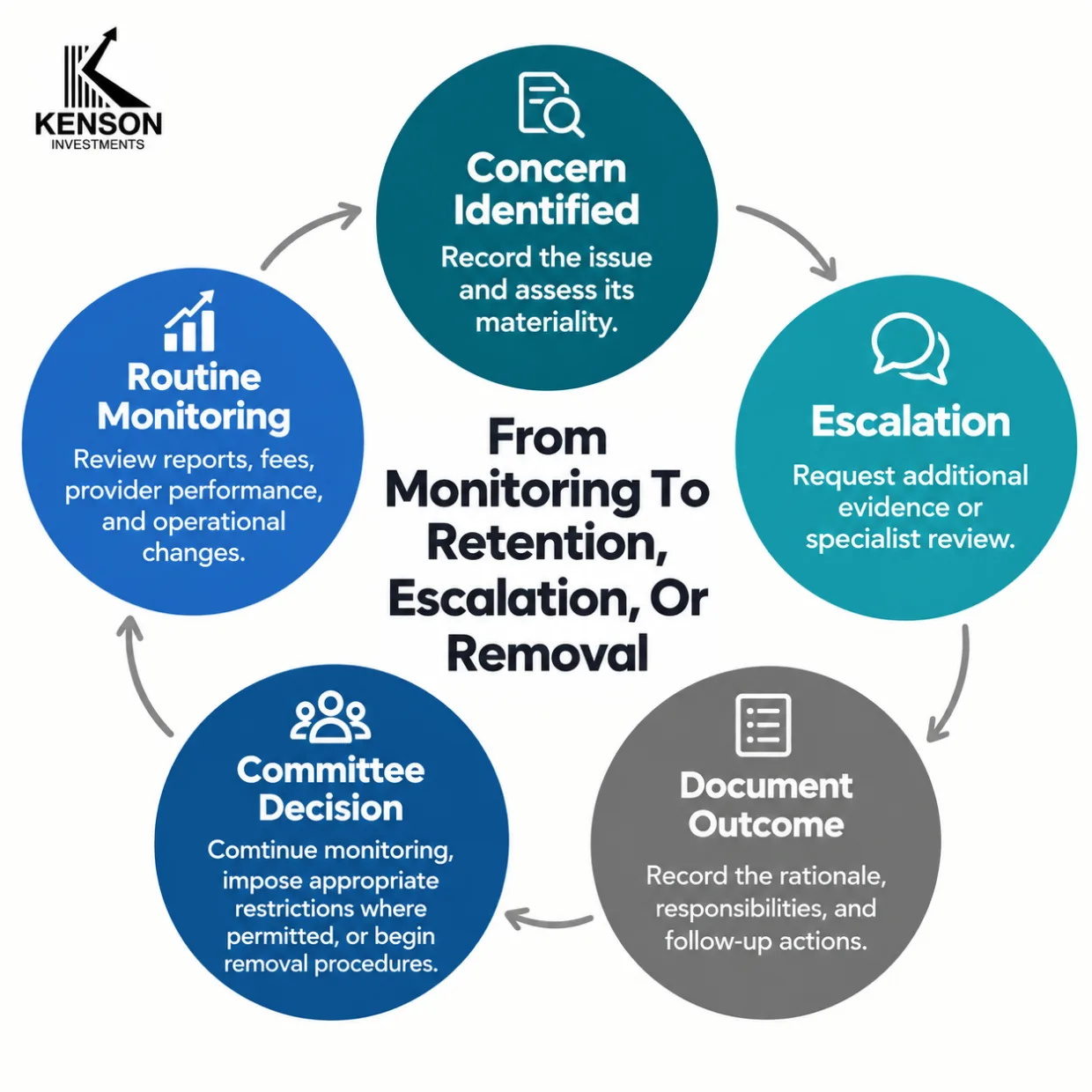
Monitoring should therefore be designed before an option enters the menu. The committee should identify the information it needs, who will supply it, how frequently it will be reviewed, and which developments require escalation.
Monitoring may cover changes in investment objectives, risk exposure, fees, provider arrangements, custody, transaction processing, legal status, and operational incidents. The specific indicators should reflect the investment rather than rely on a generic reporting template.
A defined process also distinguishes routine reporting from events that require immediate attention. A scheduled review may be appropriate for ordinary performance and expense information, while a material custody incident, loss of a critical service provider, or significant change in legal eligibility may require an earlier assessment.
The purpose is not to react to every market movement. It is to determine whether the investment continues to meet the criteria that justified its inclusion.
Define Escalation Triggers and Responsibilities
A monitoring framework is incomplete if it identifies risks without explaining what happens when a concern emerges.
Committees should establish escalation routes, assign responsibility for reviewing exceptions, and determine when additional evidence or specialist analysis is required. They should also define who has authority to make interim decisions under the plan’s governance arrangements.
Examples of developments that may warrant escalation include:
- A material change in custody, administration, or key service-provider relationships.
- New information that undermines an important assumption in the original review.
- Repeated reporting failures or unexplained discrepancies in records.
- Changes to fees, transaction restrictions, or liquidity arrangements.
- Significant legal or regulatory developments affecting eligibility or operations.
- A control failure or incident that calls the reliability of the arrangement into question.
These examples are prompts for assessment, not automatic removal rules. The committee should evaluate the facts, the severity of the issue, its effect on participants, and the available response.
Stage Six: Reassess, Restrict, or Remove When Necessary
Prudent governance includes the possibility that a previously accepted option may no longer meet the plan’s requirements. Removal should not be treated as an admission that the original decision was necessarily unreasonable. Circumstances can change, and monitoring exists to identify those changes.
The committee should distinguish a temporary issue that can be addressed from a persistent deficiency that undermines the original rationale. A short-term reporting delay, for example, may require follow-up and additional oversight. A serious unresolved custody problem or loss of required legal eligibility may call for a more urgent response.
Where concerns are material, the committee should document its assessment, the alternatives considered, and the reasons for continuing, restricting, suspending, or removing the option. It should also consider implementation implications, contractual requirements, transaction timing, and the plan’s administrative responsibilities.
Removal decisions must be handled consistently with governing documents and applicable law. The process may require coordination among the plan sponsor, recordkeeper, investment manager, and other service providers. The committee should not assume that an option can be discontinued immediately without affecting participant accounts or transaction processing.
A defined removal framework makes oversight more credible because the committee has established in advance how it will respond when an investment no longer satisfies its standards.
Keeping the Review Focused on Governance
A retirement plan digital asset fiduciary review should not attempt to resolve every question associated with digital assets in a single document. Some subjects require separate, detailed analysis.
Participant disclosure design is one such subject. Committees must ensure that applicable disclosure obligations are met, but the design and testing of participant-facing explanations deserve their own focused review. Similarly, valuation-evidence testing requires a detailed examination of pricing sources, methodology, data quality, and the treatment of exceptions. These areas support the broader governance process without replacing it.
The central review should instead establish how the committee screens candidates, evaluates the available evidence, assesses provider readiness, documents its reasoning, and maintains oversight after a decision.
This separation helps keep responsibilities clear. The committee can use specialist analyses to answer specific questions while retaining a coherent record of the overall decision.
Ending Remarks: Make the Process Defensible, Not Merely Innovative
Digital and alternative assets present retirement plan committees with a demanding governance task. New structures may create different ways to hold, administer, or access investments, but they do not displace the need for prudent selection, reasonable costs, clear accountability, and ongoing monitoring.
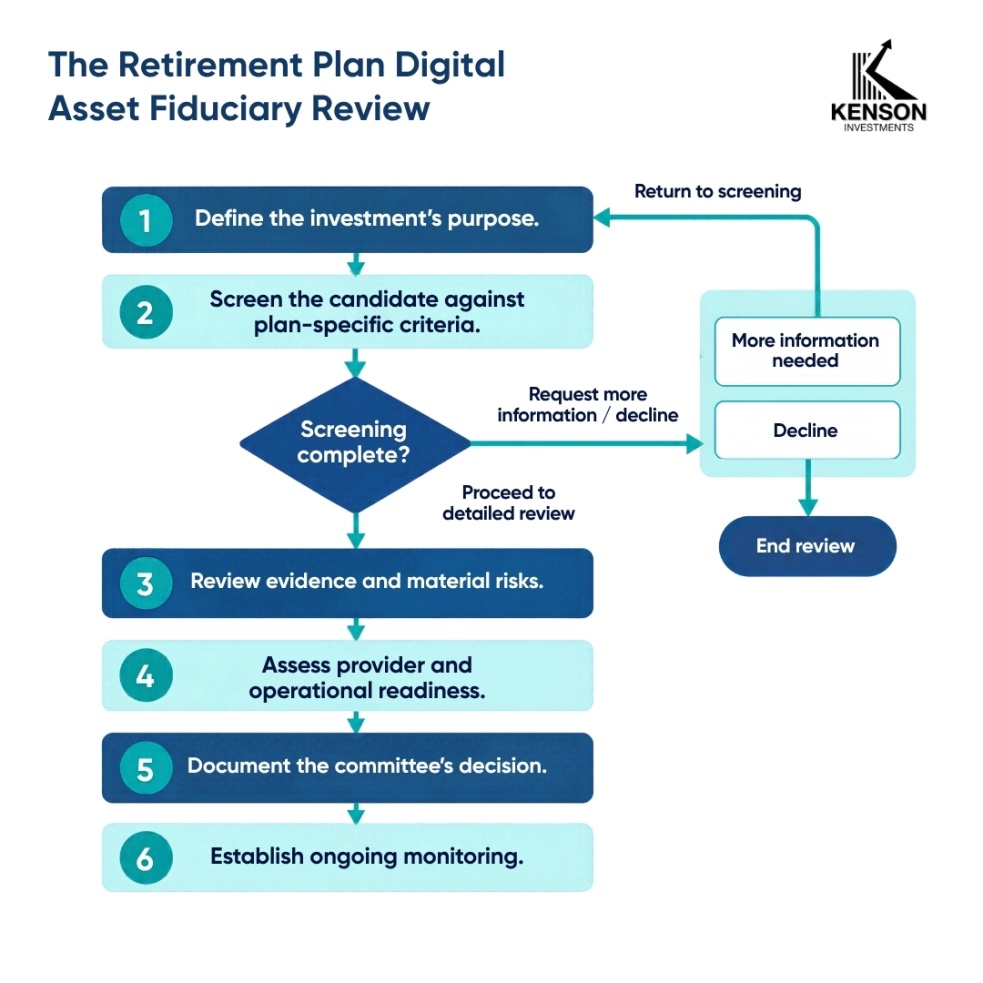
A robust retirement plan digital asset fiduciary review follows a defined sequence: screen candidates against plan-specific criteria, examine evidence and material risks, assess operational readiness, document the decision, monitor continuing suitability, and establish conditions for escalation or removal.
This process supports disciplined digital asset management by making responsibilities and limitations visible. It also gives committees a practical framework for evaluating cryptocurrency investment strategies without treating market interest as evidence of institutional suitability.
At Kenson Investments, we believe informed participation begins with research, structure, and operational clarity. Through Kenson Academy, we provide educational resources that help readers understand digital asset infrastructure, governance, and the evidence needed to assess emerging financial systems. Explore Kenson Academy to strengthen your understanding of transparent investment solutions, responsible oversight, and the institutional processes shaping digital asset markets.
Disclaimer: The information provided on this page is for educational and informational purposes only and should not be construed as financial advice. Cryptocurrency assets involve inherent risks, and past performance is not indicative of future results. Always conduct thorough research and consult with a qualified financial advisor before making investment decisions.
“The cryptocurrency and digital asset space is an emerging asset class that has not yet been regulated by the SEC and the U.S. federal government. None of the information provided by Kenson LLC should be considered financial investment advice. Please consult your Registered Financial Advisor for guidance. Kenson LLC does not offer any products regulated by the SEC, including equities, registered securities, ETFs, stocks, bonds, or equivalents.”



