









Tokenized markets can represent securities, fund interests, and other financial assets as digital records that move through programmable transaction systems. Yet recording an asset on a ledger does not, by itself, determine how a complete financial transaction will be coordinated. The architecture must also establish how participants validate instructions, synchronize asset and cash movements, handle incomplete execution, and determine which records establish the completed transaction.
Tokenized market ledger architecture describes how the records and systems supporting a transaction are organized and coordinated. A common-ledger model records participating activities within a shared environment, subject to its access and governance rules.
A connected-ledger model links separate environments that retain their own transaction records, validation procedures, and operational responsibilities. Both approaches can support digital asset transfers, but they differ in how they manage dependencies between participants and systems.
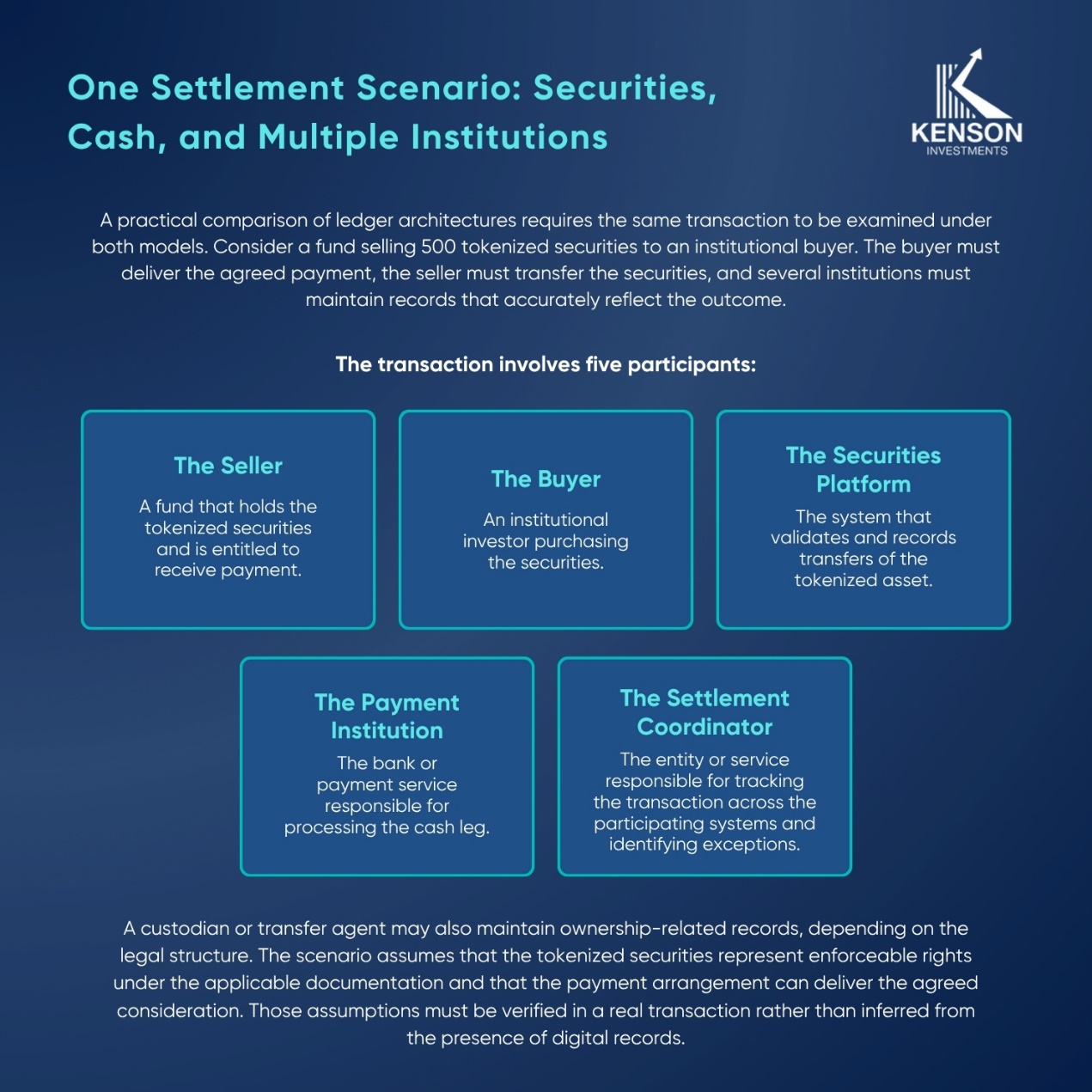
Consider a transaction in which an investment fund sells tokenized securities to a buyer. The buyer’s cash comes from a separate payment system, the securities are recorded on a tokenization platform, and a custodian or transfer agent maintains relevant ownership records.
The transaction is complete only when the required asset and payment obligations have been satisfied under the applicable arrangements. A confirmation from one system may not establish that every other system has completed its part.
This scenario provides a practical way to compare common and connected ledgers. The analysis follows the same participants and obligations through transaction preparation, execution, partial completion, failure recovery, and final recording. It also examines where governance authority begins and ends when no single platform controls every relevant record.
The central distinction is not simply whether systems share technology. It is how they coordinate state changes, communicate completion, and resolve differences between records. A useful assessment therefore examines the transaction as a sequence of linked obligations rather than treating ledger selection as an isolated infrastructure decision.
Common Ledgers: Coordinating Transactions Within One Shared Record
A common-ledger architecture places multiple transaction participants within a shared recordkeeping environment. Rather than requiring each institution to maintain a separate ledger and exchange updates with other systems, participants use a common transaction record governed by shared technical rules and defined permissions. Each organization may retain its own internal systems, but the ledger provides a coordinated view of the activities recorded within that environment.
For tokenized markets, this structure can reduce the number of separate records that must be reconciled during a transaction. The buyer, seller, settlement operator, and other authorized participants can interact with the same underlying transaction state, provided their roles and the relevant asset and payment arrangements are supported.
Shared State and Transaction Validation
The main architectural feature is a common representation of the transaction’s state. When a transfer instruction is submitted, the ledger’s validation rules determine whether it satisfies the applicable requirements. These may include participant authorization, asset availability, transfer restrictions, and transaction-specific conditions.
For the tokenized securities transaction introduced earlier, the system might verify that the seller controls the required quantity of securities and that the transfer is permitted. If cash is also represented within the same ledger environment, the transaction logic may check the buyer’s available balance and apply both movements through a coordinated execution process.
This arrangement can reduce inconsistencies caused by separate systems recording different stages of the same transaction. Instead of one participant seeing a completed transfer while another still records the previous state, the shared ledger can provide a common transaction history.
However, a common record does not mean every participant has identical access. The architecture may restrict who can submit instructions, validate transactions, view sensitive information, or administer the network. A shared ledger can therefore combine common transaction state with institution-specific permissions.
Coordinating Asset and Cash Movements
A common ledger can make it easier to coordinate multiple transaction conditions when the relevant assets, payment representations, and execution rules are available within the same environment. A transaction may be structured so that the securities transfer occurs only when the required payment condition is satisfied.
For example, a settlement instruction could specify that the buyer receives 500 tokenized securities while the seller receives the agreed cash amount. The ledger checks the required conditions before applying the relevant state changes. If the transaction is implemented as a properly coordinated operation, the system can avoid recording only one side of that operation within its own state.
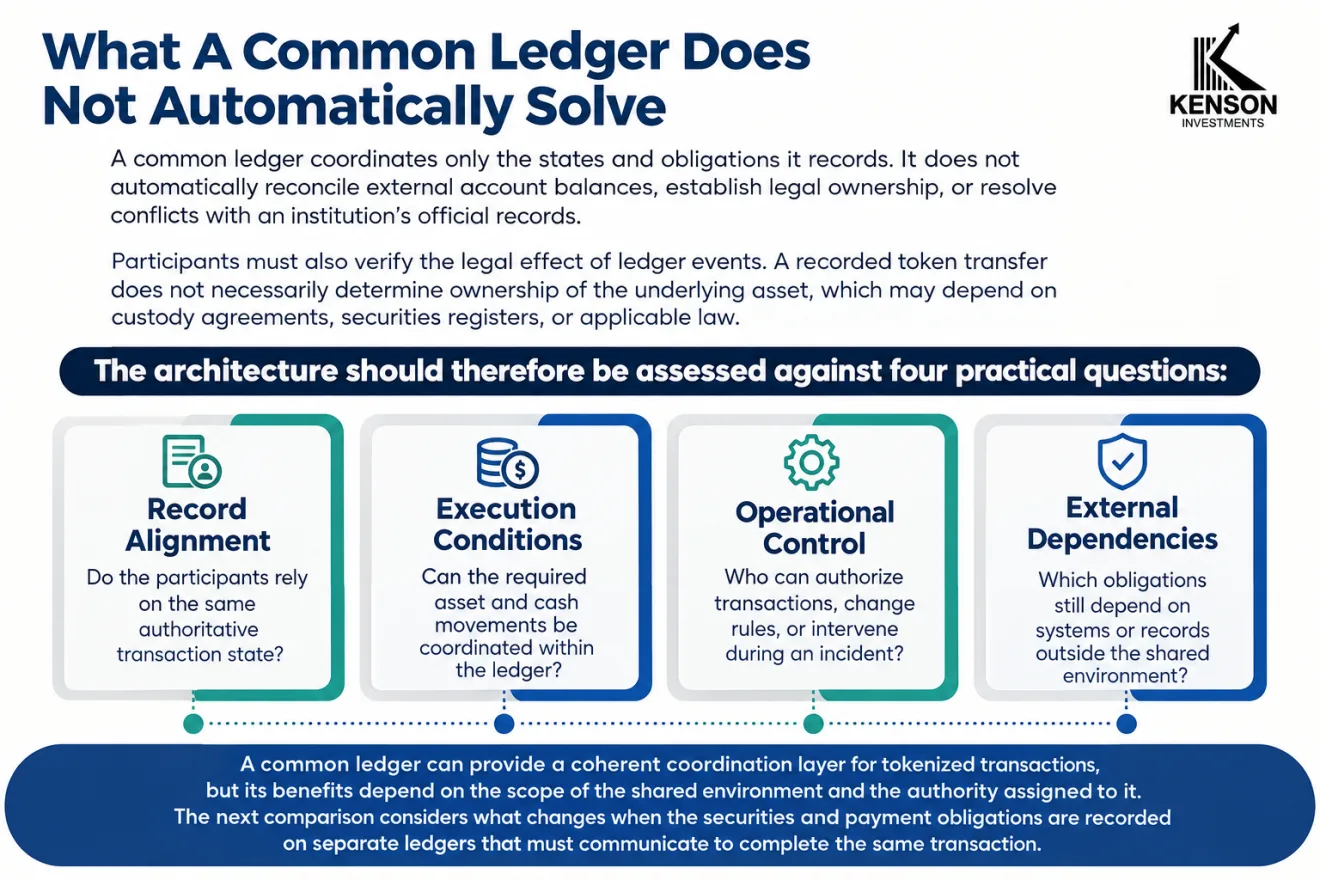
This capability depends on the architecture and transaction design. The cash representation must correspond to an arrangement that can fulfill the payment obligation, and the ledger’s rules must support the intended coordination. A token representing a monetary claim is not automatically equivalent to cash held in a bank account, and a record of payment intent is not the same as completed payment.
If the cash leg relies on an external payment system, the common-ledger model may still need an integration mechanism. The securities record may be shared while the payment record remains outside the ledger. In that case, the overall transaction inherits some of the coordination challenges associated with connected systems.
Ordering, Permissions, and Shared Dependencies
A common ledger can establish a consistent ordering of valid transactions within its environment. This helps participants determine which accepted state changes occurred first and whether a subsequent instruction is compatible with the resulting record.
For instance, if the seller attempts to transfer the same securities to two different buyers, the system can apply its ownership and availability rules to prevent both transfers from consuming the same available holdings. The exact protection depends on the ledger’s transaction model, validation logic, and controls over concurrent instructions.
The architecture also introduces shared dependencies. Participants rely on the ledger’s availability, its transaction-processing rules, and the governance arrangements controlling changes to those rules. An outage, configuration error, or disputed administrative action may affect several institutions at once.
Operational concentration can arise even when transaction records are distributed across multiple nodes. If one organization controls critical permissions, software upgrades, or transaction admission, the effective governance structure may be more centralized than the underlying technology suggests.
Connected Ledgers: Coordinating Separate Records
A connected-ledger architecture links two or more ledger environments while allowing each to maintain its own transaction records, validation rules, and operational controls. Rather than placing every relevant transaction within one shared record, this model coordinates activity across systems that may be operated by different institutions or service providers.
In tokenized markets, the securities ledger might be operated by a securities platform while the cash leg is recorded on a separate payment ledger. A custodian, transfer agent, bank, or settlement operator may maintain additional records that support the transaction. Each system can establish the status of activities within its own scope, but the overall transaction depends on how those separate records are coordinated.
Independent Records and Local Validation
Each ledger validates transactions according to its own rules. The securities platform may check ownership, transfer restrictions, and the seller’s available holdings. The payment system may verify the payer’s authorization, available funds, account status, and compliance with its payment procedures.
A successful check on one ledger does not necessarily establish that the other ledger is ready to proceed. The securities system could approve a transfer instruction while the payment system rejects the associated payment. Conversely, a payment system might process a cash movement before the securities platform confirms the asset transfer.
This separation preserves the independence of each system, but it introduces a coordination requirement: participants need a reliable method to establish whether the conditions for the complete transaction have been met.
Consider the earlier example involving 500 tokenized securities. The securities platform records the seller’s instruction to transfer the securities to the buyer. Separately, the payment system receives an instruction to move the agreed cash amount to the seller. Both systems may validate their respective instructions successfully, yet the transaction still requires a mechanism for determining whether the asset and cash obligations have been completed together under the applicable arrangements.
Messages, Confirmations, and Transaction States
Connected systems commonly rely on messages, acknowledgments, status updates, or other coordination mechanisms to exchange information about transaction progress. These communications allow one system to learn what another system has accepted or completed without requiring both to share the same underlying record.
A transaction coordinator might track several states:
- Prepared: The required instructions and transaction details have been assembled.
- Validated: The relevant systems have checked their local requirements.
- Submitted: Instructions have been sent to the appropriate ledgers.
- Confirmed: One or more systems have reported a specified outcome.
- Completed: The required obligations have reached the defined completion state.
- Exception: A rejection, timeout, mismatch, or other issue prevents normal progression.
These labels are illustrative rather than a universal standard. Implementations must define the meaning of each state and the evidence required to enter it. In particular, a message saying that an instruction was received should not be treated as proof that the instruction was executed.
A coordinator may also need to distinguish between a message that was lost and an instruction that failed. If a system processes a transaction but its confirmation never reaches the coordinator, blindly resubmitting the instruction could create duplicate-processing risks. Reliable designs therefore use transaction identifiers, status checks, and appropriate duplicate-handling controls.
Coordinating Independent Execution
Connected-ledger arrangements can coordinate execution in different ways. Some use a staged process in which participants validate instructions before the systems proceed. Others use conditional execution, escrow arrangements, or mechanisms designed to make the completion of one leg dependent on evidence concerning the other.
The choice affects how the transaction responds to failure. A staged process may allow participants to detect problems before any irreversible movement occurs. However, it can also leave resources reserved while the systems wait for confirmations. A design that executes each leg independently may improve local processing flexibility but can expose participants to a period in which one obligation is complete and the other is not.
The architecture must define what happens if one ledger becomes unavailable after the other has processed its instruction. It should specify whether the outstanding leg can be retried, whether the completed movement can be reversed, who can authorize corrective action, and how the final status is established.
A reversal should not be assumed to restore the original position automatically. Some ledger operations may be irreversible at the technical level, while correcting their economic or legal effects may require a separate transaction, an authorized adjustment, or an established dispute process.
Failure Boundaries and Reconciliation
Separate ledgers create separate operational boundaries. Each system may have its own maintenance windows, service-level commitments, transaction limits, security controls, and incident procedures. A disruption in one environment can therefore interrupt a transaction even when the other environment remains available.
For example, the securities platform may record the transfer successfully, but the payment ledger could become unavailable before the cash instruction is processed. The coordinator must preserve evidence of the securities movement, establish the payment instruction’s actual status, and prevent the transaction from being incorrectly classified as fully complete.
Reconciliation compares records and transaction evidence across the participating systems. It can identify missing confirmations, duplicated instructions, inconsistent amounts, unexpected status transitions, or differences between the coordinator’s record and the ledgers themselves. Reconciliation is an important control, but discovering a mismatch after execution is not the same as preventing it.
Connected-ledger designs therefore need explicit ownership of unresolved transactions. Someone must be responsible for monitoring exceptions, obtaining authoritative status information, initiating permitted recovery steps, and communicating the result to affected participants.
Governance Across Institutional Boundaries
Each ledger may have its own administrator, validator group, governing agreement, and process for changing technical rules. The organization coordinating a transaction does not necessarily have authority to override those controls or alter another participant’s authoritative record.
Governance arrangements should identify who can authorize a transaction, who can halt further processing, who can approve corrective entries, and which organization resolves disputes when system records conflict. They should also explain how software upgrades, permission changes, and changes to transaction rules affect existing integrations.
This distinction becomes particularly important when the securities and cash legs are subject to different legal arrangements. The organization that operates a ledger may control the technical record without having unrestricted authority over the underlying legal rights.
A connected architecture can preserve institutional autonomy and support different systems for different asset types. Its coordination burden, however, increases with the number of interfaces, dependencies, and independently governed processes involved.
The practical comparison with a common ledger is therefore not simply shared technology versus separate technology. It concerns where transaction state is recorded, how execution is coordinated, and how participants establish a consistent outcome when one system succeeds and another fails. The next section applies both approaches to the same multi-party settlement scenario.
Model A: Executing Through a Common Ledger
In the common-ledger version, the securities and an eligible representation of the payment obligation are available within one shared transaction environment. The participants have the necessary permissions, and the ledger’s rules support the required coordinated movement.
Step 1: Prepare the transaction. The buyer and seller agree on the quantity, price, settlement conditions, and relevant transaction identifiers. Their instructions are submitted through the authorized channels.
Step 2: Validate both sides. The ledger checks whether the seller has 500 transferable securities and whether the buyer has the required payment representation available. It also applies the relevant permissions and transaction rules.
Step 3: Execute the coordinated movement. If the conditions are satisfied, the ledger processes the asset and payment movements according to its execution model. The buyer receives the securities, while the seller receives the corresponding payment representation.
Step 4: Record the outcome. The shared record provides evidence of the transaction’s resulting state. Participants can use the recorded event and supporting documentation to update their internal records and perform any required reconciliation.
The main coordination advantage is that the ledger can evaluate and process both movements within one transaction environment. This may reduce the need to synchronize independent execution results manually.
However, the arrangement only covers the obligations supported by that environment. If the payment representation must subsequently be redeemed, transferred to a bank account, or reconciled against an external account, those steps remain subject to their own processes. The common ledger does not eliminate external dependencies merely because the initial transaction was coordinated within one record.
Model B: Executing Through Connected Ledgers
In the connected-ledger version, the securities remain on the securities platform while payment is processed through a separate system. Each system retains its own transaction record, and the coordinator tracks the relationship between them.
Step 1: Prepare matching instructions. The buyer and seller agree on the transaction details. The coordinator associates the securities instruction and payment instruction with a shared transaction reference so that the two legs can be monitored as parts of the same obligation.
Step 2: Validate locally. The securities platform checks the seller’s holdings and transfer permissions. The payment institution checks the buyer’s payment authorization, available funds, and other applicable requirements. Each system returns its own status.
Step 3: Establish readiness. The coordinator evaluates whether the required conditions have been met and whether the transaction can proceed under the agreed protocol. A readiness message is not necessarily a completed transaction; its meaning depends on the system’s rules and the evidence it represents.
Step 4: Process the asset and cash legs. The securities platform and payment institution execute their respective instructions. The coordination mechanism tracks the resulting confirmations and determines whether both obligations have reached their required states.
Step 5: Reconcile the outcome. The coordinator compares the reported results, checks that the quantities and transaction references match, and records any unresolved differences. Internal records are updated using evidence from the systems authorized to establish each result.
This architecture allows each institution to retain its existing ledger and operational controls. It also creates a dependency on communication, status verification, and recovery procedures across the participating systems.
For instance, if the securities platform confirms the transfer but the payment confirmation is delayed, the coordinator cannot safely assume that the cash leg failed. The payment may still be processing, or it may have completed while the confirmation was lost. The coordinator must establish the authoritative payment status before deciding whether to retry, escalate, or initiate a permitted corrective action.
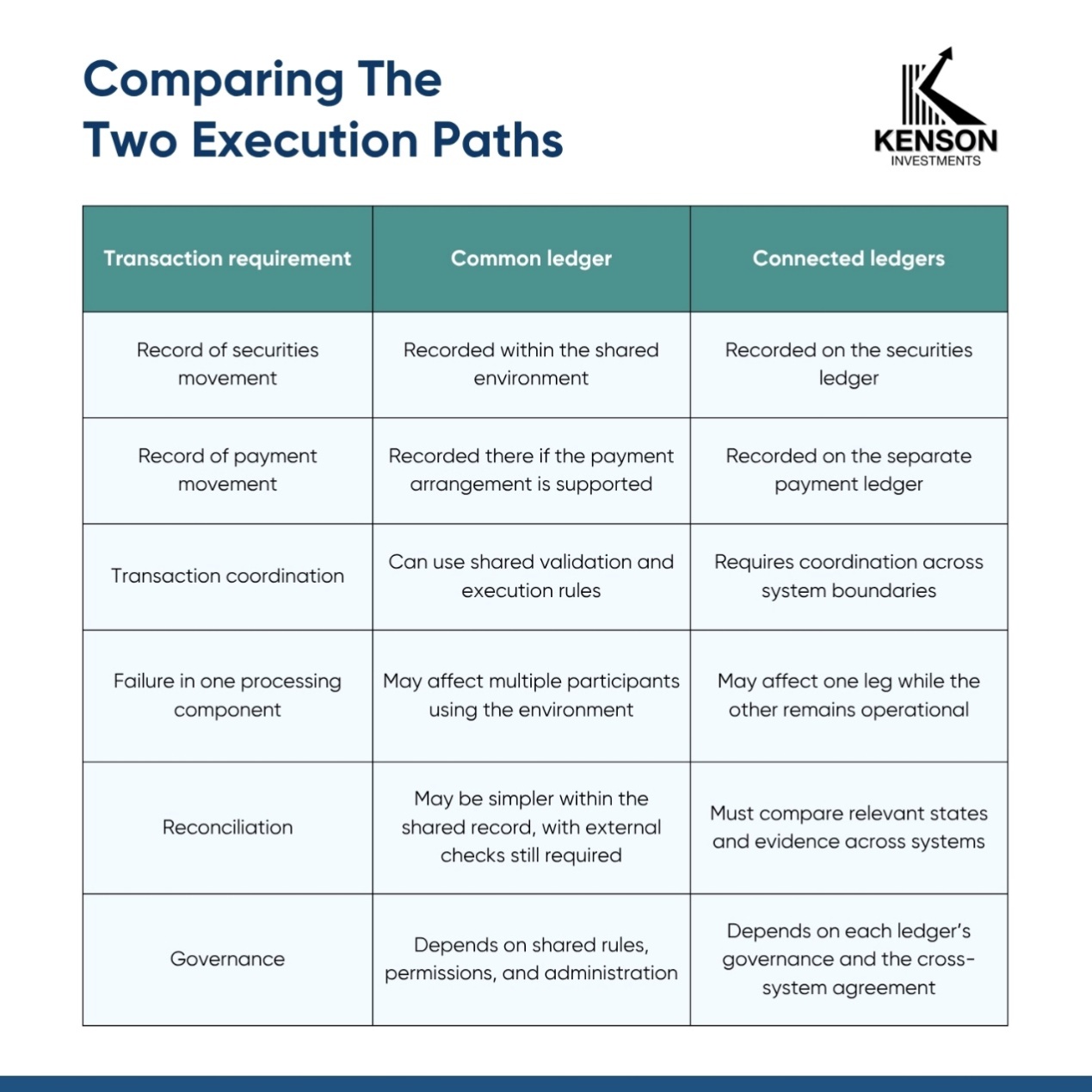
Neither model is universally superior. A common ledger may reduce coordination overhead where participants can operate under compatible rules and represent the required obligations in the same environment. Connected ledgers may be appropriate where institutions must retain distinct systems, legal arrangements, or operational controls.
The comparison also depends on the transaction’s actual boundaries. If either model relies on an external bank, custodian, registrar, or other authoritative record, that dependency must be included in the design assessment.
Trace the Transaction Beyond the Initial Confirmation
The most important test is whether the architecture can demonstrate the outcome of the complete transaction, not merely whether each system accepted an instruction.
For the 500-security sale, the review should establish the securities quantity transferred, the payment amount processed, the status of each obligation, and the evidence supporting the final classification. If the systems disagree, the process must identify which records are authoritative for the disputed facts and who is responsible for resolving the difference.
The scenario also shows why transaction coordination should be assessed separately from broader interoperability questions. Interoperability concerns how systems exchange information or value across technical and institutional boundaries. Here, the focus is narrower: how the agreed securities and payment obligations move through their respective execution paths and how the participants determine whether the transaction has completed.
The next section examines the coordination logic itself, including execution order, validation dependencies, duplicate instructions, and the controls needed to prevent a series of individually valid actions from producing an incomplete overall transaction.
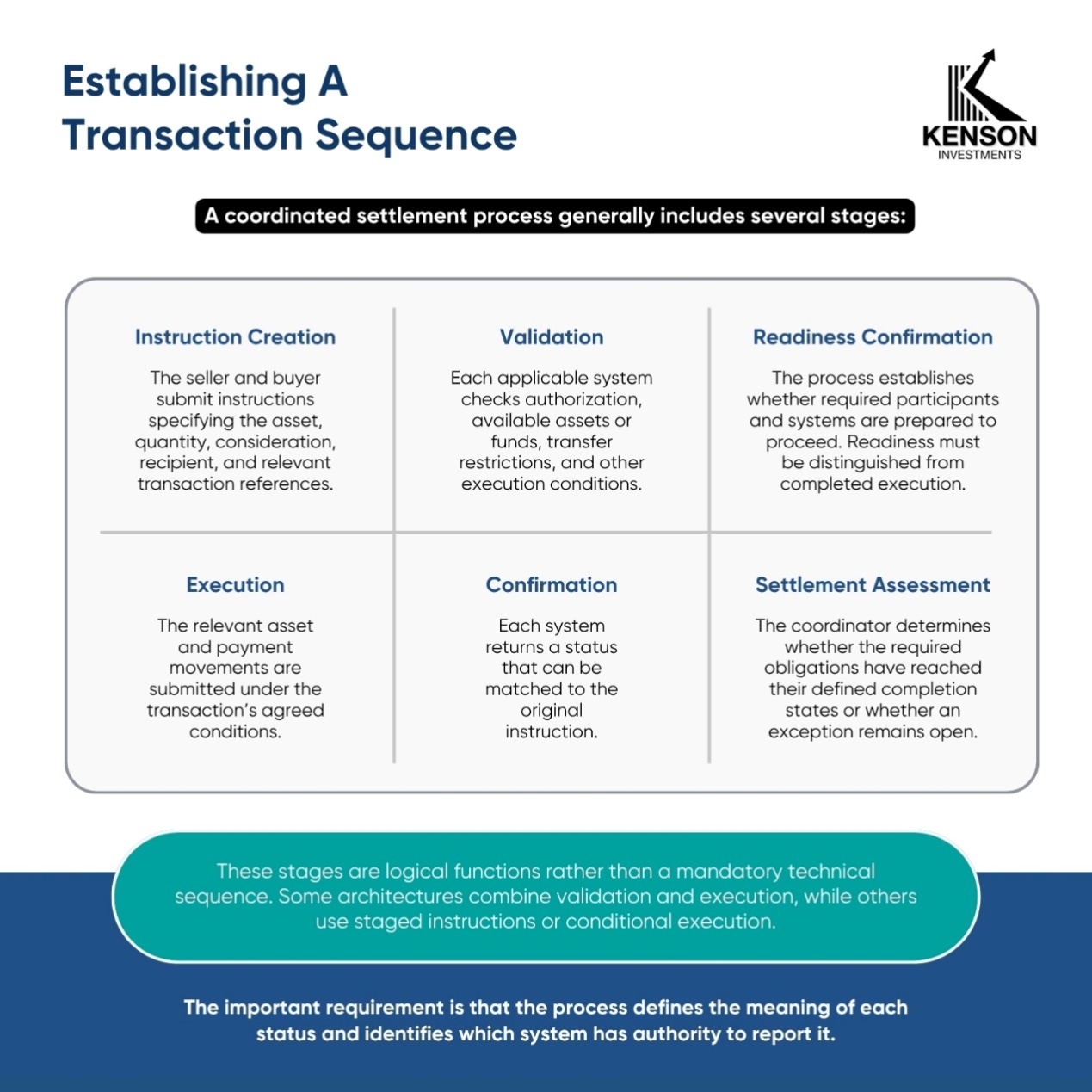
Transaction Coordination and Execution Order
Transaction coordination determines how separate obligations become one recognized settlement outcome. In tokenized markets, a securities transfer and its corresponding payment may be processed by different systems, each with its own validation rules, operating schedule, and confirmation process. The architecture must establish how these actions are ordered, how readiness is communicated, and what happens when the expected sequence breaks down.
A common ledger can coordinate eligible actions against a shared transaction state. Connected ledgers require an additional coordination mechanism to align instructions and interpret updates from separate records. In either model, the process needs defined conditions for proceeding, stopping, and confirming completion.
Ordering Actions Across Separate Ledgers
Execution order becomes particularly important when one system can complete its action independently of another. If the securities ledger transfers ownership before the payment system confirms consideration, the seller may face an unresolved exposure. If payment moves first, the buyer may face a corresponding risk that the securities transfer will not complete.
Coordination mechanisms can reduce this exposure through conditional execution, atomic transaction arrangements where supported, escrow structures, or explicit sequencing rules. Each approach has different technical, legal, and operational requirements. A conditional instruction, for example, is only as reliable as the condition it checks and the mechanism enforcing it.
The design must also account for delays. A missing confirmation does not necessarily mean that an instruction failed. The receiving system may have processed it while its response remains delayed or unavailable. Automatically resubmitting the instruction without checking its status could create duplicate-processing risks.
Defining the Authoritative Transaction State
Every participant should be able to distinguish between an instruction that has been submitted, one that has been accepted, and one whose required obligations are complete. Shared transaction identifiers, consistent status definitions, timestamps, and recorded acknowledgments help establish a traceable sequence across systems.
For tokenized market ledger architecture, the assessment should therefore examine both execution logic and the evidence supporting each state transition. A shared record can simplify coordination, while connected records may require additional messaging and reconciliation. Neither arrangement removes the need to define authority, handle delayed responses, and prevent an uncertain status from being treated as completion.
These controls become especially important when a transaction reaches partial completion, leaving one obligation settled while another remains unresolved.
Partial Completion: When One Leg Moves and Another Does Not
Partial completion occurs when one part of a settlement progresses while another remains pending, fails, or cannot be confirmed. In a tokenized securities transaction, the asset transfer might be recorded successfully while the corresponding payment remains unconfirmed. The reverse can also occur if funds move before the securities transfer completes.
A common ledger may reduce this risk when both obligations can be executed under shared transaction conditions. Connected ledgers must coordinate separate execution processes and establish how an incomplete outcome will be handled.
Identifying Incomplete Settlement
Transaction status should distinguish between preparation, submission, execution, and confirmed completion. A submitted instruction does not establish that the receiving system processed it, and a successful asset transfer does not prove that payment was received.
Consider the earlier example involving 500 tokenized securities. If the securities ledger confirms the transfer but the payment system returns no response, the coordinator should treat the overall settlement as unresolved. It should verify the payment status before retrying the instruction or initiating a corrective action.
This requires clear rules for:
- Identifying which obligation completed and which remains outstanding.
- Determining the authoritative status in each system.
- Preventing duplicate instructions while confirmation is pending.
- Assigning responsibility for investigating discrepancies.
- Recording the outcome and any corrective transaction.
Managing the Exposure
Partial completion can create financial, operational, and recordkeeping exposure. The affected party may need to determine whether it has transferred an asset without receiving consideration, paid without receiving the asset, or simply encountered a delay in confirmation.
Conditional execution and coordinated settlement arrangements can reduce these risks, but their effectiveness depends on the systems involved and the legal arrangements supporting the transaction. Where one ledger cannot reverse a completed transfer automatically, recovery may require a separate compensating transaction rather than a simple rollback.
The architecture should define escalation thresholds, status checks, and controls against duplicate processing. These procedures help distinguish a temporary communications issue from an actual settlement failure.
A reliable design makes partial completion visible, assigns responsibility for resolving it, and preserves a traceable record of the outcome. The next requirement is a recovery process that can address failures without creating additional inconsistencies.
Failure Recovery, Reconciliation, and Exception Handling
Failure recovery determines how a tokenized market transaction is investigated and resolved when execution, communication, or recordkeeping breaks down. Common-ledger systems may provide a shared transaction history, while connected ledgers often require evidence to be gathered from multiple systems. Both need defined procedures for unresolved instructions and inconsistent records.
Detecting and Resolving Exceptions
An exception may arise from rejected instructions, insufficient funds, transfer restrictions, system outages, delayed confirmations, or conflicting transaction statuses. The response should depend on the failure type and the state of each obligation.
A practical recovery process should:
- Identify the affected transaction using a shared reference.
- Check the authoritative status of each asset and payment instruction.
- Prevent automatic retries from duplicating completed actions.
- Assign an owner and escalation path for unresolved cases.
- Record corrective actions and confirm the resulting state.
A timeout alone should not be treated as proof of failure. The instruction may have been executed even if its acknowledgment was lost. Status verification should precede any resubmission, reversal, or compensating transaction.
Reconciliation Across Ledgers
Reconciliation compares records to identify missing updates, mismatched quantities, inconsistent statuses, or differences in transaction timing. Connected-ledger environments may require reconciliation between securities records, payment records, and external institutional systems.
A shared ledger can simplify comparison within its own record, but it cannot automatically establish that external bank accounts, custody records, or legal obligations match. Reconciliation remains necessary wherever authoritative information is maintained outside the shared environment.
Recovery procedures should also distinguish technical correction from legal resolution. Reversing a digital record may not reverse an external payment or restore the parties’ original legal positions. Corrective actions must follow the transaction’s governing arrangements and applicable controls.
The architecture should preserve an auditable history of the original instruction, subsequent status changes, investigation, and resolution. This provides evidence of how an exception was handled and helps prevent unresolved discrepancies from being mistaken for completed settlement.
With recovery procedures established, the next consideration is governance: who can authorize changes, resolve disputes, and take responsibility when several institutions control different parts of a transaction.

Governance Boundaries and Operational Responsibility
Ledger architecture determines where records are maintained, but governance determines who controls access, validates instructions, manages exceptions, and authorizes changes. These responsibilities are straightforward to identify within a single operating environment and can become more complex when separate institutions maintain connected ledgers.
A common ledger may centralize certain operational decisions, while connected-ledger arrangements distribute control across participating systems. Neither structure eliminates the need for clear accountability.
Defining Roles and Authority
For a tokenized securities transaction, responsibilities may be divided among the platform operator, custodian, transfer agent, payment institution, and settlement coordinator. Each role should have a defined scope covering instruction validation, record maintenance, incident response, and transaction confirmation.
Governance arrangements should establish:
- Access and authorization: Who can submit, approve, or restrict transactions.
- Operational control: Who maintains systems and manages outages or security incidents.
- Exception ownership: Who investigates incomplete transactions and coordinates corrective action.
- Record authority: Which system provides the authoritative status for each obligation.
- Change management: How updates to rules, permissions, and system interfaces are approved.
These boundaries matter when an institution can update one record but cannot compel another system to process a corresponding instruction.
Managing Cross-System Disputes
Connected ledgers may disagree about whether an instruction was accepted, completed, or rejected. Governance arrangements should specify how participants verify the underlying evidence, escalate disputes, and communicate an authoritative resolution. Shared transaction identifiers and consistent status definitions support this process, but they cannot replace agreed decision-making authority.
A common ledger also requires governance. Access permissions, validation rules, administrator privileges, and changes to the operating environment must be controlled. Shared records do not necessarily mean shared decision-making, particularly when one operator retains authority over critical functions.
The assessment should therefore examine whether operational responsibility matches the architecture’s actual control boundaries. Clear ownership helps institutions respond to incidents without leaving transactions suspended between systems or allowing conflicting records to remain unresolved.
Governance also affects how settlement completion is recognized. The next section examines where the asset and payment legs become final, and which records provide evidence of that outcome
Where Cash and Asset Legs Become Final
A tokenized transaction may involve several records, but each obligation has its own completion requirements. The securities ledger may record a change in ownership while the payment system maintains the authoritative status of the cash transfer. Understanding where each leg becomes final is essential to assessing whether the overall transaction has settled.
A ledger entry alone does not establish legal finality. The result depends on the governing arrangements, the rights represented by the token, the applicable rules, and the payment mechanism involved.
Identifying the Completion Point
For the securities leg, the relevant question is when the ownership record becomes authoritative under the applicable arrangements. This may depend on the tokenization platform, custody structure, transfer agent, or another legally recognized record.
For the cash leg, the completion point depends on the payment instrument and settlement system. A payment instruction marked as submitted or accepted may remain subject to further processing. Even a digital representation of money must be assessed according to the rights and redemption arrangements it represents.
The architecture review should identify the authoritative record for each leg, the event that establishes completion, and any remaining conditions that could affect the outcome.
Assessing the Combined Result
When asset and payment records are maintained separately, the coordinator must determine whether both obligations have reached their required completion states. A shared ledger can make this easier when both legs are supported within the same environment, but external payment or legal dependencies may remain.
Connected ledgers require reliable status communication and evidence that the records correspond to the same transaction. In either model, the design should distinguish technical confirmation from legal settlement finality and define how conflicting evidence is resolved.
For a deeper treatment of this distinction, link to the dedicated page on settlement finality rather than repeating its legal and operational analysis here.
The final assessment brings these elements together: record authority, coordination, recovery, governance, and the completion points for both obligations.
How to Assess Tokenized Market Ledger Architecture
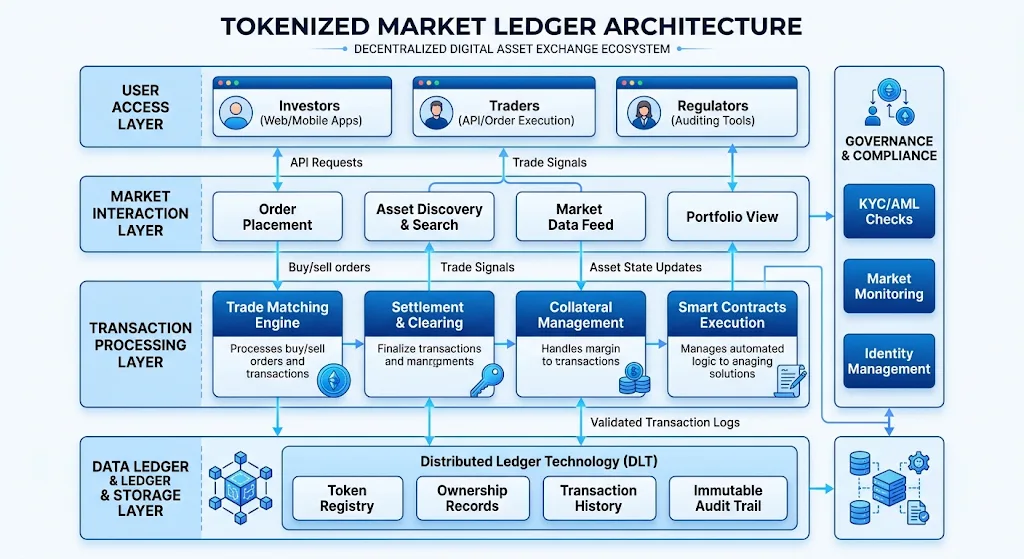
Assessing tokenized market ledger architecture requires more than comparing whether systems use one ledger or several. The relevant question is how reliably the arrangement coordinates asset and payment obligations, handles exceptions, and establishes an authoritative settlement outcome.
A practical review should examine five areas:
- Record alignment: Identify where ownership, payment, and transaction status are recorded. Establish which system is authoritative for each obligation.
- Transaction coordination: Determine how instructions are matched, validated, ordered, and confirmed. Check whether one leg can complete while another remains pending.
- Failure recovery: Review timeout handling, duplicate prevention, reconciliation, and procedures for correcting incomplete transactions.
- Governance: Assign responsibility for access, system changes, disputes, and unresolved exceptions across participating institutions.
- Completion and finality: Identify the event that establishes completion for each leg and any external conditions that remain.
The review should trace a transaction from instruction creation through confirmation, including at least one scenario in which a system becomes unavailable, or a confirmation is delayed. This reveals whether the design can establish the transaction’s actual state without relying on assumptions or inconsistent records.
Supporting material should include transaction flows, status definitions, system responsibilities, exception procedures, and the legal arrangements governing the tokenized asset and payment mechanism. Related pages on ledger interoperability and digital-money structures can provide further detail without duplicating their technical or financial explanations here.
A common ledger may simplify coordination where all required obligations can be processed within its control boundaries. Connected ledgers may preserve separate institutional controls while requiring stronger coordination and reconciliation. The appropriate assessment depends on the transaction, the systems involved, and the evidence available to verify completion.
Kenson Investments examines digital-asset market structures and their operational implications through its educational resources.
Sign up now to gain the latest insights.
Disclaimer: The information provided on this page is for educational and informational purposes only and should not be construed as financial advice. Crypto currency assets involve inherent risks, and past performance is not indicative of future results. Always conduct thorough research and consult with a qualified financial advisor before making investment decisions.
“The cryptocurrency and digital asset space is an emerging asset class that has not yet been regulated by the SEC and the US Federal Government. None of the information provided by Kenson LLC should be considered as financial investment advice. Please consult your Registered Financial Advisor for guidance. Kenson LLC does not offer any products regulated by the SEC, including equities, registered securities, ETFs, stocks, bonds, or equivalents.”



