






Ethereum exchange-traded products (ETPs) that stake their holdings introduce an additional layer of operational and financial complexity. Alongside tracking Ether’s market price, these products may earn staking rewards through participation in Ethereum’s proof-of-stake network. Those rewards can affect fund performance, but they also come with service-provider costs, network risks and potential delays when Ether must be made available for investor redemptions.
Understanding a staking Ethereum ETP requires looking beyond the headline reward rate. The key question is how validator activity translates into fund-level returns, how much of those rewards remains after fees and losses, and whether staked assets can be converted into liquid holdings when the product needs them.
How Staking Rewards Enter an Ethereum ETP
Ethereum uses proof of stake to help secure its network. Validators participate in block proposals and attestations, receiving rewards for eligible activity under network rules. Some rewards are associated with transaction fees and other network-level mechanisms, while validator performance and operating conditions influence the amounts earned.
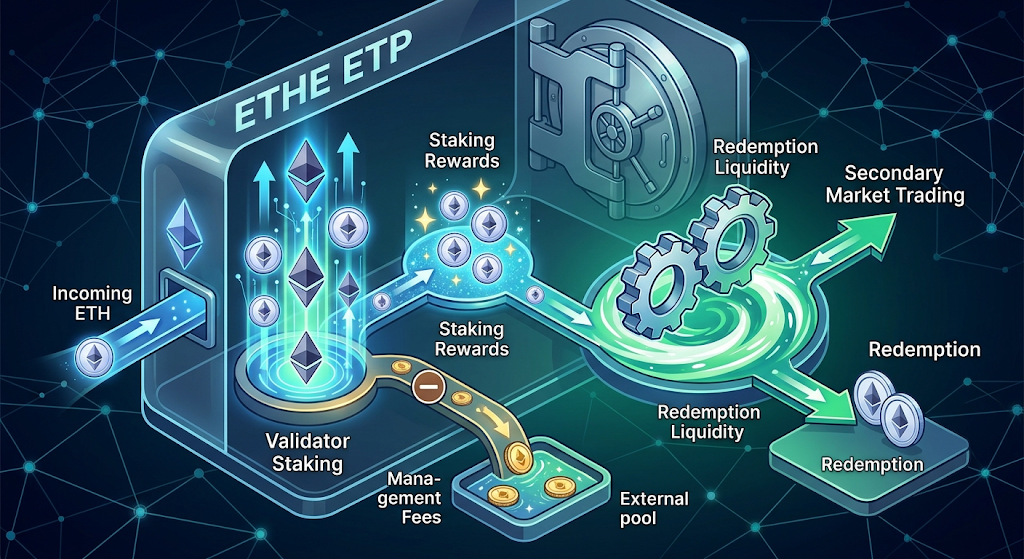
An Ethereum ETP that supports staking typically relies on an approved arrangement involving custodians, staking providers or other service providers. The fund’s Ether is allocated to staking under the product’s governing documents and operational framework. Validators then perform network duties, and the resulting rewards are accounted for according to the arrangement.
The flow is not necessarily immediate or uniform. Rewards may accrue at different intervals, and operational systems must record the amount earned, when it becomes available and how it is reflected in the product’s holdings or net asset value (NAV). The fund’s accounting policy and disclosure documents determine how these amounts are recognized and reported.
Investors should distinguish between network staking rewards and the return actually retained by the ETP. A published network yield does not automatically represent the fund’s net staking contribution. Service fees, downtime, slashing events and other costs can reduce the amount ultimately attributable to shareholders.
Service-Provider Fees and Net Staking Returns
Staking arrangements introduce costs that do not apply in the same way to an Ether holding that remains unstaked. Depending on the product structure, fees may be charged by staking operators, custodians or other service providers involved in administering the arrangement. The fund may also incur operating expenses that affect overall performance independently of staking.
A provider may retain a percentage of staking rewards, charge a service fee or use another contractual fee structure. The exact terms vary by product, so investors should review the prospectus and other disclosures rather than assume a standard rate.
Consider a simplified example. If a fund earns 3% in gross staking rewards over a period and its staking provider retains 20% of those rewards, the fund keeps 2.4% before other expenses, penalties and operational costs. The example illustrates the fee calculation only; it is not a forecast of Ethereum staking yields or the expected return of any ETP.
Three figures should therefore remain distinct:
- Gross staking rewards: Rewards generated through validator activity before provider charges.
- Net staking contribution: Rewards remaining after staking-specific fees, penalties and related costs.
- Total fund performance: The combined effect of Ether price movements, net staking income, fund expenses and tracking differences.
Staking income can help offset some fund expenses, but it does not eliminate market exposure. A decline in Ether’s price may outweigh the value of rewards accumulated during the same period. Conversely, positive staking income does not necessarily mean the fund will outperform an otherwise comparable product that does not stake its holdings.

Slashing, Downtime and Operational Exposure
Ethereum’s protocol rewards validators for correct participation and can penalize missed duties or dishonest behavior. More severe violations can trigger slashing, which destroys some staked Ether and removes the validator from active participation. The scale of a slashing penalty depends on the circumstances, including whether other validators are slashed around the same time.
For an ETP, these risks extend beyond the theoretical yield calculation. If a staking provider experiences downtime, the affected validators may miss rewards or incur penalties. If a serious validator incident occurs, the fund may face a direct reduction in its Ether holdings or a loss reflected in its staking results.
Responsibility for these outcomes depends on the contractual arrangements. A service provider may accept liability for certain operational failures, but investors should not assume that every loss is reimbursed. Disclosures may distinguish protocol-level penalties, provider negligence, cybersecurity incidents and other events, each of which can receive different treatment.
Relevant controls include provider due diligence, validator monitoring, incident reporting, allocation across infrastructure where appropriate, and clear procedures for calculating and recording staking-related losses. These measures can reduce certain operational risks, but they cannot remove all protocol or market exposure.
Unstaking Delays and Redemption Liquidity
The most important difference between an unstaked Ether holding and a staked position may become apparent when the fund needs liquid assets. An ETP must manage its portfolio in line with its product terms and redemption arrangements, while Ethereum’s staking process imposes its own withdrawal mechanics.
A validator generally cannot exit and release its entire stake instantly. Exit requests are subject to network limits and queues, while the subsequent withdrawal process determines when the Ether becomes available for transfer. Timing varies with network conditions and the number of validators seeking to exit.
This creates a distinction between asset value and immediately available liquidity. Staked Ether may remain economically attributable to the fund while not being available for immediate use in a redemption or other portfolio transaction.
To manage this mismatch, an ETP may retain some unstaked Ether or other permitted liquid resources, depending on its mandate and operating model. It may also coordinate staking allocations with expected liquidity needs. Such arrangements involve trade-offs: holding more Ether outside staking can improve immediate flexibility, while staking a larger share of eligible holdings may increase exposure to rewards but reduce the portion available without an exit process.
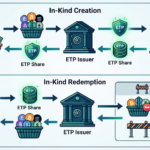
Actual redemption mechanics depend on the product. Investors should examine the prospectus for details on how redemptions are handled, who can submit them, whether the product has in-kind or cash settlement arrangements, and what restrictions apply during periods of stress. Retail investors trading ETP shares on an exchange should also distinguish their ability to sell those shares in the secondary market from the fund’s own process for creating or redeeming shares.
What to Examine in an Ethereum Staking ETP
A useful comparison focuses on the full operational and economic structure rather than a single advertised yield. Review the following areas:
- Reward disclosure: How often are staking results reported, and are figures presented before or after provider fees?
- Fee terms: What portion of rewards goes to staking providers, and what other fund expenses apply?
- Risk allocation: How are downtime, slashing and provider-related losses addressed?
- Liquidity management: What portion of holdings may be staked, and how does the fund manage redemptions while assets are exiting?
- Provider oversight: What monitoring, reporting and operational controls govern staking activity?
- Product documentation: Are there limits, suspension provisions or other conditions affecting staking and redemptions?
These details help establish whether reported staking income is transparent, how costs are allocated and what constraints could emerge when market conditions change.

Assessing the Full Economics
Staking can add a source of network-generated income to an Ethereum ETP, but the result depends on more than the gross reward rate. Provider fees, validator performance, slashing exposure, withdrawal queues and the fund’s liquidity policy all influence how staking affects the product.
For institutional participants and allocators, the central issue is how these components interact. A higher staking allocation may increase the amount of Ether participating in consensus, yet it can also make liquidity management more dependent on unstaking timelines and the fund’s available reserves. A lower allocation may preserve flexibility while reducing potential staking income.
The team of digital asset consultants at Kenson Investments examines digital asset market structures through the relationship between return sources, operational arrangements and risk controls.
When evaluating a staking Ethereum ETP, review its current disclosures alongside the assumptions behind its reported rewards. The objective is to understand how staking changes fund economics in ordinary conditions and how those economics may shift when providers, network queues or redemption needs come under pressure.
Disclaimer: The information provided on this page is for educational and informational purposes only and should not be construed as financial advice. Crypto currency assets involve inherent risks, and past performance is not indicative of future results. Always conduct thorough research and consult with a qualified financial advisor before making investment decisions.
“The crypto currency and digital asset space is an emerging asset class that has not yet been regulated by the SEC and the US Federal Government. None of the information provided by Kenson LLC should be considered as financial investment advice. Please consult your Registered Financial Advisor for guidance. Kenson LLC does not offer any products regulated by the SEC, including equities, registered securities, ETFs, stocks, bonds, or equivalents.”