








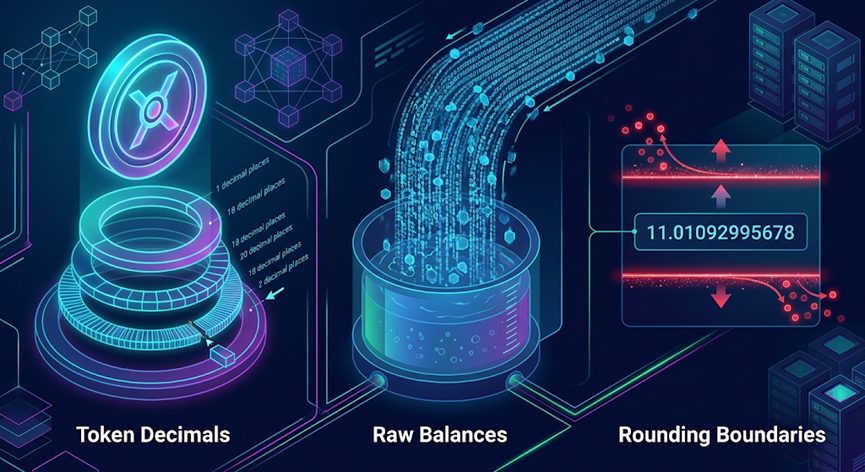
A token balance displayed as 12.50 may represent an underlying integer of 1,250,000,000 units, depending on the token’s decimal configuration. Both values describe the same quantity at different levels of precision.
Understanding token decimals and raw balances is essential when reading blockchain data, comparing balances across platforms, and reconciling differences between on-chain records and displayed figures.
The central issue is denomination precision. Raw balances store integer units, while interfaces and reports convert them into human-readable amounts. Errors can occur when that conversion uses the wrong decimal scale, rounds values prematurely, or assumes that every token follows the same convention.
How Token Decimals Convert Raw Units
Many fungible tokens, including ERC-20 tokens on Ethereum-compatible networks, store balances as integers. A token’s decimals metadata value indicates how many decimal places applications should use when displaying those units.
The conversion is straightforward:
Human-readable balance = Raw balance ÷ 10^decimals
For example, a token configured with six decimals uses 1,000,000 raw units to represent one whole token. A raw balance of 1,234,567 therefore displays as 1.234567 tokens.
A token configured with 18 decimals uses a different scale. The same raw integer would represent a much smaller human-readable quantity. The raw number alone is not enough to determine the displayed balance; the correct decimal configuration must also be known.
Importantly, decimals do not change the underlying quantity or market value. They define how integer units are expressed for display. The ERC-20 standard describes decimals as an optional metadata function, so applications should not blindly assume that every token exposes it or uses 18 decimals. Token-specific metadata must be handled appropriately.
Where Scaling Errors Enter Reports and Interfaces
A scaling error occurs when software applies the wrong decimal value or interprets a raw integer as though it were already a formatted balance.
Suppose a token has six decimals and a raw balance of 5,000,000 units. The correct displayed amount is 5 tokens. If a reporting system mistakenly assumes 18 decimals, it will show an extremely small quantity instead. The blockchain balance may be correct even though the report is not.
Errors can also arise when systems apply decimal scaling more than once. One service may convert raw units into a human-readable amount, while a second service mistakenly treats that result as raw data and divides again. Inconsistent formatting across APIs, spreadsheets and dashboards can then produce mismatched balances.
Reliable data pipelines should preserve the original integer amount, identify the token and its decimal configuration, and document when a value has been converted for display.
Rounding Boundaries and Lost Precision
Even with correct scaling, displayed precision can introduce differences. Consider a token with six decimals and a raw balance of 1,234,567 units. Its exact displayed balance is 1.234567 tokens.
A dashboard showing only two decimal places might display 1.23 or 1.23 after truncation, depending on its formatting method. Under conventional rounding, it would display 1.23 as well in this example; a balance of 1,235,000 raw units would display as 1.24 when rounded but 1.23 when truncated.
The underlying balance has not changed. Only the representation has lost precision.
Problems emerge when rounded figures are reused in calculations. If several balances are individually rounded before being summed, their total may differ from a total calculated using the original raw integers. Reconciliation systems should therefore compare precise underlying quantities whenever possible rather than relying on shortened display values.
For high-precision calculations, integer arithmetic or appropriately configured decimal arithmetic is preferable to ordinary binary floating-point calculations, which can introduce representation errors.
Maintaining Consistent Balance Data
Accurate handling of token decimals and raw balances requires a consistent process: preserve raw units, retrieve the correct token metadata, apply scaling once, and round only at the presentation stage. Reports should also distinguish exact balances from abbreviated display values so that small discrepancies are not mistaken for changes in the underlying holdings.
Kenson Investments examines digital asset infrastructure and operational risks, including the data-handling details that affect market reporting and reconciliation.
Explore more digital asset research to learn more about the technical mechanisms behind blockchain data and reliable market analysis.
Disclaimer: The information provided on this page is for educational and informational purposes only and should not be construed as financial advice. Crypto currency assets involve inherent risks, and past performance is not indicative of future results. Always conduct thorough research and consult with a qualified financial advisor before making investment decisions.
“The cryptocurrency and digital asset space is an emerging asset class that has not yet been regulated by the SEC and the US Federal Government. None of the information provided by Kenson LLC should be considered as financial investment advice. Please consult your Registered Financial Advisor for guidance. Kenson LLC does not offer any products regulated by the SEC, including equities, registered securities, ETFs, stocks, bonds, or equivalents.”



