









A Bitcoin output can be valid under consensus rules and still be difficult to spend in practice. The distinction comes down to three separate conditions: whether the output is valid on the blockchain, whether a transaction creating it meets standard relay policies, and whether spending its value makes economic sense after fees.
The Bitcoin dust threshold addresses the second condition, while economic spendability depends on the cost of a future transaction.
Understanding these differences helps explain why a small Bitcoin balance is not necessarily invalid or permanently unspendable, yet may be impractical to move.
What Is the Bitcoin Dust Threshold?
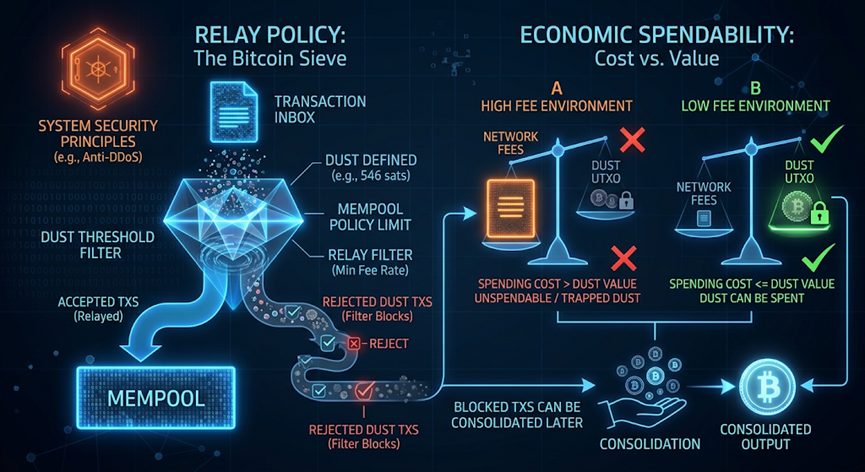
Bitcoin dust refers to a transaction output whose value falls below a threshold calculated using a node’s dust relay fee policy. Bitcoin Core estimates the size of the output and the transaction input required to spend it, then uses a configured fee rate to calculate the threshold.
Under Bitcoin Core’s default dust relay fee setting of 3,000 satoshis per virtual kilobyte, a typical legacy P2PKH output has a dust threshold of 546 satoshis, while a native SegWit P2WPKH output has a threshold of 294 satoshis. Other output types can have different thresholds.
These figures are policy-dependent rather than universal minimum balances. Node operators can configure their policies differently, and the applicable threshold depends on the output type. Bitcoin Core’s policy implementation explains how the calculation works.
Consensus Validity Is Different From Relay Policy
Bitcoin consensus rules determine whether transactions and blocks satisfy the protocol’s requirements. Relay policies govern which unconfirmed transactions individual nodes will generally accept into their mempools and forward to peers.
An output below the default dust threshold is not automatically invalid under consensus. Instead, a standard transaction that creates such an output will generally be rejected by nodes applying the relevant default policy. A miner could still include a consensus-valid transaction in a block even if ordinary nodes would not normally relay it.
This distinction matters because relay policy influences how transactions reach miners, but it does not independently determine whether a confirmed output can be spent under consensus rules.
The Bitcoin dust threshold should therefore be treated as a policy boundary, not a protocol-wide prohibition on spending small amounts.
When a Valid Output Becomes Uneconomical
Even when an output clears the dust threshold, its value may be too small to justify the fee required to spend it. This is the separate question of economic spendability.
Consider a UTXO containing 1,000 satoshis. Suppose the estimated input contribution to a future transaction is 68 virtual bytes. At a fee rate of 5 satoshis per vbyte, that input’s estimated fee contribution would be 340 satoshis. At 15 satoshis per vbyte, it would rise to 1,020 satoshis.
At the higher rate, the input’s estimated fee contribution alone exceeds the entire 1,000-satoshi balance. The transaction would also require space for its other inputs, outputs and overhead, making the economics less favorable.
These figures are illustrative, not fixed transaction costs. Actual size depends on the spending conditions and transaction structure, while the fee rate reflects the prevailing conditions when the transaction is submitted.
An output can therefore sit above the dust threshold but become uneconomical to move when fees rise. Conversely, lower fees may make that same output practical to spend later.
Why the Two Boundaries Matter
The relay-policy threshold and economic spendability answer different questions. The first concerns whether nodes generally accept a transaction creating a particular output. The second concerns whether spending an existing output is worthwhile relative to its value and the transaction fee.
Confusing the two can lead to inaccurate descriptions of small balances. An output below the default threshold is not necessarily invalid, and an output above it is not necessarily economical to spend.
For digital asset reporting, the distinction also helps separate protocol rules from the changing cost of using the network. A precise assessment should identify the output type, the applicable relay policy and the estimated cost of the actual spending transaction.
Kenson Investments examines Bitcoin infrastructure and digital asset operational risks, including the protocol and fee conditions that affect transaction usability.
Join the tribe for further analysis of Bitcoin mechanics and market infrastructure.
Disclaimer: The information provided on this page is for educational and informational purposes only and should not be construed as financial advice. Crypto currency assets involve inherent risks, and past performance is not indicative of future results. Always conduct thorough research and consult with a qualified financial advisor before making investment decisions.
“The cryptocurrency and digital asset space is an emerging asset class that has not yet been regulated by the SEC and the US Federal Government. None of the information provided by Kenson LLC should be considered as financial investment advice. Please consult your Registered Financial Advisor for guidance. Kenson LLC does not offer any products regulated by the SEC, including equities, registered securities, ETFs, stocks, bonds, or equivalents.”



