










Monitoring Bitcoin holdings requires more than checking a wallet balance. Operational teams must understand which scripts and addresses a monitoring system can recognize, how those addresses are derived, and whether the available records provide sufficient evidence to reconstruct wallet activity.
Bitcoin output descriptors help document this coverage. They describe the scripts a wallet uses to identify relevant outputs, often including information about key origins, derivation paths, and address-generation rules. When configured correctly, descriptors let compatible software monitor transactions without needing the private signing material required to spend funds.
For digital asset operations, this distinction matters. A watch-only system may report the activity it can observe, but its results are only as complete as the scripts and derivation ranges it covers. Documenting that coverage provides a stronger basis for monitoring, reconciliation, and wallet reconstruction.
What Are Bitcoin Output Descriptors?
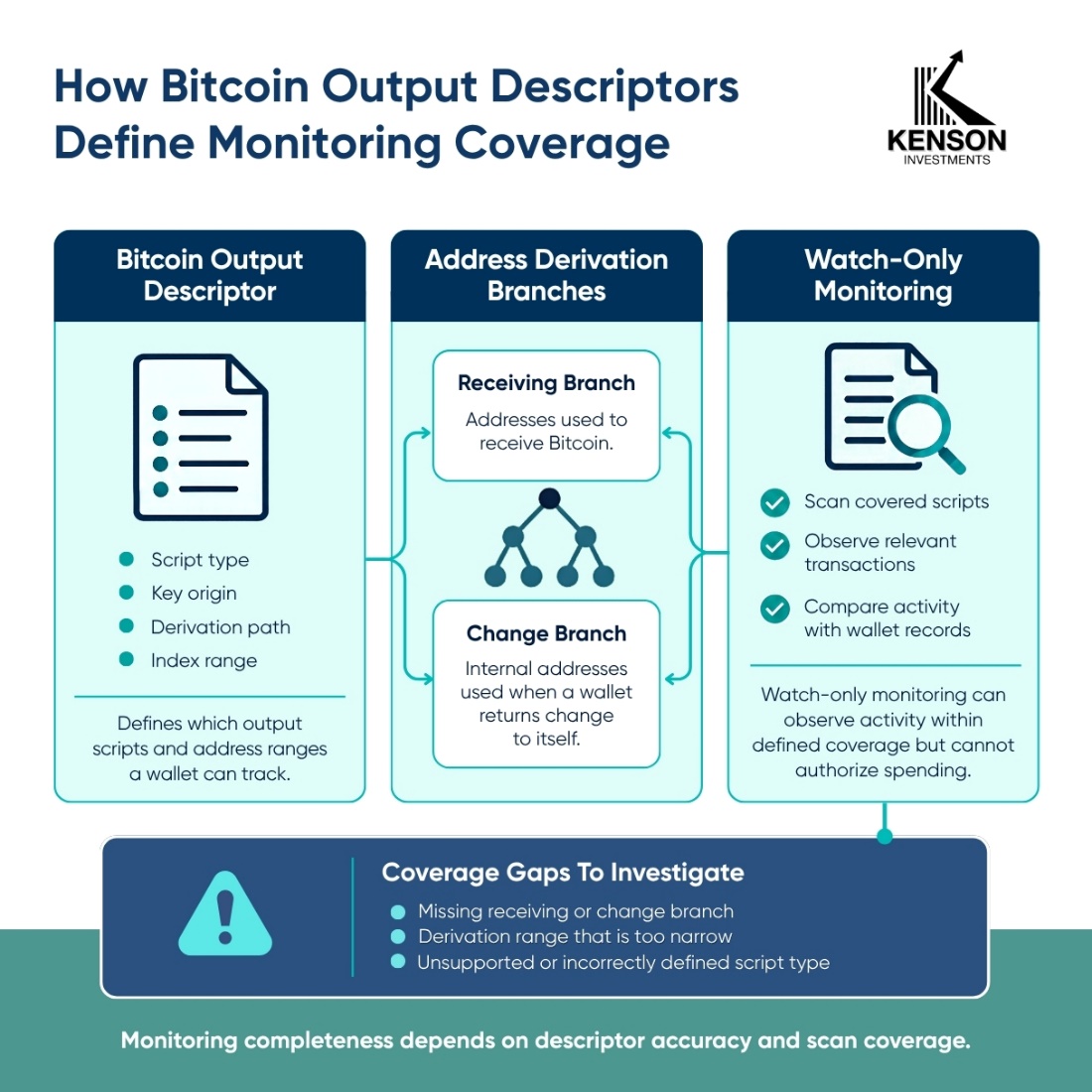
Bitcoin output descriptors are structured expressions that describe how to derive or recognize Bitcoin output scripts. Rather than relying solely on a list of addresses, a descriptor can define a rule for generating a family of scripts from specified key information.
Depending on the wallet configuration, descriptors may represent single-key scripts, SegWit outputs, nested SegWit outputs, or more complex script arrangements. Some include extended public keys and derivation paths, allowing compatible software to generate the relevant addresses within a defined range.
Descriptors can also include key-origin information and checksums. Origin details help explain where a key belongs within a derivation structure, while a checksum can help detect transcription errors in a descriptor string.
A descriptor does not automatically prove that every relevant wallet output has been captured. Its usefulness depends on the accuracy of the underlying information, the script types included, and the derivation ranges examined.
Watch-Only Monitoring Depends on Defined Coverage
A watch-only wallet can monitor transactions and balances without holding the private keys needed to authorize spending. This separation can support operational oversight by allowing monitoring functions to run independently from signing systems.
However, watch-only access is not the same as complete visibility. A monitoring system may recognize addresses derived from one descriptor while overlooking outputs associated with another script type, key branch, or derivation range.
For example, an organization may monitor an account’s external receiving addresses but fail to include its internal change addresses. Transactions involving change outputs could then appear incomplete in the monitoring system, even though the underlying Bitcoin activity is valid and recorded on-chain.
Effective coverage documentation should identify:
- The descriptor or script policy used for monitoring.
- The script types and key origins represented.
- The derivation paths and index ranges examined.
- Whether receiving and change branches are included.
- The last successful synchronization point and any known gaps.
- The method used to verify coverage against wallet records.
These details make monitoring limitations visible instead of allowing an incomplete balance view to appear authoritative.
Derivation Ranges and Reconstruction Evidence
Many Bitcoin wallets derive multiple addresses from a shared key structure. Descriptors can define the rules used to derive these addresses, but reconstruction still depends on identifying the appropriate branches and index ranges.
A system that scans only a limited range may miss an address used later in the wallet’s activity. This is particularly relevant when address generation has advanced beyond the range initially configured for monitoring.
Reconstruction evidence should therefore record the descriptor version, derivation paths, range boundaries, and scanning method. It should also document how the system determined that the examined range was sufficient for the activity under review.
A successful scan of a limited range establishes what was found within that range. It does not, by itself, prove that no relevant outputs exist beyond it.
Where possible, operators should compare reconstructed results with independent wallet records, known transaction identifiers, previously observed addresses, and available node or indexer data. Differences should be recorded and investigated rather than resolved through unsupported assumptions.
A Practical Example: Identifying Missing Coverage
Consider an organization that uses a watch-only Bitcoin wallet for internal reconciliation. Its monitoring system identifies several receiving addresses and reports the associated unspent transaction outputs. During a review, the team discovers a transaction that appears in the organization’s transaction records but is absent from the monitoring report.
The team should not immediately classify the transaction as missing from the blockchain or assume that the wallet has lost funds. Instead, it can examine the descriptor configuration and reconstruction evidence.
The review might reveal that the monitoring setup includes the receiving branch but excludes the internal change branch. Alternatively, the relevant derivation index may fall outside the scanned range, or the transaction may use a script type not represented in the configured descriptors.
The team can then update the coverage definition, rescan the appropriate range, and compare the resulting transaction history with existing records. Any configuration changes should be documented so reviewers can distinguish the original monitoring results from the reconstructed view.
This process turns a balance discrepancy into a traceable investigation of coverage, configuration, and evidence.
Documenting Coverage Without Exposing Signing Material
Output descriptors can support monitoring without requiring the watch-only system to hold private signing keys. Public key information may be sufficient for deriving or recognizing relevant scripts, depending on the descriptor and wallet design.
Nevertheless, not every descriptor is harmless to share. Extended public keys and derivation information can reveal address relationships and transaction patterns, creating privacy concerns even when spending authority is not exposed. Descriptors containing private key material require especially careful handling and should not be treated as ordinary watch-only records.
Operational documentation should distinguish between public monitoring data, sensitive wallet metadata, and private signing material. Access permissions, storage locations, version history, and approved sharing practices should reflect those differences.
The objective is to establish reproducible coverage evidence while limiting unnecessary disclosure. Teams should document what monitoring requires, who can access that information, and which controls prevent private signing material from entering watch-only systems.

The Kenson Approach: Evidence Before Assumptions
At Kenson Investments, digital asset management is grounded in operational clarity, documented controls, and disciplined recordkeeping. Bitcoin output descriptors illustrate how a technical configuration can become part of a broader evidence framework for monitoring and reconciliation.
A watch-only balance should be interpreted alongside the coverage rules that produced it. Descriptor definitions, derivation ranges, synchronization records, and reconstruction results help explain what a system can observe and where uncertainty remains.
This approach does not assume that descriptors eliminate monitoring gaps. Instead, it emphasizes making coverage boundaries explicit, preserving the evidence behind reconstructed results, and investigating discrepancies systematically.
For digital asset operations, that distinction supports more accountable reporting. Teams can explain which scripts were monitored, which ranges were scanned, and what remains unverified without implying that a partial view represents the entire wallet.
Continue Learning with Kenson Academy
Kenson Academy offers educational resources focused on digital asset infrastructure, operational controls, and responsible recordkeeping. Learn how documented coverage, watch-only monitoring, and reproducible reconstruction procedures support clearer oversight of Bitcoin activity.
Disclaimer: The information provided on this page is for educational and informational purposes only and should not be construed as financial advice. Cryptocurrency assets involve inherent risks, and past performance is not indicative of future results. Always conduct thorough research and consult with a qualified financial advisor before making investment decisions.
“The cryptocurrency and digital asset space is an emerging asset class that has not yet been regulated by the SEC and the US Federal Government. None of the information provided by Kenson LLC should be considered as financial investment advice. Please consult your Registered Financial Advisor for guidance. Kenson LLC does not offer any products regulated by the SEC, including equities, registered securities, ETFs, stocks, bonds, or equivalents.”



