









Crypto exchange-traded products (ETPs) can reference the same digital asset while using different legal vehicles, exposure mechanisms, valuation rules, and service arrangements. One product may hold cryptocurrency directly, while another may rely on futures contracts, swaps, staking, or a defined payoff formula. These differences affect how the security operates and how closely its performance follows its stated objective.
Assessing crypto ETP product structure requires a document-led review of the listed security, the assets or contracts supporting its exposure, and the arrangements that keep it functioning. Product names and headline fees provide only an initial description. The prospectus, governing agreements, benchmark methodology, fee disclosures, and service-provider arrangements establish the more complete picture.
This framework organizes that review into distinct stages: legal identity, exposure design, valuation, cash flows, operating dependencies, and disruption provisions. Each stage answers a different part of the structural analysis, helping readers compare products without ranking them or repeating the specialist mechanics of individual ETP categories.
Read the Documents in Their Proper Hierarchy
Crypto ETP disclosures serve different purposes. The prospectus summarizes the product’s objective, risks, and operating arrangements, while the governing instrument establishes the legal terms attached to the security. Supplementary documents may explain specific arrangements in greater detail.
Review the latest prospectus or offering document first. Identify amendments and supplements that modify its terms, then consult the relevant supporting documents.
- Prospectus or offering document: Product objective, material risks, fees, and operating arrangements.
- Governing instrument: Holder rights, issuer or sponsor authority, and termination provisions.
- Benchmark methodology: Pricing sources, calculation rules, and oversight arrangements.
- Fee schedule: Sponsor charges, expense limits, waivers, and payment methods.
- Service-provider disclosures: Responsibilities involving custody, administration, valuation, and other critical functions.
Resolve Conflicting Disclosures
Marketing materials and fact sheets can help identify a product’s stated positioning, but they may omit restrictions or contractual exceptions. Check effective dates, amendment language, and incorporation-by-reference provisions before relying on a description.
When two documents appear inconsistent, record the discrepancy and identify the provision requiring clarification. Do not assume that the newest document automatically overrides every earlier contractual term.
Maintain a source trail for material findings, including the document title, effective date, relevant section, and any related amendment. This makes the comparison easier to verify and helps distinguish established terms from simplified descriptions.
Establish the Legal Identity of the Wrapper
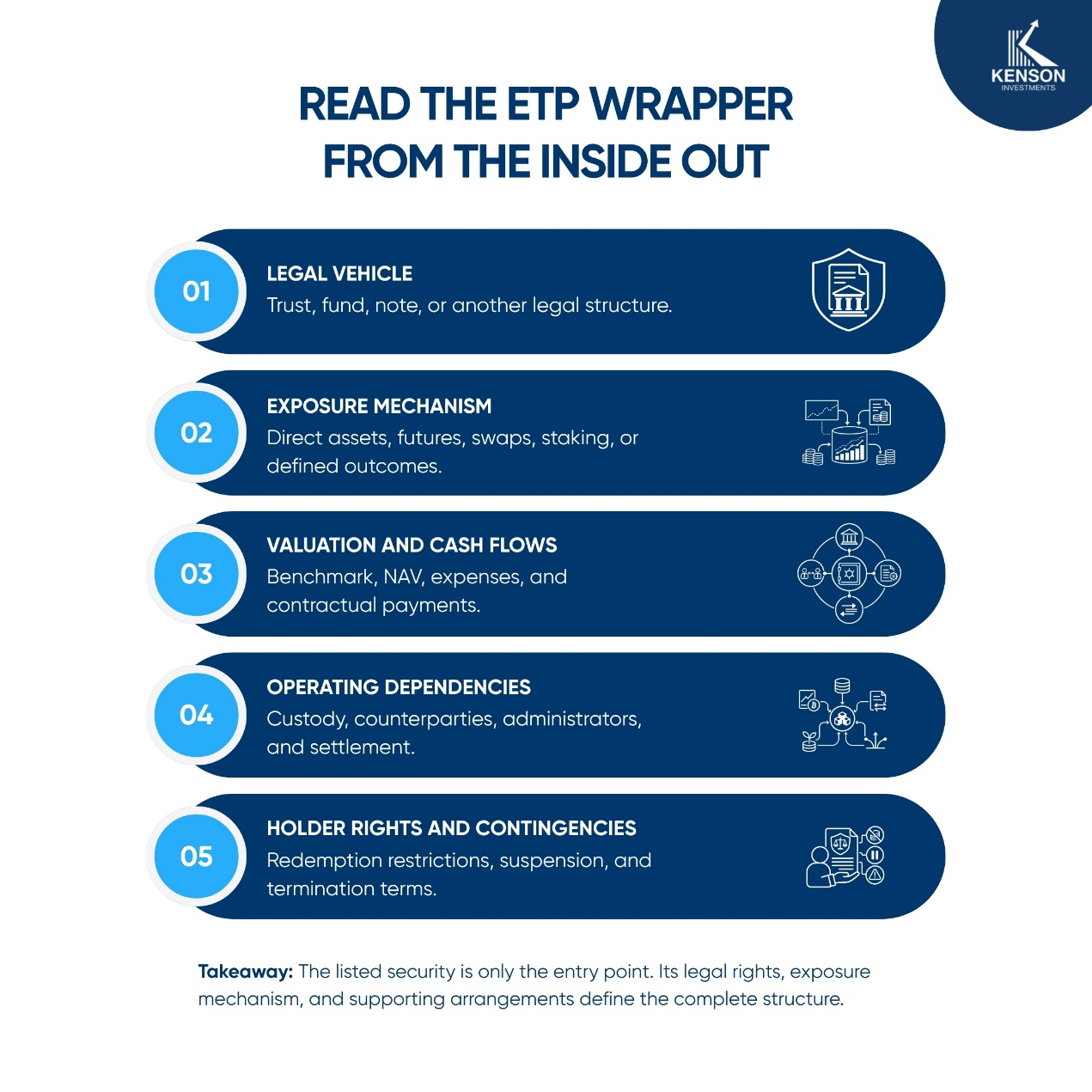
The legal wrapper defines the security being issued and the rights attached to it. The term ETP describes a broad category of exchange-traded securities, not a single legal structure. Depending on the jurisdiction and product design, a crypto ETP may take the form of a trust interest, a fund security, a debt instrument, or another legally defined interest.
The distinction is material. A trust holding cryptocurrency directly generally gives holders an interest defined by its governing documents. An exchange-traded note (ETN), by contrast, typically represents a contractual obligation of its issuer. Its value may reference a crypto asset without giving holders ownership of that asset or a claim to a segregated pool of cryptocurrency.
The SEC’s Investor Bulletin on Bitcoin and Ether ETPs explains that US spot Bitcoin and Ether ETPs structured as commodity trusts are distinct from registered investment companies, even when market participants informally refer to them as ETFs.
Start with the current prospectus or offering document, then consult the trust agreement, indenture, or other governing instrument where applicable. Record the issuer, legal vehicle, jurisdiction, and nature of the security.
The review should establish:
- The legal interest represented by each listed share or note.
- The assets, contractual rights, or payment obligations supporting that interest.
- The authority responsible for administering the structure and amending its governing arrangements.
- The provisions governing suspension, insolvency, and termination.
These details define the legal relationship between the holder and the product. They also prevent assumptions based on terminology that may have different meanings across jurisdictions.
Map the Mechanism That Creates Exposure
The next stage identifies how the product produces the exposure described in its objective. The mechanism may involve direct holdings, futures, swaps, staking arrangements, daily-reset strategies, defined-outcome payoffs, or a combination of these elements.
Record the stated objective alongside the mechanism used to pursue it. The objective describes the intended result; the mechanism establishes the financial arrangements through which that result is sought.
Direct crypto holdings
A directly held structure acquires the referenced cryptocurrency and maintains it through designated custody arrangements. Its value is linked to the holdings, adjusted for expenses, liabilities, valuation procedures, and other terms specified in the governing documents.
The prospectus should describe permitted asset activities, custody arrangements, acquisition and disposal procedures, and the treatment of incidental network events where relevant. It should also establish whether the product can stake, lend, or otherwise use its holdings.
Futures contracts
A futures-based structure uses contracts linked to the referenced crypto asset. The resulting exposure depends on contract specifications, market pricing, collateral, and the process for maintaining or replacing positions.
The documents should identify the relevant contracts, exchanges, position limits, collateral arrangements, and contract replacement rules. These provisions establish the product’s dependence on derivatives markets rather than solely on the spot price of the cryptocurrency.
Swap agreements
A swap-based structure obtains exposure through a contractual arrangement with a counterparty. Payments are determined by the terms of the agreement and may reference a benchmark or asset price.
Review the counterparty’s role, payment formula, collateral terms, valuation process, and contractual termination provisions. These arrangements determine how the exposure is delivered and what may happen if the agreement cannot continue.
Staking arrangements
A staking-linked structure introduces network participation or services intended to support staking activity. Depending on the design, the product may delegate assets to validators or use a custodian or other service provider to perform the activity.
The governing documents should establish whether staking is permitted, how rewards and fees are allocated, and how network restrictions affect asset availability. Relevant provisions may cover validator penalties, withdrawal delays, and the treatment of disrupted staking services.
Daily-reset and defined-outcome designs
Daily-reset products seek a specified exposure multiple or inverse return over a defined daily measurement period. Their stated objective does not automatically extend to the same multiple over longer holding periods. Compounding and changes in the benchmark’s path can produce materially different cumulative results. FINRA explains this feature in its overview of leveraged and inverse ETPs.
Defined-outcome structures use specified payoff rules, often involving options or related derivatives. Their results depend on the reference asset, measurement period, payoff thresholds, and contractual terms.
For these designs, record the exact measurement period, reset schedule or maturity date, and conditions that determine the stated payoff. Leave detailed analysis of derivative pricing and strategy mechanics to the relevant specialist reviews.
Verify the Benchmark and Valuation Methodology
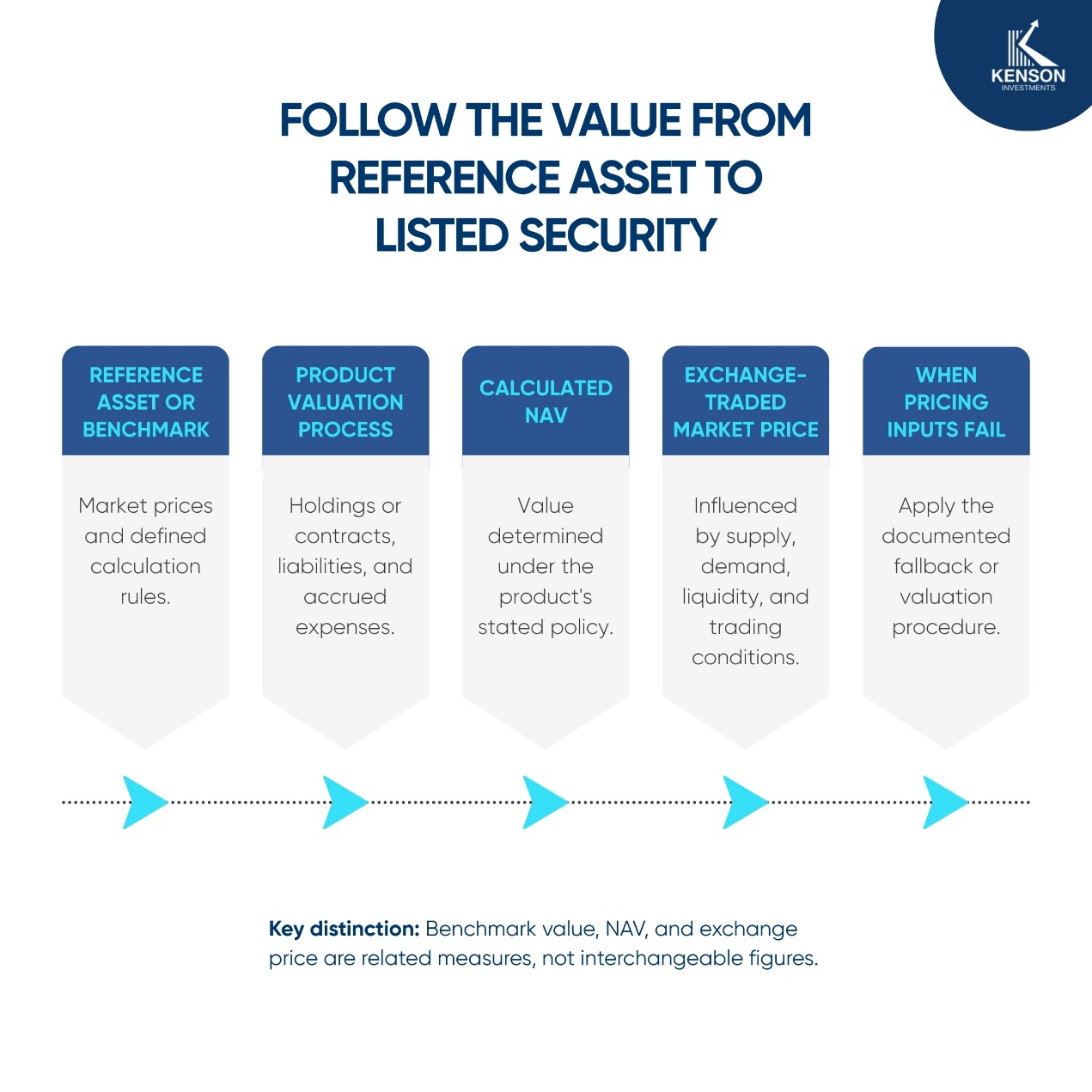
The benchmark defines the reference used to measure or calculate exposure. NAV, meanwhile, represents the product’s calculated value under its stated valuation policy. These measures can rely on related data without being identical.
The SEC’s July 2025 statement on crypto asset ETP disclosures identifies benchmark composition, pricing sources, calculation methodology, oversight arrangements, and NAV policies as relevant disclosure areas.
Read the benchmark methodology alongside the prospectus provisions governing valuation. Record the benchmark provider, eligible pricing venues, calculation window, constituent selection rules, and any material discretion available to the sponsor.
For a benchmark based on multiple trading platforms, the methodology should explain how venues are selected and how unreliable or unavailable pricing inputs are handled. A reference price drawn from a defined group of markets may behave differently from a single venue’s last-traded price, particularly when liquidity becomes uneven.
The NAV policy should establish the valuation time, pricing inputs, treatment of liabilities and accrued expenses, and procedures for exceptional conditions. Where the product uses a separate accounting fair-value method, record the disclosed differences between that method and the NAV calculation.
Document the fallback process
Normal valuation procedures may become unavailable when a benchmark fails, a pricing source becomes unreliable, or market conditions prevent the expected calculation. The documents should describe the applicable fallback method, calculation delay, fair-value process, or other response.
Record the authority responsible for applying the fallback and any circumstances that could interrupt ordinary valuation or transaction processing. A methodology that describes only routine calculations leaves an important part of the product’s operating design undocumented.
Keep NAV separate from the exchange price
The listed security trades at a market price established through exchange activity. That price can differ from NAV because of demand, liquidity, transaction costs, and the functioning of creation and redemption arrangements.
Record the NAV calculation frequency and the relevant trading and transaction arrangements. Do not treat a stated tracking objective as a guarantee that the market price will always match the referenced asset or calculated NAV.
Separate Exposure Tracking From Operational Performance
An ETP’s exposure tracking, exchange liquidity, and operational continuity describe different aspects of its performance. Reviewing them separately helps prevent one favorable indicator from obscuring a weakness elsewhere in the structure.
Keep Three Measurement Areas Distinct
Exposure tracking
Compare the product’s reported NAV performance with its stated benchmark or exposure objective over matching periods. Documented differences may reflect expenses, contract-related effects, cash balances, valuation timing, or other structural features.
Exchange trading conditions
Review available evidence on:
- Trading volume and bid-ask spreads.
- Differences between the market price and NAV.
- Disclosed creation or redemption interruptions.
- Changes affecting access to the primary market.
These indicators describe trading conditions; they do not guarantee future liquidity or establish the accuracy of the benchmark.
Operational continuity
Record documented interruptions to valuation, delayed calculations, suspended transactions, and changes in service arrangements. Note the date, duration where available, and stated consequences of each event.
Use Comparable Periods
Match measurement periods when reviewing published performance. A daily-reset objective should not be assessed using an unmatched multi-day return, and exchange-price observations should not be substituted for NAV data without explanation.
This separation helps identify whether a difference relates to the exposure mechanism, trading conditions, or an operational interruption. Each finding can then be traced to the appropriate disclosure or performance record.
Trace the Cash Flows and Cost Allocation
Cash-flow analysis establishes how money, assets, collateral, rewards, and contractual payments move through the product. It also identifies which expenses reduce the value attributable to holders and which parties are responsible for meeting particular obligations.
Begin with the initial acquisition or establishment of exposure. Continue through recurring expenses, transaction activity, settlements, collateral movements, and redemptions.
For a direct-holdings product, the flow may include cash used to purchase cryptocurrency, asset transfers to custody, and sales used to meet permitted expenses. A futures-based product may involve margin, collateral, contract settlements, and costs associated with replacing positions. A swap-based design may involve contractual payments, collateral transfers, and settlement obligations.
Staking-linked arrangements can add rewards, validator charges, and costs associated with maintaining the service. Defined-outcome structures may involve option premiums and settlements under the stated payoff terms.
The purpose of the map is to identify each material flow, its timing, the responsible party, and its effect on product assets or liabilities.
Distinguish fees from other costs
The sponsor fee is only one component of the economic cost structure. Depending on the design, other costs may include trading expenses, spreads, financing charges, derivative-related costs, custody fees, or expenses arising from portfolio adjustments.
Read the fee schedule alongside the provisions explaining which costs the sponsor pays and which are charged to the product. Record any expense caps, temporary fee waivers, reimbursement arrangements, and conditions that could change the published fee.
Also identify how expenses are paid. Some directly held crypto trusts cover expenses by selling a portion of their holdings. The quantity of cryptocurrency represented by each share may therefore decline over time, even if the number of shares remains unchanged. The SEC’s 2025 disclosure statement specifically discusses disclosure of fees and the effect of expenses paid from underlying crypto assets.
For comparison purposes, record the stated sponsor fee, additional disclosed costs, payment method, and any conditions attached to waivers or expense limits. Keep estimates separate from costs explicitly stated in the documents.
Identify the Critical Operating Dependencies
The product’s legal and financial arrangements rely on service providers and market infrastructure. Depending on the structure, these may include a sponsor, custodian, administrator, benchmark provider, authorized participants, derivatives intermediaries, counterparties, exchanges, and settlement providers.
Create a provider register that records each party’s function, contractual responsibility, and role in maintaining the product’s exposure or operations. Use the prospectus and relevant agreements to establish which providers are material rather than assuming that every named service provider has the same importance.
Custody and asset control
For a product holding crypto assets directly, identify who controls the private keys, how wallets are organized, how transfers are authorized, and whether assets are segregated or commingled. Record the disclosed procedures for reconciling holdings and transferring assets if a custody arrangement changes.
Insurance disclosures also require careful reading. The existence of insurance does not establish that every loss scenario is covered. Coverage depends on the policy’s scope, exclusions, limits, and claims conditions.
For a structure that relies on derivatives rather than direct crypto holdings, focus instead on the assets actually held, collateral arrangements, and contractual rights that support the exposure.
Counterparties and concentration
A product can name several providers yet remain dependent on one institution for a critical activity. Identify whether a single party performs multiple functions and whether a replacement could be arranged under the documented terms.
For derivatives, review default provisions, collateral rights, close-out arrangements, and conditions that permit early termination. For custody, review transfer procedures and the terms governing the end of a service relationship.
Record the consequences of a provider failure only where the documents support them. If the replacement process, recovery period, or allocation of losses is not specified clearly, mark the issue as unresolved.
Creation and redemption arrangements
Authorized participants and other intermediaries may facilitate the creation or redemption of exchange-traded securities. The governing documents should specify who may submit orders, how those orders are processed, and whether settlement occurs in cash, cryptocurrency, or another permitted form.
Record restrictions, fees, settlement conditions, and circumstances that may permit creation or redemption to be suspended. These arrangements can influence the relationship between the exchange-traded price and NAV.
The existence of exchange trading does not establish that every primary-market function will remain available under all conditions. Keep the exchange listing and the creation-redemption process as separate entries in the operating register.
Examine Asset-Specific Events and Governance Provisions
Crypto networks can undergo protocol changes or other events that require decisions beyond routine custody and valuation. Depending on the referenced asset and the product’s terms, these events may include network upgrades, chain splits, airdrops, or changes to supported transaction formats.
The product’s governing documents determine how such events are assessed and handled. Holding a security linked to a cryptocurrency does not automatically establish entitlement to every additional asset, distribution, or network-related right.

Record Discretion and Unresolved Issues
Some documents give the sponsor discretion to evaluate technical feasibility, legal considerations, custody support, or market conditions before acting. Record the factors the governing terms permit the sponsor to consider and any stated notification requirements.
Also distinguish the product’s legal entitlement from its ability to access or manage an asset. A network feature may exist technically without being supported by the product’s custody and operating arrangements.
Where the documents provide limited detail, flag the uncertainty instead of assuming a particular outcome. This review captures asset-specific governance issues that may affect the wrapper during its life without repeating the broader disruption and termination analysis.
Record Disruption, Suspension, and Termination Provisions
The ordinary operating model describes how the product is intended to function. The disruption provisions establish the response when an essential arrangement becomes unavailable or a specified event occurs.
Review the conditions that may permit the issuer or sponsor to suspend transactions, delay valuation, replace a provider, terminate a contract, amend an arrangement, or wind down the product. Relevant events may include unavailable pricing inputs, custody problems, counterparty defaults, regulatory restrictions, or market disruptions.
Record the party authorized to make each decision, the notification requirements, and any contractual deadlines. Distinguish mandatory actions from discretionary powers and identify any conditions under which holders may have limited remedies.
The relevant scenarios vary by structure. Direct-holdings products require clear arrangements for asset valuation and transfer during custody changes or wind-down. Derivative-based structures need provisions for outstanding contracts, collateral, and termination payments. Staking-linked designs may face network withdrawal restrictions that affect the timing of asset recovery.
Defined-outcome products also require clear treatment of maturity, contractual settlement, and any early termination events specified in the documentation.
This review should not attempt to predict every disruption. It should establish whether material events have documented procedures, clear decision authority, and identifiable consequences for the product.
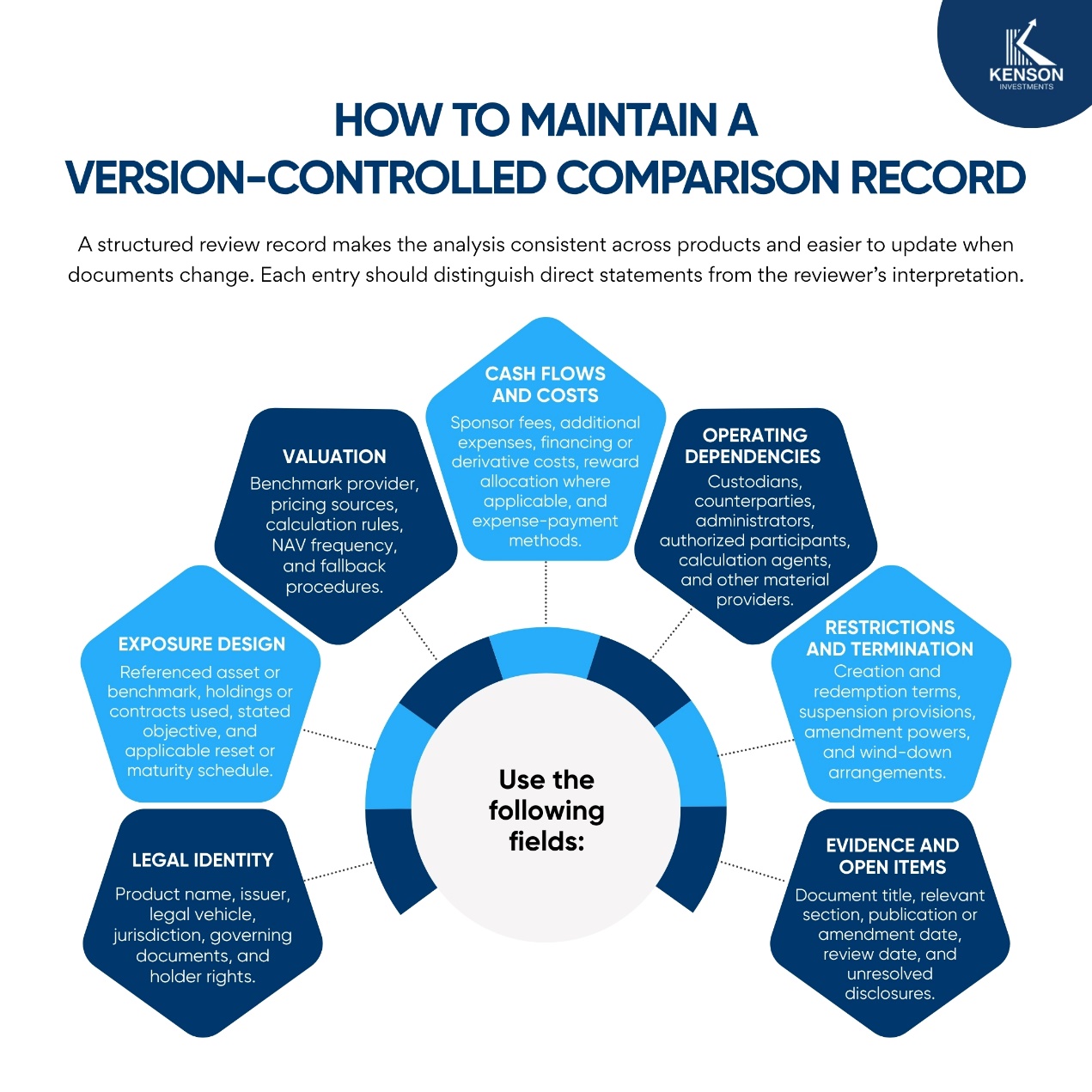
Keep the source document attached to each material finding, using the exact section or page reference wherever possible. Record the date on which the document was checked and identify superseded versions.
A prospectus amendment, revised fee schedule, benchmark change, or provider replacement can alter the product’s structure. Version control helps prevent a comparison from relying on terms that no longer apply.
Where the documents do not establish a material fact, mark it as unconfirmed. Do not fill gaps with assumptions based on the product’s name, a marketing summary, or the structure of a similar security.
Apply the Framework to Structural Comparisons
A useful comparison explains how each ETP is legally organized, how it creates exposure, how value is calculated, and which financial and operational arrangements sustain it. It also identifies the documented limits of those arrangements.
Direct holdings, futures, swaps, staking, daily resets, and defined outcomes should be treated as distinct structural features rather than interchangeable labels. Some products may combine multiple features, so the complete design should be recorded without forcing it into a single category.
The same discipline applies across jurisdictions. Legal terminology, investor rights, and regulatory treatment can differ, making the applicable governing documents more reliable than assumptions based on familiar labels.
Register with us to explore more insights with Kenson Investments. Our digital asset management consultants work on educational resources that can help examine the structures and infrastructure shaping digital asset markets.
Build a comparison record for the ETPs under review, verify each entry against current issuer documents, and flag unresolved issues involving legal rights, exposure, valuation, costs, or operating dependencies before drawing conclusions.
Disclaimer: The information provided on this page is for educational and informational purposes only and should not be construed as financial advice. Crypto currency assets involve inherent risks, and past performance is not indicative of future results. Always conduct thorough research and consult with a qualified financial advisor before making investment decisions.
“The cryptocurrency and digital asset space is an emerging asset class that has not yet been regulated by the SEC and the US Federal Government. None of the information provided by Kenson LLC should be considered as financial investment advice. Please consult your Registered Financial Advisor for guidance. Kenson LLC does not offer any products regulated by the SEC, including equities, registered securities, ETFs, stocks, bonds, or equivalents.”



