










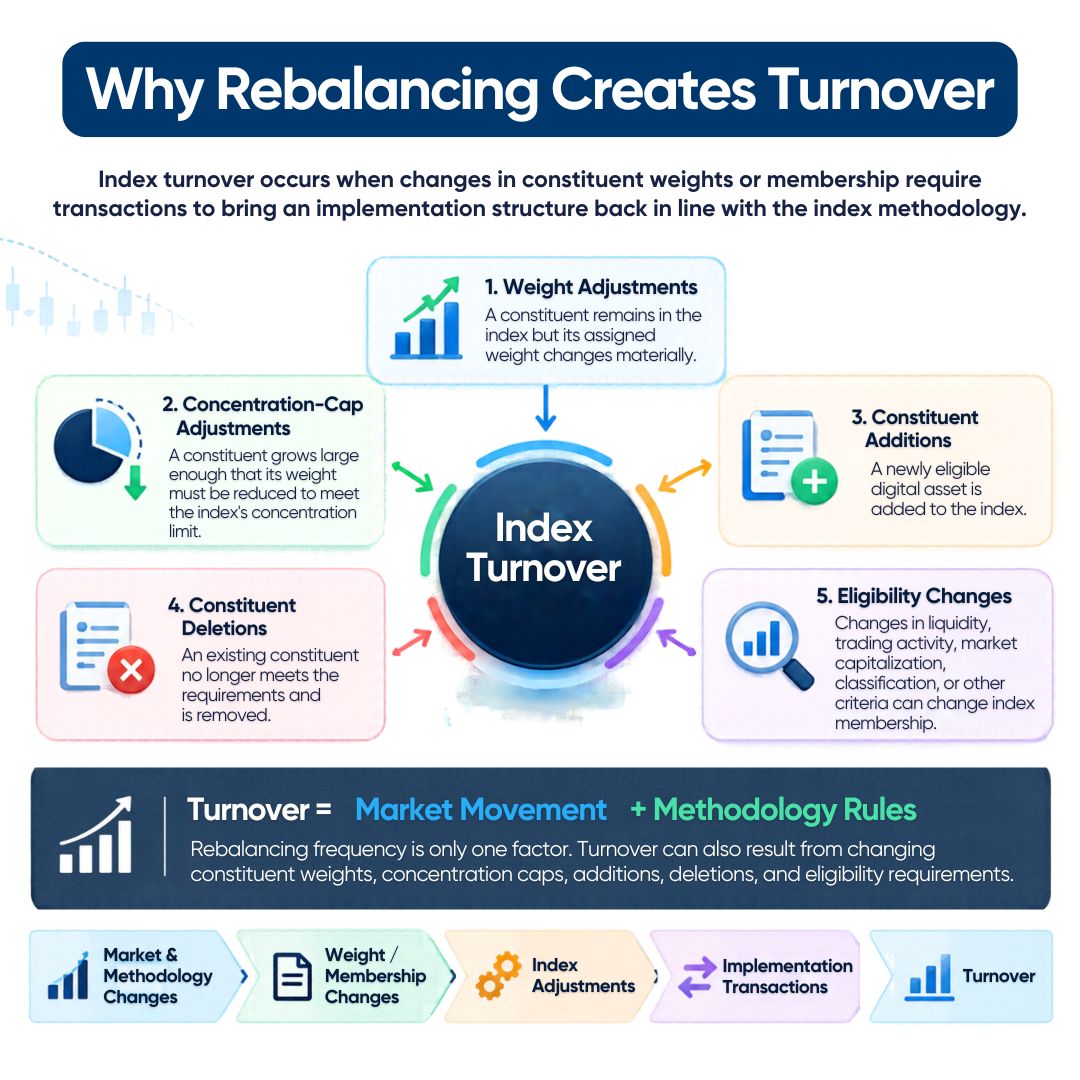
Crypto index construction involves more than selecting a group of digital assets and assigning weights. The methodology used to cap constituents, reset weights, retain or remove assets, and manage turnover can materially affect how an index behaves between and during scheduled rebalancing events.
Crypto index rebalancing is therefore a central part of index methodology. It determines how a benchmark responds when constituent prices diverge, market capitalization changes, liquidity shifts, or an asset reaches a defined concentration limit.
A multi-asset crypto index may begin with market-capitalization weighting, equal weighting, or another rules-based framework. Once concentration caps and scheduled rebalancing are introduced, the resulting exposure can differ substantially from an uncapped market representation.
How Concentration Caps Change Index Weights
Market-capitalization weighting naturally gives larger digital assets greater representation. If one constituent appreciates faster than the rest of an index, its weight can increase significantly before the next scheduled review.
A concentration cap places a predefined limit on that weight.
For example, an index methodology may specify that a constituent cannot exceed a particular percentage of the index at rebalancing. If its uncapped weight is above that threshold, the excess must be redistributed according to the methodology.
The redistribution rule matters. Excess weight could be allocated proportionally among other eligible constituents or handled through another predefined calculation.
Current crypto index methodologies illustrate this distinction. The CoinDesk 20, for example, uses market-capitalization weighting with additional caps for larger constituents and quarterly rebalancing.
A capped index therefore does not simply represent market capitalization. It represents market capitalization subject to explicit weighting constraints.
Constituent Drift Between Rebalances
Constituent weights can change after a rebalance because digital asset prices move continuously.
Suppose an asset receives a 15% weight at the effective date. If its price subsequently rises faster than the other constituents, its share of the index can increase. Another constituent may experience the opposite effect after underperforming relative to the rest of the basket.
This is constituent drift.
The resulting weight may differ from the target weight established at the previous review. Unless the methodology includes an intra-period adjustment mechanism, the index generally continues to reflect those market-driven changes until the next scheduled event.
This creates an important distinction between:
- Post-rebalance weight: The weight established by the methodology.
- Drifted weight: The weight produced by subsequent market movements.
The cap controls the methodology’s treatment of concentration at the relevant review point. It does not necessarily prevent temporary weight changes between reviews.
Scheduled Rebalancing Creates a Reset Point
A scheduled rebalance provides the mechanism for resetting index weights according to the methodology.
Depending on the index, the process can include:
- Recalculating constituent weights
- Applying concentration caps
- Adding eligible constituents
- Removing constituents
- Reassessing liquidity requirements
- Applying selection buffers
- Establishing new reference weights
The dates used in this process also matter. A methodology can specify separate reference dates for constituent eligibility, weighting, and implementation.
Market prices can move between those dates.
Current CoinDesk methodology documentation explicitly accounts for selection and weighting through defined reference dates and uses buffers in some methodologies to reduce unnecessary turnover.
As a result, the announced methodology weight and the weight observed at implementation do not necessarily represent the same point in market time.
Selection Buffers Can Moderate Turnover
Index methodologies may use buffers to prevent relatively small ranking changes from repeatedly triggering constituent additions and deletions.
A buffer can allow an existing constituent to remain eligible even when a new entrant has moved ahead of it under the normal ranking rules.
The purpose is to reduce unnecessary changes caused by marginal differences in market position.
The Multi Digital Asset Indices methodology, for example, describes selection buffers specifically as a mechanism to mitigate excessive index turnover.
Buffers create another methodological tradeoff. They can reduce unnecessary constituent changes, but they may also delay the replacement of an existing asset when rankings shift.
That makes the buffer specification relevant when comparing index methodologies.
Rebalancing Frequency Changes the Drift-Turnover Relationship
Rebalancing frequency affects how long constituent weights can move away from their reference levels.
With more frequent reviews, the methodology can reset weights more often. This can shorten the period during which significant constituent drift persists.
However, more frequent reviews also create more scheduled opportunities for weight adjustments and constituent changes.
With less frequent reviews, the index may experience longer periods of drift before weights are reset.
The relationship can therefore be summarized as:
More frequent rebalancing can reduce the duration of drift while increasing the number of scheduled adjustment points. Less frequent rebalancing can reduce scheduled intervention while allowing market-driven weight changes to persist longer.
The actual turnover depends on the magnitude of market movements, the weighting methodology, constituent eligibility rules, and the treatment of caps.
Liquidity Affects Implementation
A mathematically defined rebalance does not guarantee identical execution conditions across constituents.
Digital assets differ in trading volume, market depth, exchange coverage, and bid-ask spreads. These differences can affect the practical implementation of index weight changes.
An index may therefore specify liquidity requirements as part of constituent eligibility.
The CoinDesk 20 methodology, for example, incorporates trading and liquidity criteria into constituent selection and uses trading-volume measures when ranking eligible assets.
This matters when a rebalance requires simultaneous adjustments across several constituents.
The theoretical index weight is determined by the methodology. The practical implementation occurs in an underlying market with its own liquidity conditions.
Concentration Caps Can Redistribute Weight
When a large constituent is capped, the excess weight has to be handled according to the index methodology.
If it is redistributed across other eligible constituents, those assets receive greater representation than they would under an uncapped market-capitalization approach.
The effect becomes more pronounced when multiple large constituents approach their respective limits.
At that point, the index’s final composition reflects the interaction between market capitalization and the cap structure.
The redistribution rule therefore deserves attention alongside the cap itself.
A 20% cap with proportional redistribution can produce a different weighting outcome from a 20% cap using equal redistribution or another predefined method.
Turnover Has an Implementation Dimension
Turnover is often presented as a numerical measure of how much an index changes. For digital assets, the implementation effects can extend beyond that calculation.
A scheduled rebalance can require multiple transactions within a limited implementation window. If market conditions are volatile or liquidity differs substantially between constituents, the practical process can become more complex.
Relevant implementation variables include:
- Reference-price timing
- Effective-date timing
- Order execution
- Market depth
- Bid-ask spreads
- Trading volume
- Constituent liquidity
- Rebalance sequencing
This creates a distinction between index methodology and index implementation.
The methodology determines the required benchmark composition. Implementation involves translating those requirements into transactions under prevailing market conditions.

What to Review in a Crypto Index Methodology
Concentration caps, rebalancing, and turnover should be evaluated as connected components.
Important methodology variables include:
Constituent selection: Which digital assets can enter the index?
Weighting method: How are eligible constituents initially weighted?
Concentration cap: What is the maximum permitted constituent weight?
Redistribution rule: How is excess weight handled after a cap is applied?
Review frequency: How often are weights and constituents reassessed?
Reference date: Which market data determines the rebalance?
Effective date: When do the new weights become operative?
Selection buffers: How does the methodology limit unnecessary constituent turnover?
Liquidity requirements: What trading conditions must constituents satisfy?
Exceptional-event rules: How are unusual market or constituent events handled?
Two indices can therefore contain similar digital assets while producing different exposure paths because their methodologies apply different caps, buffers, review schedules, and weighting rules.
Methodology Determines the Exposure Path
Crypto index rebalancing turns methodology rules into changing index composition. Concentration caps limit oversized constituents, market movements create drift between reviews, and scheduled rebalancing resets weights. Selection buffers can reduce unnecessary changes, while liquidity requirements influence eligibility and implementation.
As a result, an index reflects both market behavior and methodology design. Evaluating an index requires looking beyond its constituent list to its weighting rules, concentration limits, rebalance frequency, selection criteria, and implementation conditions.
As a dedicated investment analysis and portfolio management company, Kenson Investments provides educational market analysis covering digital asset market structure, blockchain infrastructure, tokenization, custody, and evolving digital asset developments.
Register now for additional insights.
Disclaimer: The information provided on this page is for educational and informational purposes only and should not be construed as financial advice. Crypto currency assets involve inherent risks, and past performance is not indicative of future results. Always conduct thorough research and consult with a qualified financial advisor before making investment decisions.
“The cryptocurrency and digital asset space is an emerging asset class that has not yet been regulated by the SEC and the US Federal Government. None of the information provided by Kenson LLC should be considered as financial investment advice. Please consult your Registered Financial Advisor for guidance. Kenson LLC does not offer any products regulated by the SEC, including equities, registered securities, ETFs, stocks, bonds, or equivalents.”



