









Digital asset adoption is developing across several layers of the financial system. Cryptocurrency ownership remains one measure, but adoption now also includes stablecoin payments, institutional market access, tokenized assets, digital custody, blockchain-based settlement, and infrastructure supporting financial institutions.
This broader definition changes how global adoption should be evaluated. A market can have high retail ownership without having mature institutional infrastructure, while another may show relatively modest consumer adoption but substantial activity in tokenized securities, regulated products, payments, or financial-market infrastructure.
The global market is therefore moving toward a more diverse adoption model. Stablecoins are expanding digital payment and money-movement use cases, institutional participation is becoming more structured, and tokenization is moving from experimentation toward early commercial deployment.
At the same time, regulatory differences, operational dependencies, liquidity considerations, and financial-stability concerns continue to shape the pace of adoption. The IMF identifies stablecoins, digital payments, CBDCs, and tokenization as important forces behind the continued expansion of digital finance in the current era.
What Counts as Digital Asset Adoption?
Digital asset adoption is broader than the number of people holding cryptocurrency. A more useful framework separates adoption into several categories.
Retail adoption includes ownership, trading, payments, remittances, and other consumer uses of digital assets.
Institutional adoption includes regulated investment products, custody arrangements, trading infrastructure, treasury applications, and governance frameworks.
Payment adoption includes stablecoins and other blockchain-based mechanisms used for transfers, settlement, treasury movement, and cross-border payments.
Asset-market adoption includes tokenized securities, funds, deposits, money-market instruments, and other assets represented on programmable digital ledgers.
Infrastructure adoption includes custody technology, compliance systems, blockchain networks, interoperability solutions, settlement infrastructure, and institutional transaction controls.
These categories can develop at different speeds. Measuring only cryptocurrency ownership can therefore miss significant changes occurring inside financial markets and payment infrastructure.
Global Adoption Is Becoming More Diverse
Global digital asset adoption does not follow a single geographic pattern. Different markets are adopting different technologies for different economic and financial reasons.
The 2026 Chainalysis Geography of Cryptocurrency report identifies Brazil, the United States, Singapore, Canada, and Ukraine among the leading countries under its methodology. It also highlights the continued expansion of stablecoin activity across domestic and cross-border use cases.
Regional differences are important because adoption can reflect local financial conditions, regulatory structures, currency characteristics, technology access, and existing payment infrastructure.
In some emerging markets, digital assets can be connected to cross-border transfers, remittances, and access to dollar-denominated instruments. In more developed financial markets, adoption is increasingly visible through regulated investment products, institutional custody, tokenization initiatives, and financial-market infrastructure.
This means adoption rankings should be interpreted alongside the type of activity taking place. High transaction activity, high ownership, institutional participation, and infrastructure development each reveal different aspects of market maturity.
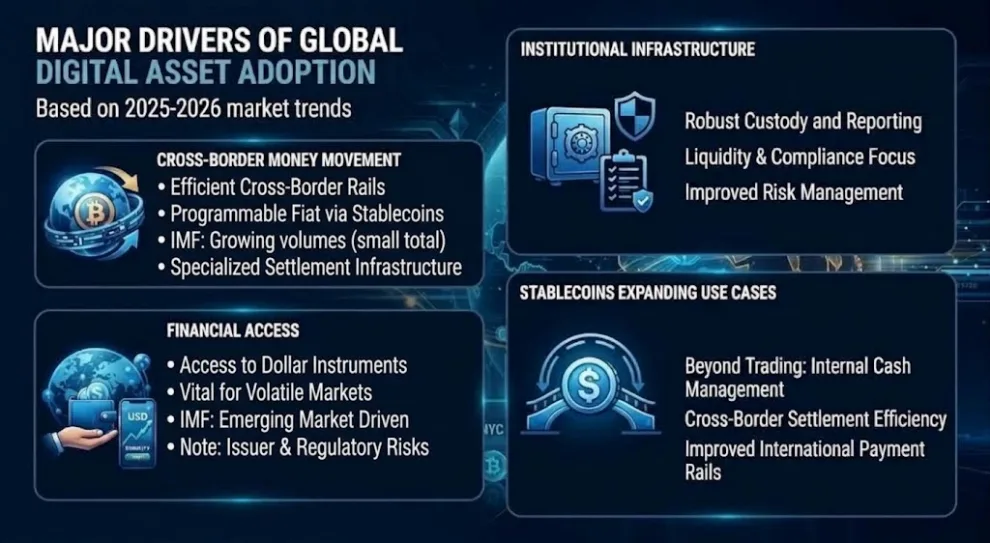
Major Drivers of Global Digital Asset Adoption
Several forces are contributing to broader digital asset adoption.
Cross-Border Money Movement
Cross-border payments remain an important area for digital-asset experimentation. Blockchain-based systems can provide alternative rails for transferring value across jurisdictions, while stablecoins can provide programmable digital representations of fiat-denominated value.
The scale of current activity should still be viewed in context. The IMF reports that stablecoin transaction volumes have expanded significantly, but stablecoin payment flows remain a relatively small portion of the overall global cross-border payments market.
The significance is therefore less about replacing the existing payment system immediately and more about the development of alternative infrastructure that can support specific payment and settlement needs.
Financial Access
Digital assets can provide additional ways to access financial products and dollar-denominated instruments, particularly in markets where traditional financial infrastructure is limited or where local currencies experience significant volatility.
Stablecoins have become particularly relevant in this context. IMF analysis notes that stablecoin adoption in emerging markets can be influenced by foreign-exchange volatility, inflation, institutional conditions, and access to conventional dollar-based financial infrastructure.
Access alone does not eliminate risk. Users can still face issuer, custody, liquidity, regulatory, and technology risks.
Institutional Infrastructure
Institutional adoption increasingly depends on the availability of infrastructure that can support governance, custody, liquidity, compliance, reporting, and transaction controls.
The 2026 Coinbase and EY-Parthenon institutional survey of 351 institutional decision-makers found that 66% reported exposure through spot crypto exchange-traded products, while 81% preferred spot exposure through a registered vehicle. Nearly half of surveyed institutions had also strengthened their focus on risk management, liquidity, and position sizing.
These developments indicate that institutional adoption is becoming increasingly connected to operating structures rather than simply market exposure.
Stablecoins Are Expanding Digital Asset Use Cases
Stablecoins have become one of the most important components of the digital-asset adoption story.
Their role has expanded beyond facilitating cryptocurrency trading. Institutions are exploring stablecoins for cash management, money movement, settlement, and other transaction-related activities.
The 2026 Coinbase and EY-Parthenon survey also found that 85% of surveyed institutions were already using stablecoins or interested in using them for internal cash management and money movement.
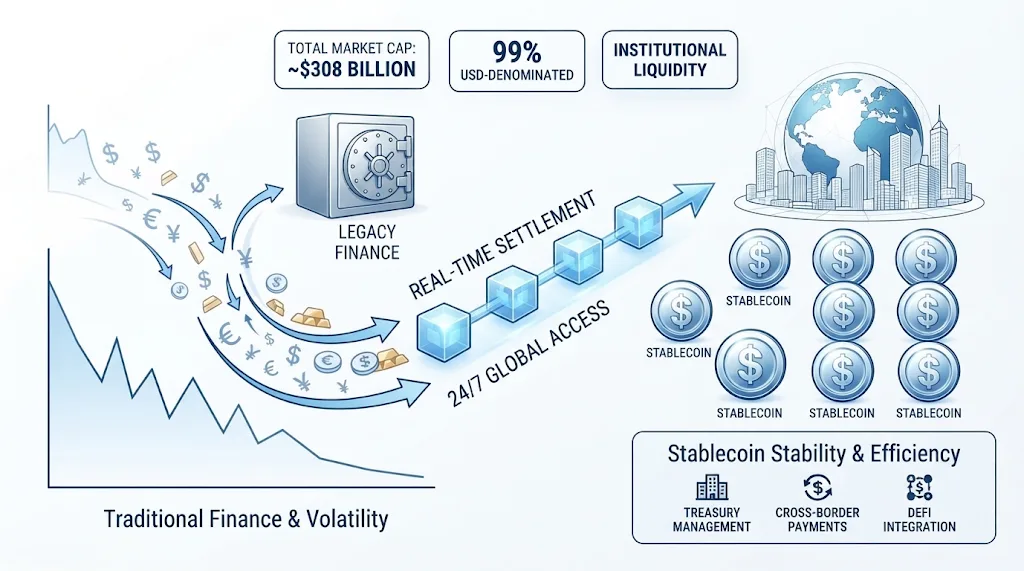
The IMF reported that stablecoin market capitalization had nearly tripled between 2021 and 2025, reaching roughly $300 billion, while noting that growth had been relatively flat over the most recent year. It also reported that nearly 99% of stablecoins are denominated in U.S. dollars.
This concentration creates both utility and policy considerations. Dollar-denominated stablecoins can facilitate digital access to dollar value and cross-border transactions, but widespread adoption can also contribute to currency substitution and create implications for monetary policy in emerging markets.
The BIS has similarly highlighted the potential impact of stablecoins on the international monetary and financial system, particularly for emerging and developing economies.
Institutional Adoption Is Moving Toward Infrastructure
Institutional participation is increasingly supported by a wider digital-asset operating environment.
This includes:
- Regulated market access
- Institutional custody
- Transaction monitoring
- Governance controls
- Liquidity management
- Compliance infrastructure
- Stablecoin operations
- Tokenized asset platforms
- Blockchain settlement
- Reporting and reconciliation
The institutional market is also becoming more selective. The 2026 Coinbase and EY-Parthenon survey found that regulatory clarity was identified as a major catalyst for increased digital-asset allocation, while regulatory uncertainty remained a leading concern.
This distinction is important. Increasing institutional adoption does not necessarily mean institutions are treating every digital asset or blockchain network equally. Participation can depend heavily on custody arrangements, market access, liquidity, regulatory treatment, operational controls, and the infrastructure surrounding a particular use case.
Tokenization Is Creating Another Adoption Layer
Tokenization is extending digital-asset adoption beyond native cryptocurrencies.
Tokenization involves representing assets, liabilities, or financial instruments on programmable digital ledgers. The approach can support new forms of settlement, ownership records, transfer, and automated transaction processes.
The IMF describes tokenization as moving toward commercial deployment while remaining at an early stage. Its 2026 framework separates developments into infrastructure, assets, and services, covering settlement rails, tokenized money, financial assets, wallets, exchanges, and related applications.
Institutional interest is also increasing. In the 2026 Coinbase and EY-Parthenon survey, 64% of surveyed asset managers expressed interest in tokenizing assets, compared with 40% in the previous year’s survey. The survey also found that 63% of investors were interested in allocating to tokenized assets.
Tokenization therefore represents a different form of adoption from cryptocurrency ownership. The relevant indicators include the assets being represented, the institutions participating, the settlement infrastructure being used, and the legal and operational framework supporting those systems.
Regulation Is Becoming Part of the Adoption Infrastructure
Regulation increasingly influences where and how digital assets can develop.
Clearer frameworks can provide institutions with defined requirements for custody, market access, reporting, consumer protection, stablecoin issuance, and other activities. Regulatory uncertainty can have the opposite effect by increasing compliance complexity and limiting institutional participation.
The Financial Stability Board’s global framework for cryptoasset activities and stablecoin arrangements continues to provide a reference point for regulatory implementation. A 2026 review found progress across jurisdictions but also continuing differences in how frameworks are being implemented.
This creates an increasingly fragmented global environment. A digital asset or service can face different requirements depending on the jurisdiction, the type of activity, the institution involved, and whether the activity involves payments, custody, investment products, or other financial functions.
For institutions, regulatory analysis is therefore part of evaluating digital-asset infrastructure rather than a separate consideration added after adoption decisions.
Adoption Does Not Mean Market Maturity
Growing adoption does not eliminate the structural risks associated with digital assets.
Higher usage can increase the importance of:
- Custody and key management
- Operational resilience
- Liquidity
- Counterparty exposure
- Network reliability
- Smart-contract dependencies
- Interoperability
- Governance
- Regulatory compliance
- Transaction monitoring
- Market concentration
Tokenization can also change the speed at which financial transactions and risks move through the system. IMF analysis notes that tokenized structures can reduce clearing and reconciliation delays while also creating new liquidity, governance, legal, and financial-stability considerations.
The BIS has likewise emphasized that digital innovation can improve efficiency while creating new macro-financial challenges. Its 2026 analysis highlights the need to preserve trust in money while considering the role of stablecoins and tokenized financial infrastructure.
Adoption should therefore be evaluated alongside the controls and infrastructure supporting it.
How to Evaluate Whether Digital Asset Adoption Is Deepening
A single adoption statistic cannot capture the development of the digital-asset market. A broader assessment can track several measurable indicators.
Ownership and participation: The number and type of users participating in digital-asset markets can indicate consumer adoption.
Transaction activity: Onchain transaction volumes and payment activity can reveal how frequently networks are being used.
Stablecoin activity: Market capitalization, transfer activity, payment flows, and institutional usage can indicate the expansion of digital money infrastructure.
Institutional participation: Regulated products, institutional custody, trading activity, and financial-institution involvement can show whether digital assets are becoming integrated into established markets.
Tokenization activity: The number and type of assets being represented on digital ledgers can provide a measure of adoption beyond cryptocurrency.
Infrastructure development: Custody, compliance, settlement, interoperability, and transaction-control systems can indicate whether markets are developing the operational capacity required for larger-scale participation.
Regulatory development: Licensing regimes, stablecoin frameworks, market-structure rules, and cross-border cooperation can influence the conditions under which adoption develops.
This framework helps distinguish usage growth from infrastructure maturity. A market can experience rapid transaction growth while still having unresolved custody, governance, regulatory, or interoperability challenges.
What Global Adoption Could Mean for Financial Infrastructure
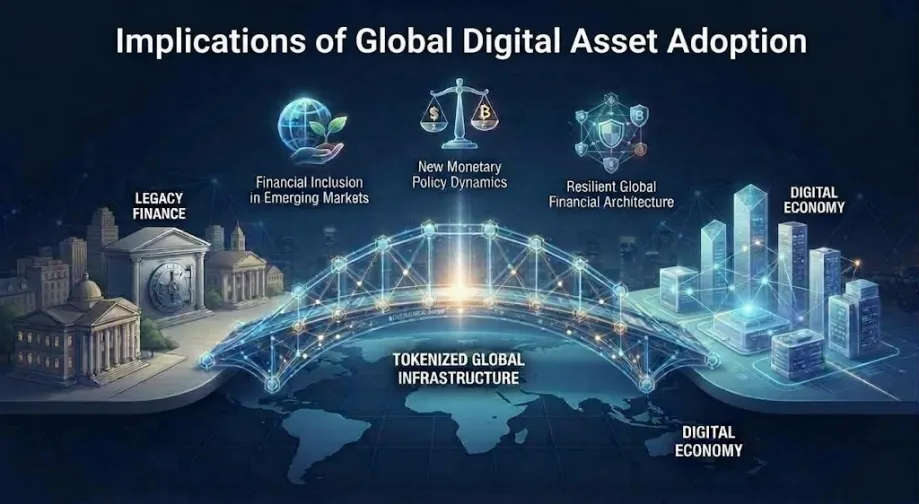
The most significant implication of digital-asset adoption may be the gradual integration of blockchain-based infrastructure into existing financial systems.
Stablecoins can introduce new mechanisms for money movement. Tokenization can change how assets are issued, transferred, and settled. Regulated digital-asset products can create additional market-access channels. Institutional infrastructure can connect these developments with established financial processes.
The IMF’s 2026 research describes tokenization as a potential structural change in financial architecture, particularly as programmable assets, shared ledgers, and new settlement mechanisms develop.
The transition is unlikely to occur uniformly. Different jurisdictions, financial institutions, asset classes, and payment systems can adopt different technologies at different speeds.
For that reason, the next phase of global digital-asset adoption should be assessed through the quality of infrastructure supporting participation as well as the scale of participation itself.
Digital asset management consultants at Kenson Investments provide educational market analysis covering digital assets, blockchain infrastructure, custody, market developments, and the evolving financial systems supporting digital-asset activity.
Join the tribe for additional insights that can help examine the infrastructure, risks, and market developments shaping the next phase of digital finance.
Disclaimer: The information provided on this page is for educational and informational purposes only and should not be construed as financial advice. Crypto currency assets involve inherent risks, and past performance is not indicative of future results. Always conduct thorough research and consult with a qualified financial advisor before making investment decisions.
“The cryptocurrency and digital asset space is an emerging asset class that has not yet been regulated by the SEC and the US Federal Government. None of the information provided by Kenson LLC should be considered as financial investment advice. Please consult your Registered Financial Advisor for guidance. Kenson LLC does not offer any products regulated by the SEC, including equities, registered securities, ETFs, stocks, bonds, or equivalents.”



