






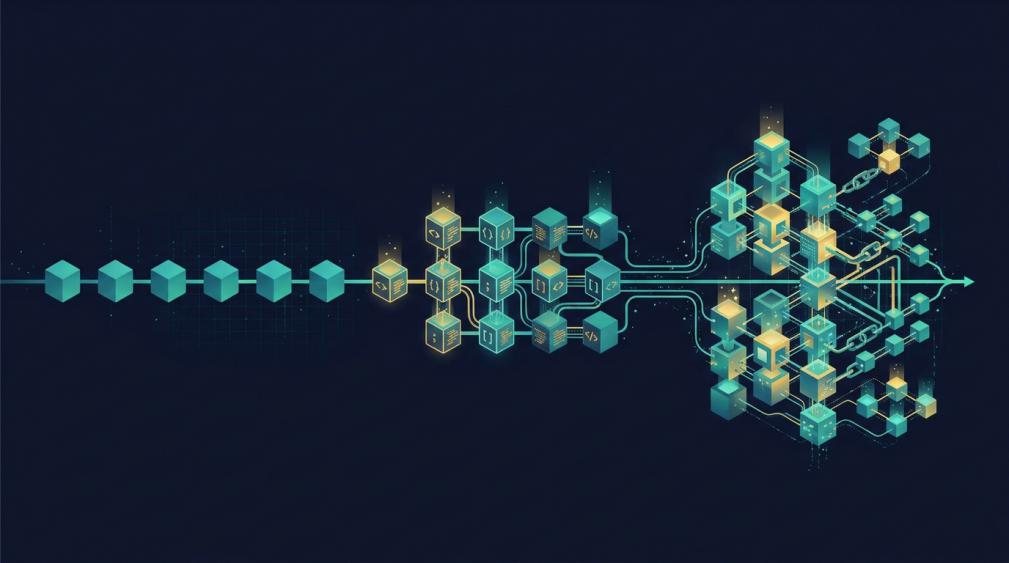
Blockchain has evolved in stages. Bitcoin (2009) introduced a secure, decentralized ledger for payments. Ethereum (2015) added programmable smart contracts. Third-generation networks such as Polkadot and Cardano focused on scalability, interoperability and governance. Today, rollups and modular designs split blockchain functions across layers.
Key takeaways
- Generation 1: Bitcoin, digital scarcity and peer-to-peer payments.
- Generation 2: Ethereum, smart contracts, DeFi and tokens.
- Generation 3: scalability, interoperability and on-chain governance (Polkadot, Cardano, high-throughput chains).
- Now: modular and rollup-centric designs; Ethereum’s Fusaka upgrade (December 2025) expanded data capacity for layer 2s.
Understanding how blockchains evolved helps explain the trade-offs between networks today. This guide walks through each generation, a timeline, and what the changes mean for investors. For evaluating projects, see long-term viability of blockchain projects.
Bitcoin: The Genesis of Blockchain
Bitcoin combined proof-of-work mining, a fixed supply of 21 million coins and a public ledger to create digital money without a central issuer. Its design prioritizes security and decentralization over speed. Later upgrades such as SegWit and Taproot, and layer 2 systems like the Lightning Network, added capacity and features without changing its core rules.
Second Generation: Ethereum and Smart Contracts
Ethereum introduced a general-purpose virtual machine where developers deploy smart contracts. This enabled tokens, DeFi, NFTs and DAOs. In 2022, Ethereum moved from proof of work to proof of stake (“the Merge”), cutting energy use dramatically.
Third Generation: Scalability, Interoperability and Governance
| Network | Focus | Key design choices |
| Polkadot | Interoperability | Shared security across connected chains; nominated proof of stake |
| Cardano | Research-driven design and governance | Ouroboros proof of stake; on-chain governance introduced in 2024 |
| High-throughput layer 1s (e.g. Solana) | Speed and low fees | Single fast chain; high validator hardware requirements |
| Cosmos ecosystem | App-specific chains | Independent chains connected by the IBC protocol |
Today: Rollups and Modular Blockchains
- Rollups: layer 2 networks execute transactions and post data and proofs to a base layer.
- Data availability: Ethereum’s Dencun (2024) and Fusaka (2025) upgrades increased and cheapened data space for rollups.
- Modular design: separating execution, settlement, consensus and data availability.
- Faster finality: Solana’s Alpenglow upgrade (October 2026) targets ~150 ms finality; see Solana vs. Ethereum.
- Tokenization: financial institutions now use public and permissioned chains for tokenized funds and securities.
Timeline
| Year | Milestone |
| 2009 | Bitcoin network launches |
| 2015 | Ethereum launches with smart contracts |
| 2017–2020 | Third-generation networks launch (Cardano, Cosmos, Polkadot, Solana) |
| 2021 | Bitcoin Taproot upgrade; rollups go live on Ethereum |
| 2022 | Ethereum moves to proof of stake |
| 2024 | Ethereum Dencun upgrade; US spot bitcoin ETFs launch |
| 2025 | Ethereum Pectra (May) and Fusaka (December) upgrades |
| 2026 | Solana Alpenglow upgrade; tokenized asset market grows past $38 billion |
Free educational tool
Test your blockchain knowledge
The Readiness Quiz helps you check your understanding of blockchain basics and digital asset risks.
Educational tool. Results are not investment advice.
What This Means for Investors
- Different generations make different trade-offs between security, decentralization and speed.
- Newer is not automatically better; adoption, security record and developer activity matter.
- Upgrades can change a network’s economics and risks, so follow them.
- Interoperability adds connections, but bridges are a frequent attack target.
Work With Kenson Investments
Kenson Investments’ digital asset specialists focus on education around blockchain technology. Explore our blockchain consulting services or contact the team to learn more.
Disclaimer: The information provided on this page is for educational and informational purposes only and should not be construed as financial advice. Digital assets involve significant risk, including the possible loss of principal, and past performance is not indicative of future results. Always conduct thorough research and consult a qualified financial advisor before making investment decisions.
Digital asset regulation in the United States is still developing. Some areas, such as payment stablecoins, now have a federal framework, but comprehensive market-structure legislation has not yet been enacted. None of the information provided by Kenson LLC should be considered financial investment advice. Please consult your Registered Financial Advisor for guidance. Kenson LLC does not offer any products regulated by the SEC, including equities, registered securities, ETFs, stocks, bonds, or equivalents.
References
- Ethereum.org — Smart contracts
- Ethereum.org — Roadmap
- Eco (rwa.xyz data) — Tokenized RWA market size 2026



