






Cloud mining lets investors rent computing power (hashrate) in a remote data center and receive a share of the coins it mines. Real income equals mining revenue minus maintenance fees, pool fees and the contract’s upfront cost. XRP cannot be mined at all; platforms that pay in XRP are converting mining revenue into it.
Key takeaways
- XRP is not mineable. All XRP was created when the XRP Ledger launched; “XRP cloud mining” means payouts converted to XRP.
- Mining revenue is driven by hashprice: about $31.90 per petahash per day in August 2026, near multi-year lows.
- Rising network difficulty and maintenance fees often turn advertised returns into net losses.
- Cloud mining has a long fraud history; the HashFlare operation took in more than $577 million.
Cloud mining is often marketed as passive income without the hassle of owning machines. In practice, the economics are the same as running miners yourself, plus the provider’s margin. This guide separates real mining revenue from platform incentives, explains why XRP is a special case, works through a net-return scenario and lists the risks to check. For yield generated by securing proof-of-stake networks instead, see staking mechanisms and rewards.
Where Cloud Mining Income Comes From
Underlying income comes only from block rewards and transaction fees earned by the hashrate you rent. The provider collects those coins and passes on your share after fees. Any return above that, such as a fixed advertised “daily profit,” is not mining income and should be treated as a warning sign.
| Driver | Effect on income |
| Coin price | Higher price raises the dollar value of mined coins |
| Network difficulty | Rises as more miners join, cutting each terahash’s share of rewards |
| Block subsidy | Halved in April 2024 to 3.125 BTC per block; the next halving is expected around 2028 |
| Transaction fees | Add to revenue; volatile and often short-lived spikes |
| Maintenance fee | Charged per TH/s per day for power and hosting; deducted first |
| Contract cost | Upfront price paid for the hashrate; must be recovered before any profit |
Hashprice combines the first four drivers into one number: expected revenue per unit of hashrate per day. It stood at about $31.90 per PH/day (about $0.032 per TH/day) in August 2026 according to Hashrate Index data cited by ViaBTC, and it is gross revenue, not profit (ViaBTC).
Why XRP Cannot Be Mined
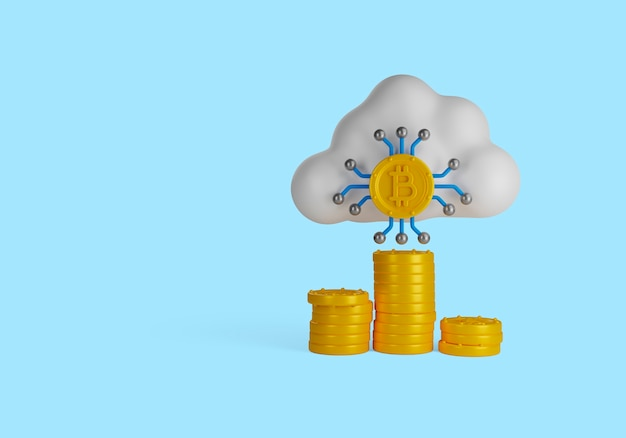
XRP runs on the XRP Ledger, which uses a consensus protocol among validators rather than proof-of-work mining. All 100 billion XRP were created at launch. A cloud mining product “paying in XRP” mines another coin, usually Bitcoin or Litecoin, and converts the proceeds into XRP.
That conversion adds price risk on two assets instead of one, plus exchange fees and spreads. See the XRP Ledger documentation and our XRP overview. Other proof-of-work coins, such as Litecoin and Dogecoin (merge-mined together), can be cloud mined, but each has its own difficulty and price dynamics.
Worked Scenario: Advertised vs. Net Return
Illustrative only. An investor buys a one-year contract for 100 TH/s of Bitcoin hashrate for $1,500, with a maintenance fee of $0.012 per TH/s per day. Starting hashprice is $0.0319 per TH/day; rising difficulty is assumed to cut revenue by 10% on average over the year.
| Line item | BTC flat | BTC +50% | BTC −40% |
| Gross mining revenue | $1,048 | $1,572 | $629 |
| Maintenance fees (100 × $0.012 × 365) | −$438 | −$438 | −$438 |
| Contract cost | −$1,500 | −$1,500 | −$1,500 |
| Net result | −$890 | −$366 | −$1,309 |
Even with a 50% rise in Bitcoin, the contract loses money in this example, because the upfront price exceeds a year of net revenue. In reality, a higher Bitcoin price also tends to attract more miners and raise difficulty, further reducing per-terahash revenue. Many contracts also stop paying automatically if daily revenue falls below the maintenance fee.
Free educational tool
Model price scenarios before committing capital
The Digital Asset Scenario Tool lets you see how bullish, flat and bearish price paths would affect a digital asset position.
Educational tool. Results are not investment advice.
Risks and Red Flags
- Fraud: HashFlare sold more than $577 million of mining contracts from 2015 to 2019 using dashboards that misrepresented mining capacity; its founders pleaded guilty to wire fraud conspiracy (Cointelegraph).
- Guaranteed or fixed daily returns: real mining revenue changes every day with price and difficulty.
- Unverifiable hashrate: no way to see the pool or the machines doing the work.
- Referral-heavy rewards: income driven by recruiting others is a Ponzi warning sign.
- Withdrawal limits and minimums: payouts held back until high thresholds are reached.
- Counterparty risk: the provider can shut down, change terms or go bankrupt.
- Tax: in the US, mined coins are generally income at fair market value when received.
Due-Diligence Checklist
- Which coin is actually mined, and in which pool? Can I verify hashrate independently?
- What are the upfront price, maintenance fee and pool fee per TH/s?
- What happens when daily revenue falls below fees?
- Is payout in the mined coin or converted to another (e.g. XRP), and at what rate?
- Who operates the facility, where is it registered, and is it regulated?
- How does the net return compare with simply buying the coin?
Frequently Asked Questions
Is cloud mining profitable?
It can be in some periods, but upfront contract costs, maintenance fees and rising difficulty mean many contracts lose money compared with buying the coin directly.
Can I mine XRP?
No. XRP is not created through mining. Any XRP payout from mining is a conversion from another coin.
How can I spot a cloud mining scam?
Be wary of fixed daily returns, unverifiable hashrate, pressure to recruit others and difficulty withdrawing funds.
Work With Kenson Investments
Kenson Investments’ digital asset specialists focus on education about how digital asset income is generated and the risks behind it. Explore our altcoin resources or contact the team to learn more.
Disclaimer: The information provided on this page is for educational and informational purposes only and should not be construed as financial advice. Digital assets involve significant risk, including the possible loss of principal, and past performance is not indicative of future results. Always conduct thorough research and consult a qualified financial advisor before making investment decisions.
Digital asset regulation in the United States is still developing. Some areas, such as payment stablecoins, now have a federal framework, but comprehensive market-structure legislation has not yet been enacted. None of the information provided by Kenson LLC should be considered financial investment advice. Please consult your Registered Financial Advisor for guidance. Kenson LLC does not offer any products regulated by the SEC, including equities, registered securities, ETFs, stocks, bonds, or equivalents.
References
- ViaBTC — Bitcoin hashprice explained: what it means for miners in 2026
- Cointelegraph — US appeals sentences of HashFlare co-founders
- XRP Ledger — Official documentation