








Crypto exchange-traded products (ETPs) rely on a primary-market process that connects share issuance and cancellation with the movement of underlying digital assets. At the center of this process is the authorized participant (AP), which submits creation or redemption orders and coordinates the delivery of shares, cryptocurrency, or other required assets.
The operational details matter. A creation order cannot be completed simply because an asset transfer has been initiated, and a redemption is not finished merely because shares have been surrendered. Order acceptance, basket calculations, custody instructions, settlement confirmation, and record reconciliation must align.
The U.S. Securities and Exchange Commission (SEC) approved orders permitting in-kind creations and redemptions for crypto ETPs on July 29, 2025, bringing these products closer to established commodity-based ETP practices. The precise procedures still depend on each product’s governing documents and authorized participant agreements.
How the In-Kind Model Works
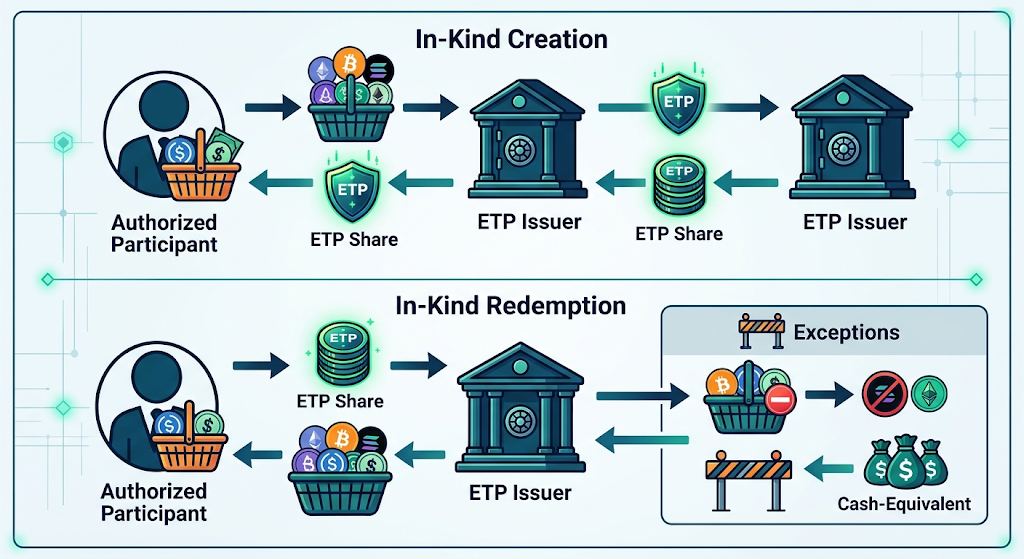
In an in-kind transaction, the AP delivers cryptocurrency to the fund to create shares or receives cryptocurrency from the fund when redeeming shares. The fund does not necessarily need to sell the underlying asset and distribute cash, as it would in a cash-based redemption.
This changes the operational responsibilities. Digital asset transfers must be coordinated with securities processing, and the relevant parties must confirm that the correct quantities reach the correct accounts under the agreed settlement terms.
A typical workflow involves the AP, fund sponsor, transfer agent, crypto custodian, fund administrator, and, where applicable, the Depository Trust Company (DTC). Their responsibilities differ, but the process must produce a consistent record of the order, the assets exchanged, and the shares created or cancelled.
Importantly, the workflow is product-specific. Basket sizes, order cutoffs, settlement deadlines, fees, and permitted delivery arrangements can differ between ETPs.
Step 1: Order Submission and Basket Calculation
The process begins when an AP submits a creation or redemption request through the channel specified by the ETP’s operating procedures.
Orders generally cover a defined number of shares grouped into a basket. The basket’s cryptocurrency component is calculated according to the product’s terms, taking account of the quantity attributable to the shares and applicable adjustments for expenses or liabilities.
For a creation, the AP must arrange delivery of the required crypto assets. For a redemption, the AP must deliver the corresponding shares for cancellation in exchange for the specified digital assets.
Order validation is an essential control at this stage. The transfer agent and sponsor need to confirm that the request is authorized, submitted before the applicable cutoff, and consistent with the required basket size.
An incomplete instruction, incorrect order quantity, or missed deadline can prevent an order from proceeding as expected. Once accepted, the order must be communicated to the parties responsible for preparing and settling the transaction.
Step 2: Coordinating Basket Delivery and Custody
After order acceptance, the operational focus shifts to asset movement.
For an in-kind creation, the AP or its designated agent transfers the required cryptocurrency to the fund’s designated custody account. The custodian verifies receipt and confirms that the transfer satisfies the applicable requirements.
For a redemption, the process runs in reverse. The AP delivers the required shares, and the custodian prepares to release the corresponding cryptocurrency to the authorized destination.
Digital asset transfers introduce specific operational considerations. Blockchain transactions may require network confirmations, and transfers sent to incorrect addresses may be difficult or impossible to reverse. Network congestion, insufficient transaction fees, or a mismatch between the transfer instructions and the approved account details can also delay settlement.
Custody controls must therefore cover more than private-key security. They must establish who can authorize transfers, which wallets are approved, how addresses are verified, and how receipt is confirmed.
The operational record should connect the order reference, asset quantity, sending and receiving accounts, transaction identifier, and custody confirmation.
Step 3: Share Issuance, Cancellation, and Settlement Confirmation
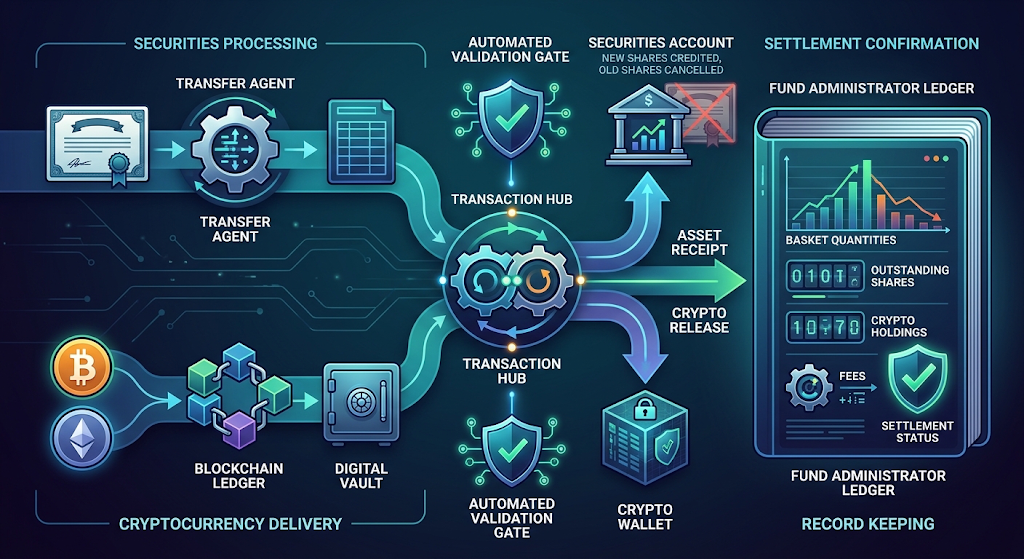
Crypto delivery and securities processing must converge before the transaction can be treated as complete.
Following a successful creation, the transfer agent arranges for the corresponding shares to be credited to the AP’s securities account under the product’s procedures. Following a redemption, the relevant shares are received and cancelled while the corresponding cryptocurrency is released.
The precise sequencing and any conditions for completing these steps depend on the ETP’s documentation. Some procedures require coordinated confirmation that the necessary assets have been received before the transaction is finalized.
This coordination reduces the risk of one side of the exchange being completed without the other.
The fund administrator also needs to maintain consistent records of basket quantities, outstanding shares, crypto holdings, fees, and settlement status. These records support the calculation of net asset value (NAV) and help establish that the fund’s accounting reflects the assets actually held.
Where Exceptions Can Disrupt the Workflow
Not every transaction follows the expected sequence. Common exceptions include:
- Late or incomplete orders: A request misses the cutoff or fails validation.
- Insufficient delivery: The AP transfers less cryptocurrency or fewer shares than required.
- Delayed blockchain confirmation: The transfer remains pending beyond the expected settlement window.
- Incorrect destination details: Assets are sent to an unapproved or mismatched address.
- Custody restrictions: A receiving account cannot accept the asset or requires additional verification.
- Reconciliation differences: The custodian’s records do not match the administrator’s expected balances.
Each exception needs a defined response. That includes identifying the responsible party, determining whether settlement can continue, escalating unresolved discrepancies, and documenting any cancellation, rescheduling, or alternative settlement arrangement permitted by the product’s terms.
A delayed transfer should not automatically be treated as a completed delivery simply because the sending institution has initiated the transaction.
Reconciliation Is the Final Control
Reconciliation connects the records maintained by the AP, custodian, transfer agent, administrator, and sponsor.
The objective is to confirm that the cryptocurrency delivered or received matches the basket calculation, that the corresponding shares were issued or cancelled, and that all associated fees and liabilities have been recorded correctly.
Differences should be investigated rather than automatically adjusted away. A discrepancy may indicate a timing difference, an incomplete transfer, an incorrect instruction, or an accounting error.
A reliable process maintains an audit trail linking the original order to its final settlement status. This gives operations teams a defensible record of what was requested, what moved, which controls were completed, and how any exceptions were resolved.

The Importance of Operational Detail
Kenson Investments examines digital asset markets through the infrastructure, controls, and institutional processes that support them. In crypto ETP operations, in-kind settlement depends on coordination between digital asset custody and conventional securities administration.
The ability to move cryptocurrency directly into or out of an ETP does not eliminate settlement risk. It changes where operational attention is required: basket calculations, transfer authorization, wallet verification, delivery confirmation, share accounting, and exception management.
For institutions assessing digital asset infrastructure, these processes offer a useful view of how blockchain-based assets interact with established financial-market systems.
Register now to follow Kenson Investments’ analysis of digital asset infrastructure, institutional market developments, and the operational frameworks shaping crypto markets.
Disclaimer: The information provided on this page is for educational and informational purposes only and should not be construed as financial advice. Crypto currency assets involve inherent risks, and past performance is not indicative of future results. Always conduct thorough research and consult with a qualified financial advisor before making investment decisions.
“The crypto currency and digital asset space is an emerging asset class that has not yet been regulated by the SEC and the US Federal Government. None of the information provided by Kenson LLC should be considered as financial investment advice. Please consult your Registered Financial Advisor for guidance. Kenson LLC does not offer any products regulated by the SEC, including equities, registered securities, ETFs, stocks, bonds, or equivalents.”



