







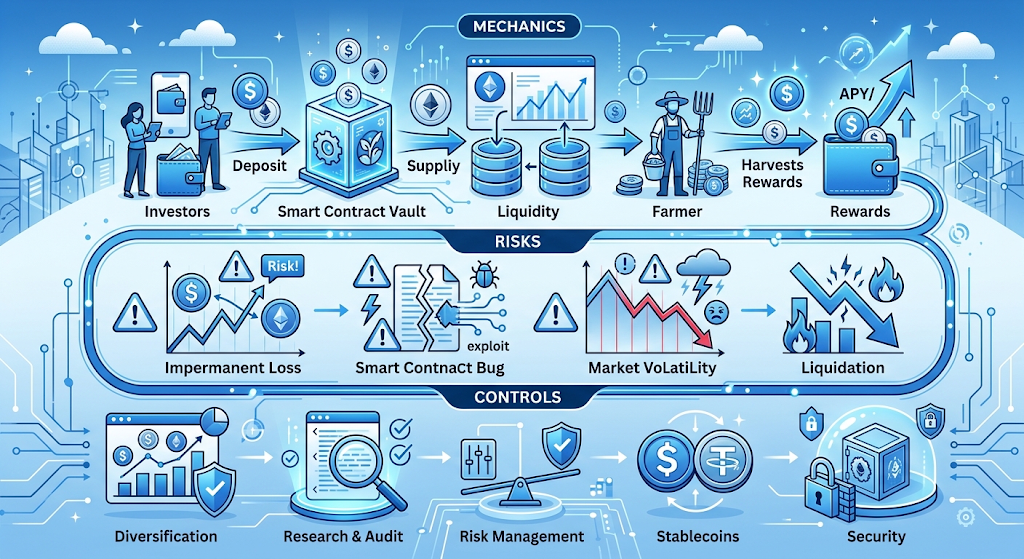
Decentralized finance (DeFi) enables digital asset holders to deploy tokens through lending protocols, liquidity pools, and automated vaults that generate yield through different mechanisms. These arrangements can provide access to on-chain financial activity, but the resulting yield depends on market conditions, protocol design, liquidity, transaction costs, and the security of connected systems.
Evaluating DeFi yield farming strategies requires more than comparing advertised annual percentage yields (APYs). A strategy may generate lending interest or trading fees while exposing deposited assets to price changes, smart-contract vulnerabilities, collateral liquidation, or restrictions on withdrawals. Additional layers of automation can introduce further dependencies.
How DeFi Yield Farming Generates Yield
Yield farming involves deploying digital assets into DeFi protocols to receive interest, transaction fees, token incentives, or other protocol-defined rewards. The source of yield determines the economic exposure and risks associated with the strategy.
Lending and Borrowing Markets
DeFi lending protocols connect suppliers of digital assets with borrowers through smart contracts. Suppliers may receive interest generated by borrowing demand, while borrowers generally provide collateral under protocol-defined requirements.
The yield available to suppliers can change as utilization, borrowing demand, and protocol parameters change. A displayed rate is therefore a variable measure rather than a fixed commitment.
Borrowing introduces another layer of exposure. When collateral loses value or falls below a required threshold, automated liquidation mechanisms may sell collateral to restore the protocol’s required position. Borrowers using recursive leverage, where borrowed assets are repeatedly redeployed as collateral, can accumulate interconnected exposures that become difficult to unwind during volatile markets.
The Bank of Canada’s April 2026 research on DeFi lending examines borrowing behavior, recursive leverage, and liquidation dynamics using transaction-level data from Aave V3. Its findings reinforce the importance of evaluating leverage and liquidation mechanisms alongside headline lending rates. Read the Bank of Canada’s DeFi lending research.
Liquidity Provision
Automated market makers (AMMs) use liquidity pools to facilitate token swaps. Liquidity providers deposit assets into a pool and may receive a share of trading fees and, in some cases, additional token incentives.
The resulting position remains exposed to changes in the relative prices of the deposited assets. Impermanent loss describes the difference between the value of a liquidity provider’s position and the value of holding the same assets outside the pool, under a specified comparison.
Trading fees and incentives can offset some of this difference, but they do not eliminate it. Pool composition, trading volume, price movements, withdrawal conditions, and transaction costs all influence the outcome.
Recommended Read: Liquidity Pools and Market Making in DeFi.
Protocol Incentives and Reward Reinvestment
Some protocols distribute tokens to attract liquidity, encourage borrowing, or support participation in their ecosystems. These incentives can increase the reported yield, but their economic contribution depends on the value of the reward token, distribution rules, and the duration of the incentive program.
Reinvesting rewards can compound exposure when the underlying strategy continues to generate positive net returns. However, compounding also introduces additional transactions, fees, and exposure to the assets or contracts receiving the reinvested funds.
A strategy that relies heavily on temporary incentives may produce a substantially different result once distributions decline or market demand changes.
Vaults and Multi-Protocol Strategies
Yield aggregators and vaults can automate deposits, allocation, and reward reinvestment across selected strategies. This can reduce manual execution requirements, but it also introduces dependencies on vault contracts, strategy administrators, underlying protocols, and external infrastructure.
A vault’s reported yield does not reveal every risk embedded in its strategy. Due diligence should establish where assets are deployed, how allocations change, what permissions a curator or administrator holds, and whether withdrawals remain possible during market stress.
When a strategy spans multiple protocols or blockchains, each additional dependency creates another possible failure point.
Understanding APY, Reward Tokens, and Realized Yield
Annual percentage yield commonly annualizes a stated rate and may assume that rewards are reinvested. The calculation method, observation period, reward valuation, and compounding assumptions can differ between protocols and data providers.
A useful assessment separates three components:
- Underlying income: Interest, borrowing fees, or trading fees generated by economic activity.
- Incentive income: Tokens distributed under a protocol’s reward program.
- Net outcome: The value remaining after transaction costs, borrowing expenses, protocol fees, asset-price changes, and relevant position losses.
For example, a strategy displaying a high APY may depend primarily on incentives distributed in a volatile token. If the token’s market value declines, the realized value of those rewards may fall even when the number of tokens earned matches the published rate.
Net results can also be affected by changing utilization, compounding assumptions, gas costs, and the difference between quoted and executable transaction prices.
A defensible analysis records the yield source, calculation method, observation period, fees, reward-token exposure, and assumptions used to estimate net results. Historical yield and current APY should not be treated as reliable forecasts of future outcomes.
The Main Risks of Yield Farming
Smart-Contract and Protocol Risk
Yield-farming positions depend on code that governs deposits, withdrawals, token transfers, collateral, and reward calculations. Vulnerabilities can permit unauthorized transactions, disrupt accounting, or prevent normal access to deposited assets.
An audit provides evidence that code has undergone a defined review. It does not establish that every vulnerability has been found or that subsequent contract changes are safe.
Due diligence should examine audit scope and date, unresolved findings, known incidents, upgrade permissions, administrative keys, emergency pause mechanisms, and dependencies on other contracts.
Impermanent Loss and Asset-Price Risk
Liquidity providers can experience relative underperformance when the prices of pooled assets diverge. Separately, a decline in the market value of either asset can reduce the position’s value in absolute terms.
These effects should not be confused. Impermanent loss compares a liquidity position with holding the deposited assets; market-price loss concerns changes in the value of the assets themselves.
Fee income, token incentives, and withdrawal costs affect the overall result, but none guarantees that a liquidity position will outperform holding the underlying assets.
Liquidity and Withdrawal Risk
A position may be difficult to exit when pool liquidity declines, borrowing markets become stressed, withdrawal queues develop, or blockchain congestion raises transaction costs.
Smart-contract functionality does not guarantee that an exit can be completed at a particular price or time. A protocol may technically permit withdrawals while available liquidity remains insufficient for a large position without substantial price impact.
Evaluate withdrawal limits, redemption mechanisms, exit liquidity, and the potential effect of multiple participants attempting to withdraw simultaneously.

Leverage and Liquidation Risk
Leveraged strategies combine market exposure with borrowing obligations and collateral requirements. A sharp price decline can reduce collateral value, trigger liquidation, and create additional losses through liquidation penalties or unfavorable execution.
Recursive borrowing can increase exposure across several linked positions. A disruption affecting one asset or lending market may therefore affect other positions that depend on the same collateral or liquidity source.
Monitoring should account for collateral thresholds, debt balances, asset volatility, borrowing costs, and the time required to respond to deteriorating conditions.
Stablecoin, Oracle, and Cross-Chain Risk
Stablecoins can deviate from their intended value, while oracle failures can provide inaccurate or delayed data to protocols that depend on external prices. Either event can affect collateral valuation, liquidation, and pool composition.
Cross-chain strategies introduce additional dependencies on bridges, messaging systems, wrapped or representative assets, and destination-chain contracts. A failure in one component can interrupt transfers or affect the value and usability of assets elsewhere in the strategy.
The Bank for International Settlements identifies leverage, liquidity mismatches, interconnectedness, and governance concentration as important DeFi vulnerabilities. These risks should be assessed across the full strategy rather than only at the primary protocol level.
Free educational tool
Test a hypothetical allocation against history
Choose assets and weights, set contributions and costs, and review historical outcomes, volatility and drawdowns. Historical data, not a forecast.
Educational tool. Results are not investment advice.
A Threat Model for DeFi Yield Farming
A threat model identifies who or what may be affected, the control that could fail, and the resulting exposure. The appropriate controls differ according to the participant’s custody arrangement and operational responsibilities.
Individual self-custody: The main exposures include private keys, seed phrases, wallet credentials, and token approvals. Controls include protected backups, careful verification of transaction details, restricted token permissions, and periodic review of connected applications.
Institutional operations: Treasury assets may be exposed through compromised staff credentials, excessive signing authority, weak transaction approvals, or inadequate separation of duties. Controls should include role-based access, independent transaction approval, authorization thresholds, documented change management, and monitoring of privileged activity.
Third-party custody and services: A custodian, wallet provider, RPC service, vault curator, or automation platform may become unavailable or compromised. Due diligence should establish who controls the keys, which party can authorize transactions, what service dependencies exist, and how incidents are communicated and escalated.
Protocol and market dependencies: Smart contracts, stablecoins, oracles, bridges, collateral assets, and liquidity pools can affect the same position. A dependency inventory helps identify exposures that may otherwise appear unrelated.
The Financial Action Task Force’s July 2026 report on DeFi emphasizes that arrangements described as decentralized can still involve meaningful control or influence through governance concentration, administrative privileges, upgrades, and infrastructure. Evaluating actual control arrangements is therefore more useful than relying on a decentralization label alone.
Building an Operational Control Architecture
Yield-farming controls should cover the full lifecycle, from wallet access and transaction authorization to monitoring, incident response, and post-incident reconciliation.
Identity and Authorization
Protect wallet credentials and signing authority with controls appropriate to the value and complexity of the position. Institutional arrangements should define who can initiate, approve, and execute transactions, with independent review for material actions.
Where available, use transaction limits, allowlisted destinations, and documented approval thresholds. Review privileged accounts and administrative permissions whenever the strategy or service arrangement changes.
Transaction and Permission Controls
Before depositing assets or granting token approvals, verify the destination contract, network, token, transaction parameters, and requested permissions. Avoid granting unlimited or unnecessary approvals when narrower permissions are supported.
Record material transactions and review outstanding approvals periodically. If a wallet or approval is suspected to be compromised, use a verified response process rather than relying on an unfamiliar interface or unverified emergency instructions.
Protocol and Position Monitoring
Monitor collateral ratios, liquidation thresholds, pool liquidity, reward changes, contract upgrades, and material protocol announcements. Alerts should identify conditions that require investigation or action rather than merely reporting market movements.
Institutional processes should define alert ownership, escalation thresholds, response time expectations, and the authority required to reduce or exit a position.
Dependency and Change Management
Maintain an inventory of the contracts, services, assets, and external data sources supporting each strategy. Assess whether multiple positions depend on the same stablecoin, bridge, oracle, or underlying lending market.
Review material contract upgrades, changes to protocol parameters, and alterations to vault allocation rules. A previously assessed strategy may present a different risk profile after these changes.
Free educational tool
Are you ready for digital assets?
Seven quick questions on knowledge, mindset and goals, with one honest answer about where you stand.
Educational tool. Results are not investment advice.
Failure Scenarios and Incident Response
A practical response plan should distinguish between stopping further exposure, restoring technical access, and recovering economic value. These outcomes are not interchangeable.
Compromised wallet or malicious approval: Detect unexpected transactions or permissions, establish which assets and accounts may be affected, and use verified procedures to revoke permissions or transfer unaffected assets when safe and feasible. Preserve transaction hashes and relevant evidence.
Smart-contract exploit: Identify affected contracts and positions, monitor official protocol communications, and follow verified emergency procedures. Protocol-level pause controls may limit additional activity, but users cannot assume that exploited assets will be recovered.
Rapid collateral decline: Review collateral thresholds and outstanding debt, assess liquidation proximity, and execute authorized risk-reduction measures if available. Congestion, limited liquidity, or rapid price movements may prevent timely action.
Stablecoin depeg or liquidity disruption: Determine which assets and pools are affected, examine available withdrawal routes, and reassess related collateral positions. Avoid assuming that a token can be redeemed at its intended value under stressed conditions.
Third-party service outage: Establish whether the issue affects access, transaction signing, monitoring, or the underlying protocol. Use a pre-verified alternative service where available and authorized, while checking for duplicate transactions or inconsistent position records.
A structured incident sequence is:
- Detect and classify the event.
- Contain further unauthorized activity or exposure where possible.
- Preserve transaction records, timestamps, contract addresses, alerts, and communications.
- Assess affected wallets, positions, protocols, and dependencies.
- Execute the approved response and escalation procedures.
- Verify balances, outstanding permissions, liabilities, and transaction outcomes.
- Document findings, test corrective controls, and update the risk assessment.
NIST SP 800-61 Rev. 3 provides a framework for integrating incident response into cybersecurity risk management. Comprehensive custody and business-continuity planning should be addressed separately from the yield-farming controls described here.

Due-Diligence Checklist for Yield Farming
Before assessing a protocol or strategy, establish whether its mechanics, dependencies, and controls are sufficiently transparent to evaluate.
- Yield source: Identify the economic activity generating interest, fees, or incentives.
- Reward assumptions: Verify how APY is calculated, how reward tokens are valued, and whether incentives are temporary.
- Contract security: Review audits, known incidents, upgrade authority, administrative privileges, and unresolved findings.
- Wallet permissions: Confirm that signing authority and token approvals are limited to intended activity.
- Custody arrangements: Establish who controls keys, who authorizes transactions, and how third-party failures are handled.
- Liquidity and exits: Assess withdrawal conditions, pool depth, redemption limits, and transaction costs.
- Leverage and collateral: Review liquidation thresholds, borrowing costs, collateral volatility, and connected positions.
- Dependencies: Identify reliance on oracles, stablecoins, bridges, external services, and other protocols.
- Monitoring: Confirm that alerts cover unusual transactions, collateral deterioration, contract changes, and liquidity disruption.
- Incident readiness: Establish escalation responsibilities, evidence-preservation procedures, and recovery limitations.
- Governance and legal context: Assess material control rights and the regulatory considerations applicable to the arrangement and jurisdiction.
Passing these checks does not make a strategy safe. The checklist creates a consistent basis for identifying exposures, comparing control arrangements, and documenting unresolved risks.
Free educational tool
How healthy is your hypothetical portfolio?
Seven questions about how a hypothetical portfolio is structured, with three sub-scores and an overall Health Score out of 100.
Educational tool. Results are not investment advice.
Yield Farming Requires More Than Comparing Advertised Rates
DeFi yield farming combines financial mechanisms with software, wallet permissions, market liquidity, and connected protocol dependencies. A strategy’s reported yield captures only part of this structure.
A more complete assessment examines the origin of rewards, the assumptions behind quoted rates, the potential for liquidation or withdrawal constraints, and the controls available when a dependency fails. It also distinguishes individual self-custody from institutional authorization requirements and third-party service exposure.
Kenson Investments provides educational market analysis covering digital asset market structure, blockchain infrastructure, custody, tokenization, and evolving digital asset developments.
Sign up now to access related research on liquidity pools, operational controls, and the infrastructure supporting decentralized markets.
Disclaimer: The information provided on this page is for educational and informational purposes only and should not be construed as financial advice. Crypto currency assets involve inherent risks, and past performance is not indicative of future results. Always conduct thorough research and consult with a qualified financial advisor before making investment decisions.
“The cryptocurrency and digital asset space is an emerging asset class that has not yet been regulated by the SEC and the US Federal Government. None of the information provided by Kenson LLC should be considered as financial investment advice. Please consult your Registered Financial Advisor for guidance. Kenson LLC does not offer any products regulated by the SEC, including equities, registered securities, ETFs, stocks, bonds, or equivalents.”