










An altcoin is any cryptocurrency other than Bitcoin. The term covers very different assets, from smart contract platforms like Ethereum to payment networks, stablecoins, governance tokens and memecoins. Altcoins differ from Bitcoin in purpose, consensus design, supply rules, governance and, usually, risk.
Key takeaways
“Altcoin” is a catch-all; meaningful analysis starts by identifying which category an asset belongs to.
Altcoins are typically more volatile and less liquid than Bitcoin, and most move with Bitcoin in sharp sell-offs.
Since September 2025, US exchanges can list qualifying spot crypto ETPs under generic standards, widening regulated access to some large altcoins.
Supply schedules, token unlocks, concentration and regulatory classification are central to diligence.
For investors, the line between Bitcoin and everything else matters because the risk profile changes sharply once you leave Bitcoin. Altcoins can offer exposure to specific technologies and use cases, but most have shorter histories, more concentrated ownership and higher odds of permanent loss. This guide explains the categories, how they differ, current market structure and a diligence framework. For the case investors make for Bitcoin itself, see Why Choose Bitcoin.
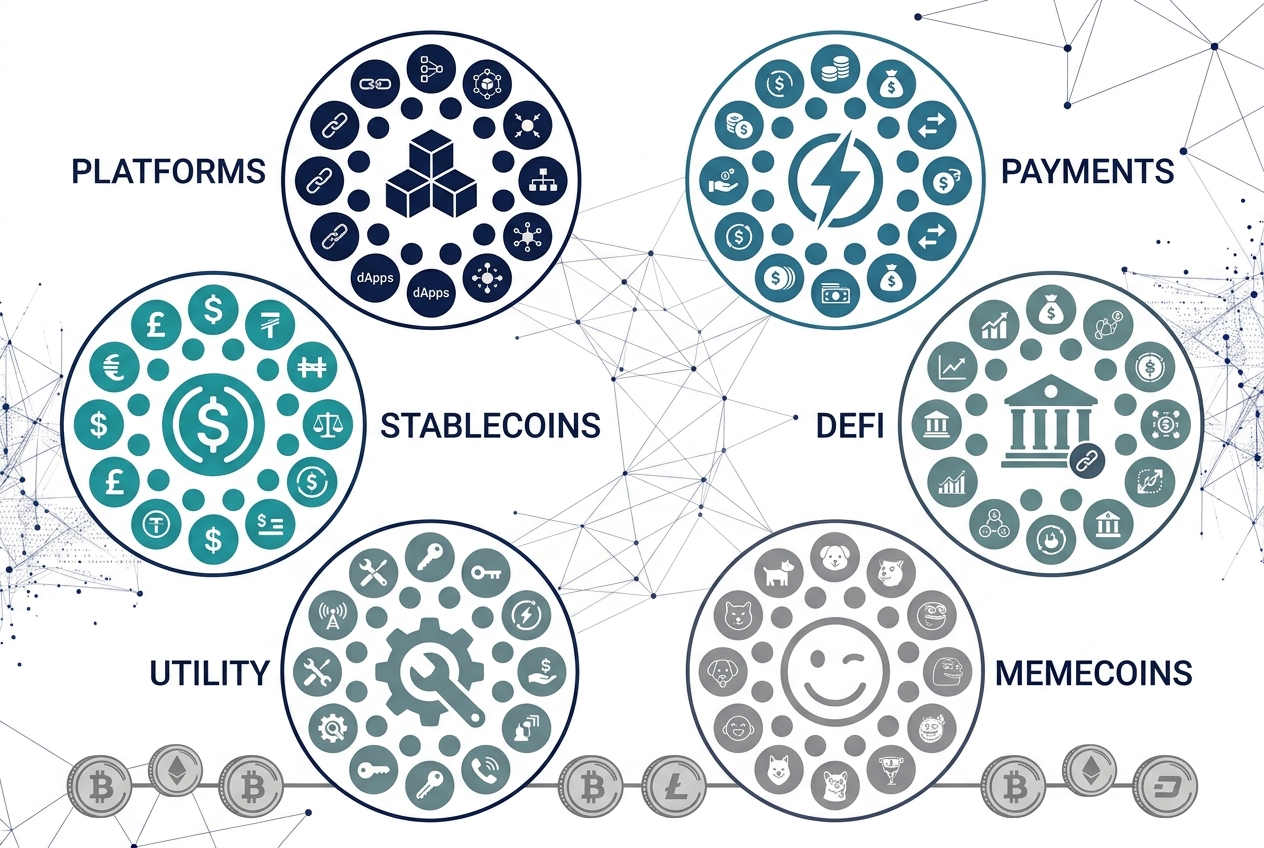
Main Categories of Altcoins
| Category | Purpose | Examples of the type | Primary risks |
| Smart contract platforms (layer 1) | Run applications and settle transactions | Ethereum, Solana, Cardano | Competition, technical failures, validator concentration |
| Scaling networks (layer 2) | Process transactions cheaply on top of a layer 1 | Rollup network tokens | Value accrual to token is often weak; sequencer centralisation |
| Payment and settlement tokens | Fast, low-cost transfers | XRP, Litecoin, Stellar | Adoption vs. stablecoins; regulatory history |
| Stablecoins | Hold a stable value | USDC, USDT | Issuer and reserve risk (different from price risk) |
| DeFi and governance tokens | Govern or capture fees from protocols | DEX and lending protocol tokens | Smart contract risk; fee rights; governance capture |
| Utility / infrastructure tokens | Pay for compute, storage, data | Decentralized storage and oracle tokens | Weak demand link to token price |
| Memecoins | Community or cultural interest | Dog-themed and trend tokens | Extreme volatility; no fundamental anchor |
Our guides to utility tokens and stablecoins cover two of these categories in depth.
How Altcoins Differ From Bitcoin
Bitcoin is a proof-of-work network with a fixed 21 million supply cap, conservative governance and a single dominant purpose as digital money. Altcoins often use proof of stake, have flexible or inflationary supply, change faster through upgrades, and aim to support applications, payments or specific services.
| Dimension | Bitcoin | Typical altcoin |
| Consensus | Proof of work | Often proof of stake or variants |
| Supply | Capped at 21 million; issuance halves about every four years | Varies: capped, inflationary, or adjustable by governance |
| Governance | Slow, conservative upgrade culture | Faster upgrades; foundations or token votes |
| Launch and distribution | Mined from 2009 with no pre-sale | Often pre-mined or allocated to teams, investors and treasuries |
| Liquidity and access | Deepest market; spot ETFs since 2024 | Ranges from deep (large caps) to very thin |
| Regulatory view (US) | Widely treated as a commodity | Depends on design and how it was sold; 2026 guidance clarified many categories |
Consensus differences matter for investors because they shape security and reward structures; see proof of stake vs. proof of work.
Market Structure: How Altcoins Trade Today
Bitcoin dominance: Bitcoin has historically represented roughly half or more of total crypto market value, and altcoins’ combined share tends to shrink in risk-off periods.
Correlation: most altcoins move with Bitcoin, often more sharply. In the October 2025 crash, non-BTC and non-ETH assets fell further and faster than Bitcoin as liquidity vanished (WisdomTree).
Regulated access: in September 2025 the SEC approved generic listing standards that let US exchanges list qualifying spot crypto ETPs without individual approval, alongside approval of a multi-asset fund holding BTC, ETH, XRP, SOL and ADA (Yahoo Finance).
Classification: a March 2026 SEC–CFTC joint interpretation set out categories such as digital commodities, collectibles and tools, clarifying that many tokens are not securities in themselves (Baker Donelson). Comprehensive market-structure legislation remained pending in 2026.
Why Altcoin Risk Is Different
Altcoins carry higher volatility, thinner liquidity, greater dependence on small development teams, and a much higher rate of permanent failure than Bitcoin. Many tokens launched in past cycles are now illiquid or worthless, so survivorship bias can make the category look stronger than it is.
Permanent loss risk: projects can be abandoned, exploited or out-competed.
Supply and unlock risk: scheduled releases to insiders can add sell pressure; see tokenomics and valuation.
Liquidity risk: exits can be costly or impossible in stress.
Concentration risk: a few wallets may hold much of the supply.
Exchange delisting risk: tokens can lose access to major venues.
Scam risk: new tokens are a common vehicle for fraud; see identifying crypto scams.
Free educational tool
How much altcoin risk fits your profile?
The Crypto Risk Profile Quiz helps you think through your tolerance for volatility and permanent loss before adding smaller digital assets.
Take the Crypto Risk Profile Quiz →
Educational tool. Results are not investment advice.
Altcoin Due-Diligence Checklist
Which category is the asset in, and what problem does it solve?
Is there measurable, organic usage (fees, active users, developers)?
What are the circulating and total supply, and when are major unlocks?
How concentrated is ownership, including team and foundation wallets?
How deep is liquidity, and on which regulated venues does it trade?
What audits, security incidents and governance controls exist?
How was the token distributed and marketed, and how is it classified in your jurisdiction?
How has it performed relative to Bitcoin in past drawdowns?
Free educational tool
See how altcoins change your overall risk mix
The Portfolio Allocation Visualizer shows how different digital asset categories combine with the rest of a portfolio across risk levels.
Open the Allocation Visualizer →
Educational tool. Results are not investment advice.
Frequently Asked Questions
Is Ethereum an altcoin?
Technically yes, since it is not Bitcoin, though many analysts treat Ethereum as its own category because of its size and role as a smart contract platform.
Are altcoins riskier than Bitcoin?
Generally, yes. Most altcoins have higher volatility, thinner liquidity, shorter histories and greater dependence on specific teams.
Can I invest in altcoins through regulated products?
Some large altcoins are available through exchange-traded products in certain markets. Availability, fees and structures vary.
Work With Kenson Investments
Kenson Investments’ digital asset specialists focus on education across the digital asset spectrum. Explore our altcoin resources or contact the team to learn more.
Disclaimer: The information provided on this page is for educational and informational purposes only and should not be construed as financial advice. Digital assets involve significant risk, including the possible loss of principal, and past performance is not indicative of future results. Always conduct thorough research and consult a qualified financial advisor before making investment decisions.
Digital asset regulation in the United States is still developing. Some areas, such as payment stablecoins, now have a federal framework, but comprehensive market-structure legislation has not yet been enacted. None of the information provided by Kenson LLC should be considered financial investment advice. Please consult your Registered Financial Advisor for guidance. Kenson LLC does not offer any products regulated by the SEC, including equities, registered securities, ETFs, stocks, bonds, or equivalents.



