









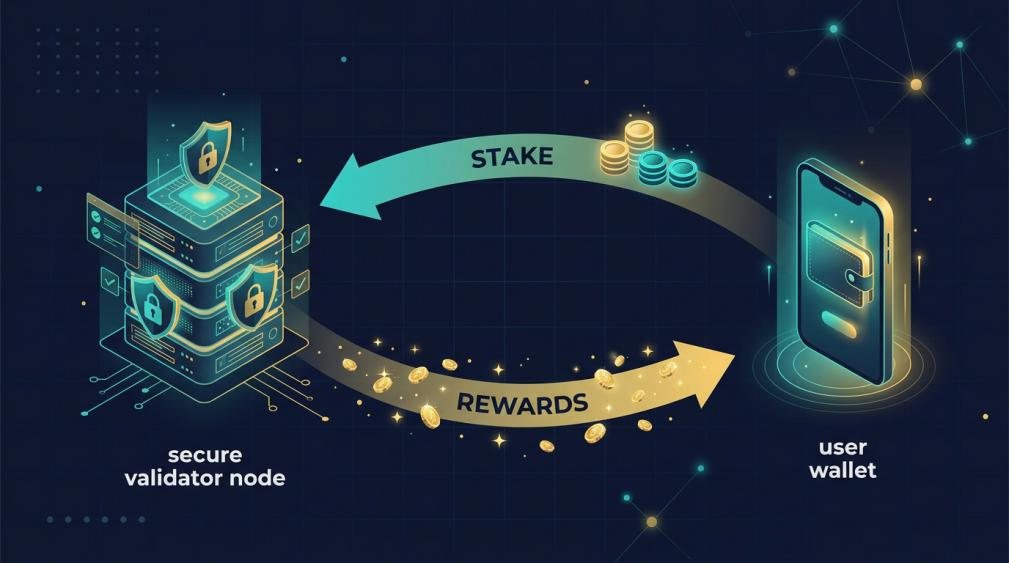
Staking means locking proof-of-stake tokens to help secure a blockchain in return for rewards paid in that token. Beginners can stake through an exchange, a liquid staking protocol, a staking ETF or their own validator. Rewards are typically a few percent a year, but the token’s price can move far more than the yield.
Key takeaways
- Ethereum staking rewards were around 2.6% a year in 2026, with about a third of ETH staked.
- Ways to stake: exchange, liquid staking, staking ETF, delegation or solo validator.
- Risks: price falls, lockups, slashing, platform failure and smart contract bugs.
- Rewards are generally taxable income in many countries when received.
Staking is one of the most common ways holders earn rewards on proof-of-stake assets. This guide covers the basics for beginners. For the protocol mechanics, see staking mechanisms and rewards; for compliance, see staking protocols compliance guide.
How Does Staking Work?
- You commit tokens to a validator (yours or someone else’s).
- Validators propose and confirm blocks.
- The network pays rewards from new issuance and transaction fees.
- Validators that misbehave or go offline can be penalized (slashing or lost rewards).
- To exit, you unstake, which may take days or weeks depending on the network.
Ways to Stake
| Method | How it works | Pros | Cons |
| Exchange staking | Exchange stakes on your behalf | Easy; low minimums | Platform risk; fees; less control |
| Liquid staking | Receive a token (e.g. stETH) representing staked assets | Stay liquid; use in DeFi | Smart contract and depeg risk |
| Staking ETF / ETP | Fund stakes and passes on rewards net of fees | Brokerage access; no keys | Fees; market hours; no on-chain use |
| Delegation | Assign tokens to a validator, keeping custody | Keep custody on many chains | Validator choice matters |
| Solo validator | Run your own node (32 ETH on Ethereum) | Full control; no middleman fees | Technical; uptime and slashing risk |
In the US, staking ETPs became available from late 2025, and a large asset manager launched a staked ETH ETF in March 2026 (Ethereum staking data).
Free educational tool
Plan how you would build a position over time
The DCA Calculator shows how regular contributions could build a position, before you decide whether staking fits.
Educational tool. Results are not investment advice.
Worked Example: Staking Rewards vs. Price Moves
Illustrative only. An investor stakes 10 ETH bought at $3,000 ($30,000) for one year at a 2.6% reward rate, paying a 10% platform fee on rewards.
| Item | Result |
| Gross rewards | 0.26 ETH |
| After 10% fee | 0.234 ETH |
| Balance after one year | 10.234 ETH |
| If ETH ends at $3,000 | $30,702 (+2.3%) |
| If ETH ends at $2,000 | $20,468 (−31.8%) |
| If ETH ends at $4,000 | $40,936 (+36.5%) |
The reward is small relative to price movements, so staking does not protect against a falling token price.
Risks to Understand
- Price risk: rewards are paid in the same volatile token.
- Lockup and exit delays: you may not be able to sell quickly.
- Slashing: validator errors can cost part of the stake.
- Platform risk: exchange or protocol failure, or withdrawal freezes.
- Smart contract and depeg risk for liquid staking tokens.
- Tax: rewards may be taxable when received, even if not sold.
Getting Started Checklist
- Do I want to hold this token long term anyway?
- Which staking method suits my technical comfort and need for liquidity?
- What fee does the platform take, and what is the net reward?
- How long does unstaking take?
- What happens if the platform fails?
- How will I record rewards for tax purposes?
Work With Kenson Investments
Kenson Investments’ digital asset specialists focus on education around staking and proof-of-stake assets. Explore our Ethereum resources or contact the team to learn more.
Disclaimer: The information provided on this page is for educational and informational purposes only and should not be construed as financial advice. Digital assets involve significant risk, including the possible loss of principal, and past performance is not indicative of future results. Always conduct thorough research and consult a qualified financial advisor before making investment decisions.
Digital asset regulation in the United States is still developing. Some areas, such as payment stablecoins, now have a federal framework, but comprehensive market-structure legislation has not yet been enacted. None of the information provided by Kenson LLC should be considered financial investment advice. Please consult your Registered Financial Advisor for guidance. Kenson LLC does not offer any products regulated by the SEC, including equities, registered securities, ETFs, stocks, bonds, or equivalents.
References
- Ethereum staking data — Staking statistics



