








Public blockchains are often described as “transparent by default.” Transactions are visible, balances can be traced, and activity is recorded immutably. While this visibility is foundational to decentralized systems, it does not meet the operational or regulatory standards required by institutions.
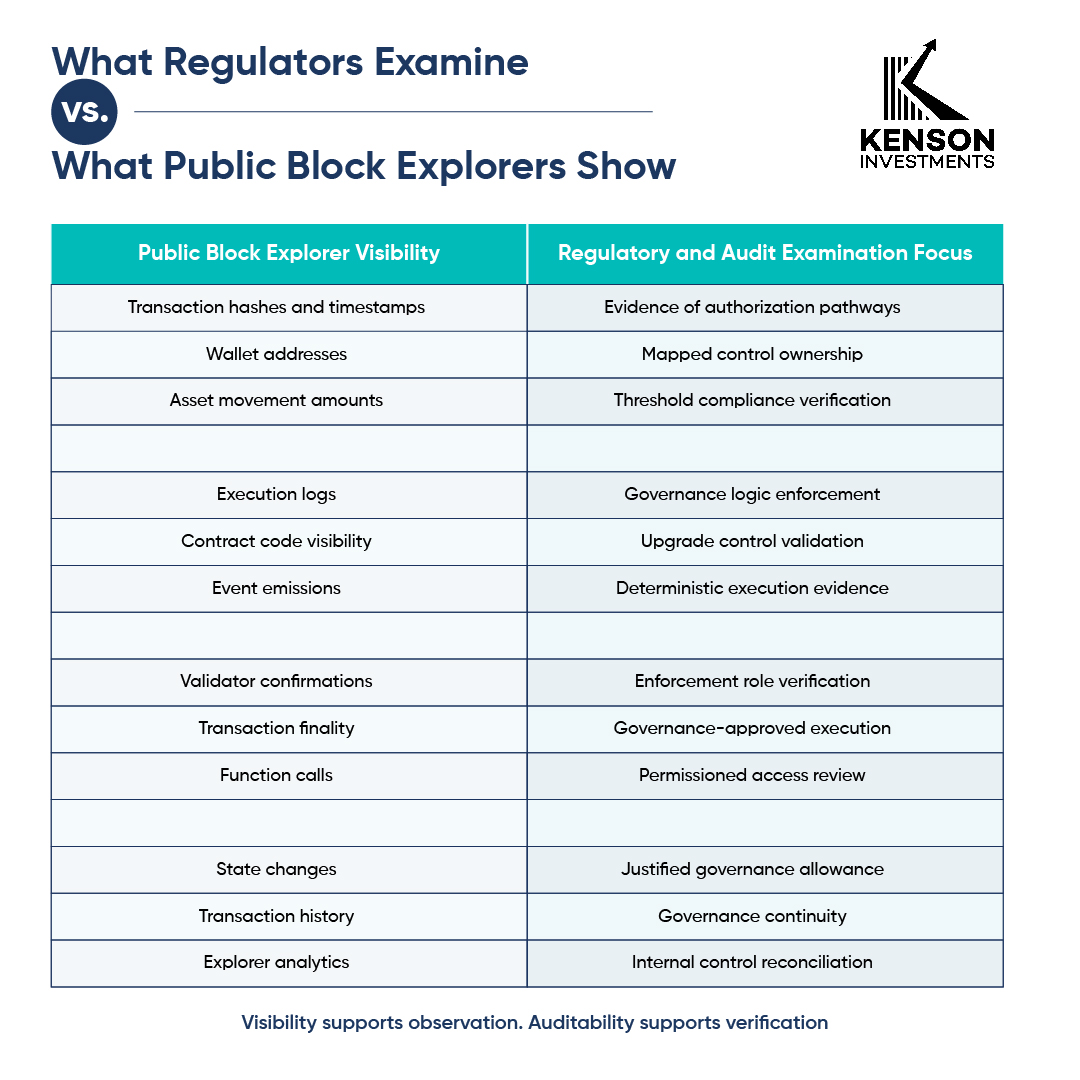
Transparency shows what happened. Auditability explains who authorized it, under what controls, and whether governance rules were followed.
For institutional participants, regulators, and auditors, openness alone is insufficient. What matters is on-chain auditability—the ability to reconstruct decision paths, verify authorization thresholds, and confirm that activity complied with defined internal and external controls. This distinction sits at the core of institutional blockchain compliance and determines whether on-chain systems can operate within regulated financial environments.
Transparency vs. Auditability: They Are Not the Same
Transparency refers to the availability of raw data. On-chain, this includes transaction hashes, wallet addresses, block numbers, timestamps, and smart contract state changes. Anyone can observe what happened, when it happened, and which addresses were involved.
Auditability, however, refers to the ability to formally examine, validate, and reconcile activity against predefined controls, policies, and authorization structures. An auditable system answers questions that transparency alone cannot:
- Who was authorized to initiate this action?
- What approvals were required before execution?
- Were internal thresholds respected?
- Can this activity be reconciled with governance documentation and compliance records?
Institutional environments require structured evidence, not just visible data. Transparency exposes activity; auditability explains and validates it.
Why Regulators Focus on Control, Not Visibility
Regulators do not assess compliance by scanning block explorers. Their focus is on whether an organization maintains effective internal controls, traceable decision authority, and demonstrable enforcement of policy.
In traditional finance, audit trails are built around:
- Segregation of duties
- Approval hierarchies
- Time-stamped authorization logs
- Immutable records of decision-making
On-chain systems must replicate these properties at a protocol and operational level. A transaction being visible does not prove it was properly authorized, nor does it confirm adherence to internal governance standards.
This is why institutional blockchain compliance frameworks prioritize:
- Multi-signature authorization records
- Role-based access enforcement
- Deterministic execution paths
- Verifiable governance events linked to documented policies
Auditability bridges the gap between decentralized execution and centralized accountability.
Attribution: The Core Audit Challenge On-Chain
One of the primary limitations of raw blockchain transparency is pseudonymity. Wallet addresses reveal activity, but not responsibility. From an audit perspective, this creates ambiguity unless attribution is formally established.
Auditability requires:
- Mapping addresses to internal roles or entities
- Documented ownership and custody structures
- Clear designation of signing authority
- Revocation and rotation controls
Without these layers, even fully visible transactions lack institutional meaning. Auditors assess whether an organization can demonstrate who controls a private key at a given time, under what authority, and within which governance boundaries.
On-chain auditability transforms addresses from anonymous endpoints into accountable control points.

Governance Events as Audit Objects
Institutional-grade blockchain systems treat governance actions as first-class audit objects. This includes:
- Parameter changes
- Contract upgrades
- Emergency interventions
- Validator configuration changes
Each of these actions must generate verifiable on-chain evidence that aligns with internal governance documentation. Effective auditability ensures:
- Governance proposals are immutably recorded
- Approval thresholds are cryptographically enforced
- Execution occurs only after the required conditions are satisfied
- All state changes are traceable to an authorized decision
Transparency shows the outcome. Auditability validates the process.
Time Delays and Deterministic Enforcement
Auditability is reinforced through deterministic enforcement mechanisms such as time delays and condition-based execution. These controls create predictable review windows and prevent discretionary or undocumented interventions.
From an audit standpoint, time delays serve several functions:
- Provide verifiable evidence of review periods
- Prevent rapid, unchecked state changes
- Demonstrate procedural discipline under operational pressure
Unlike off-chain controls that rely on human enforcement, on-chain delays are self-executing and non-bypassable, making them inherently auditable.
Emergency Controls Require Higher Audit Standards
Emergency intervention mechanisms introduce elevated risk and scrutiny. These controls can bypass standard workflows, making post-execution accountability essential.
Audit-ready emergency frameworks include:
- Predefined activation conditions
- Restricted scope of intervention
- Elevated authorization thresholds
- Mandatory post-action documentation
The presence of emergency controls alone is not enough. Institutions must demonstrate that these controls were used appropriately, proportionately, and in line with governance policy. On-chain auditability ensures that emergency actions remain reviewable rather than discretionary.
Metrics Turn Governance Into Evidence
Auditability is not static. It relies on continuous measurement. Metrics convert governance activity into quantifiable compliance signals that can be monitored and reviewed over time.
Common audit-relevant metrics include:
- Proposal approval rates versus rejection rates
- Frequency of emergency interventions
- Consistency of threshold compliance
- Validator or executor performance accuracy
- Deviation from expected governance patterns
These metrics allow institutions to demonstrate not just compliance at a moment in time, but operational consistency across periods—a core regulatory expectation.
Why Transparency Alone Falls Short
Pure transparency assumes that observers can reconstruct intent, authority, and compliance through inference. Institutional reviews do not operate on inference. They require explicit evidence.
Transparency without auditability creates several risks:
- Ambiguous responsibility
- Unverifiable authorization
- Inconsistent governance enforcement
- Weak incident accountability
- Difficulty aligning on-chain activity with internal controls
Auditability resolves these risks by aligning blockchain mechanics with established compliance principles.
How Auditability Aligns Blockchain With Existing Regulatory Models
Rather than replacing traditional compliance frameworks, on-chain auditability integrates with them. When governance logic, authorization thresholds, and execution rules are embedded on-chain, they become self-documenting controls.
This alignment allows institutions to:
- Map on-chain processes to internal policies
- Reduce reliance on off-chain attestations
- Simplify audit preparation
- Improve regulator confidence
Auditability does not eliminate oversight. It strengthens it by making compliance verifiable by design.
Building Audit-Ready On-Chain Systems
Institutional blockchain compliance begins with auditability, not visibility. For organizations navigating governance design, authorization structures, and regulator-aligned controls, working with experienced digital asset consultants can clarify how on-chain systems translate into audit-ready operational frameworks.
As a leading digital asset strategy consulting firm, Kenson Investments provides educational and informational insight to help institutions understand how governance, control enforcement, and auditability intersect in on-chain finance—supporting more disciplined, reviewable, and regulator-aware participation in digital asset systems.
Disclaimer: The information provided on this page is for educational and informational purposes only and should not be construed as financial advice. Crypto currency assets involve inherent risks, and past performance is not indicative of future results. Always conduct thorough research and consult with a qualified financial advisor before making investment decisions.
“The crypto currency and digital asset space is an emerging asset class that has not yet been regulated by the SEC and the US Federal Government. None of the information provided by Kenson LLC should be considered as financial investment advice. Please consult your Registered Financial Advisor for guidance. Kenson LLC does not offer any products regulated by the SEC, including equities, registered securities, ETFs, stocks, bonds, or equivalents.”