









Institutional interest in digital assets is no longer theoretical. Tokenized bonds, funds, and settlement pilots are live across multiple jurisdictions. Yet adoption remains uneven. The gap is not driven by a lack of innovation. It is driven by infrastructure.
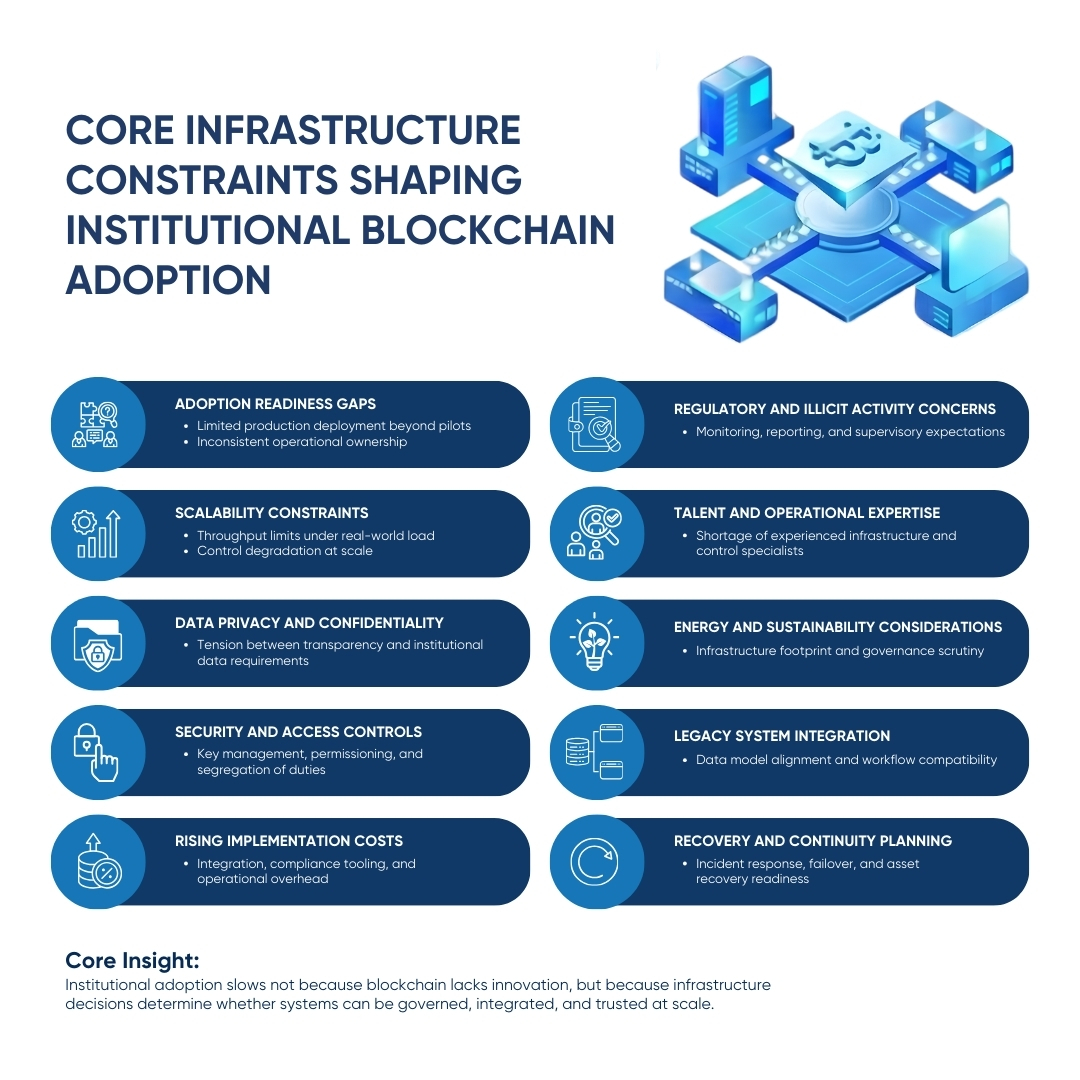
Institutions do not stall because blockchains are too new. They stall because the underlying systems fail to meet operational expectations built over decades. Institutional blockchain infrastructure succeeds or fails on mundane decisions that rarely make headlines but determine whether systems can operate at scale. These choices define the real digital asset adoption barriers.
Innovation Rarely Fails First, Operations Do
Most blockchain pilots perform well in controlled environments. Throughput is sufficient. Settlement works. Demonstrations impress stakeholders. Problems emerge when systems move from pilots to production.
Data formats fail to align with existing reporting. Access controls prove too rigid or too permissive. Monitoring is fragmented. Recovery procedures are undefined. These issues do not sound revolutionary, but they are decisive.
Institutions engaging blockchain and digital asset consulting increasingly report that infrastructure readiness, not protocol capability, is the primary gating factor for expansion.
Data Models Decide Whether Systems Integrate or Isolate
Institutions run on data. Accounting systems, risk engines, compliance tools, and reporting workflows all depend on consistent, interpretable records.
Tokenized systems often introduce new data models that do not map cleanly to legacy environments. Transaction metadata is incomplete. Asset identifiers vary across chains. Time conventions differ. These mismatches force manual reconciliation and increase operational risk.
For firms managing digital asset investments, data integration is often the first friction point. Adoption slows not because assets cannot be traded, but because they cannot be reconciled, audited, or reported reliably.
This is why digital asset advisory services increasingly focus on data architecture rather than asset selection.
Access Controls Matter More Than Speed
Public blockchains emphasize openness. Institutions emphasize control. Reconciling these priorities requires careful design.
Role-based permissions, approval thresholds, segregation of duties, and emergency access must be engineered deliberately. Many early deployments treated wallet access as a technical detail. Institutions learned quickly that access design is a governance decision.
Misconfigured access controls remain one of the most common causes of institutional incidents in digital markets. As a result, security in digital asset management has shifted from perimeter defense to internal control design.
Firms seeking secure digital asset consulting solutions now prioritize access architecture alongside custody.
Monitoring Is the Difference between Confidence and Surprise
Traditional financial systems rely on layered monitoring. Exceptions trigger alerts. Trends surface gradually. In digital markets, activity unfolds continuously and globally.
Without real-time visibility, institutions discover issues after the fact. Exposure breaches, liquidity constraints, or governance changes may persist for hours before detection.
This has accelerated the adoption of continuous monitoring frameworks. Instead of periodic checks, institutions embed controls that evaluate activity as it occurs. Risk management in crypto investments increasingly depends on live telemetry rather than historical review.
This shift aligns with best practices in digital asset consulting, where prevention outweighs remediation.
Recovery Planning Is Where Most Pilots Break Down
Recovery planning rarely appears in pitch decks. It matters more than almost anything else.
Institutions plan for system failures, key loss, operational errors, and vendor outages. Many blockchain pilots reach production without defined recovery procedures. When incidents occur, teams improvise.
In 2024, several institutional pilots were paused indefinitely after recovery weaknesses were exposed during minor incidents. No assets were lost. Confidence was.
Recovery planning is now a central topic in consulting on digital asset management, covering key replacement, transaction reversal policies, and system failover scenarios.
Scalability Is Operational, Not Just Technical
Scalability is often discussed in terms of transactions per second. Institutions define it differently.
Can the system support more users without degrading controls. Can reporting scale with activity. Can compliance oversight expand without linear headcount growth.
Tokenized systems that scale technically but not operationally stall quickly. This is why digital asset management consulting services increasingly evaluate organizational readiness alongside technology.
Infrastructure decisions that feel boring determine whether systems grow smoothly or collapse under their own complexity.
The Compliance Angle Institutions Cannot Ignore
Regulatory expectations continue to evolve. What regulators consistently demand is control, transparency, and accountability.
Institutions adopting digital asset consulting for compliance focus less on rule interpretation and more on system behavior. Can controls be demonstrated. Can activity be explained. Can risks be contained.
Always-on controls, auditable data trails, and clear accountability structures matter more than novel features. Compliance failures often trace back to infrastructure shortcuts taken early.
Why Startups and Institutions Diverge Here
Startups optimize for speed. Institutions optimize for resilience. This difference explains many adoption delays.
What works for a startup rarely translates directly to an institutional environment. Bridging this gap requires translation, not transformation.
This is where digital asset consulting services for businesses play a role, helping organizations adapt blockchain systems to institutional realities without stripping away core functionality.
The most effective digital asset strategy consulting firm engagements focus on aligning incentives, controls, and workflows rather than chasing innovation cycles.
Infrastructure Choices Signal Long-Term Intent
Institutions pay close attention to how systems are built, not just what they promise.
Clear data standards signal commitment to transparency. Robust access controls signal governance maturity. Thoughtful recovery planning signals long-term intent.
These signals matter when institutions evaluate partners, platforms, and service providers. Many strategic digital asset consulting partners emphasize infrastructure discipline as a trust-building mechanism.
The Quiet Path to Adoption
Institutional adoption of digital assets will not be driven by the next breakthrough protocol. It will be driven by steady improvements in reliability, control, and integration, supported by practices such as Solana DeFi risk management.
The infrastructure decisions that feel unexciting are the ones that persist. They enable scale, support oversight, and reduce operational anxiety, which is why many organizations seek consultancy for DeFi finance investments when evaluating long-term strategies.
Institutions seeking long-term investment in digital assets increasingly recognize that boring infrastructure is not a constraint. It is an enabler.
Adoption Is Built on What Works Every Day
Digital markets do not scale on vision alone. They scale on systems that function reliably under routine conditions, often designed with input from a derivative consultant to strengthen risk oversight and market structure.
Kenson Investments works with institutions evaluating how infrastructure design choices shape adoption outcomes across tokenized markets. Explore how disciplined operational decisions support durable participation in digital finance.
Disclaimer: The information provided on this page is for educational and informational purposes only and should not be construed as financial advice. Crypto currency assets involve inherent risks, and past performance is not indicative of future results. Always conduct thorough research and consult with a qualified financial advisor before making investment decisions.
“The crypto currency and digital asset space is an emerging asset class that has not yet been regulated by the SEC and the US Federal Government. None of the information provided by Kenson LLC should be considered as financial investment advice. Please consult your Registered Financial Advisor for guidance. Kenson LLC does not offer any products regulated by the SEC, including equities, registered securities, ETFs, stocks, bonds, or equivalents.”



