







Programmable finance—money and contracts that execute themselves according to code—has a simple sales pitch: set it up once, let the software manage everything, and enjoy a hands-off relationship with your assets. That promise fuels many of the most persistent passive crypto investing myths.
In reality, the automation that makes programmable finance powerful also creates unique failure modes that demand ongoing human responsibility. Keep reading as our digital asset consultants offer insights into why apparent passivity is often an illusion, what risks require active oversight, and what “responsibility” looks like when code replaces or reshapes traditionally manual processes.
Why “Set It And Forget It” Feels So Believable
Several familiar services and features make crypto feel passive. Delegated staking, liquidity pools with automated market makers (AMMs), yield-generating vaults, and custodial services all create the perception that work is done for you. Automation, scheduled compounding, and API-driven portfolio rebalancing reinforce that sense of frictionless participation.
That perception rests on two true facts: code can automate repetitive tasks, and transparent blockchains make many operations visible. But visibility and automation are not the same as safety or permanence. Automation executes programmed rules exactly as written, not as the original designer intended if conditions change or malicious actors intervene.
Plenty of incidents show that “automated” procedures can be exploited when the surrounding environment isn’t actively managed. Smart contract flaws and emergent attack techniques continue to produce losses large enough to puncture the myth of effortless passivity.
Core Failure Modes That Turn Passive Into Active Problems
1. Bugs, exploits and the still-human problem of code correctness
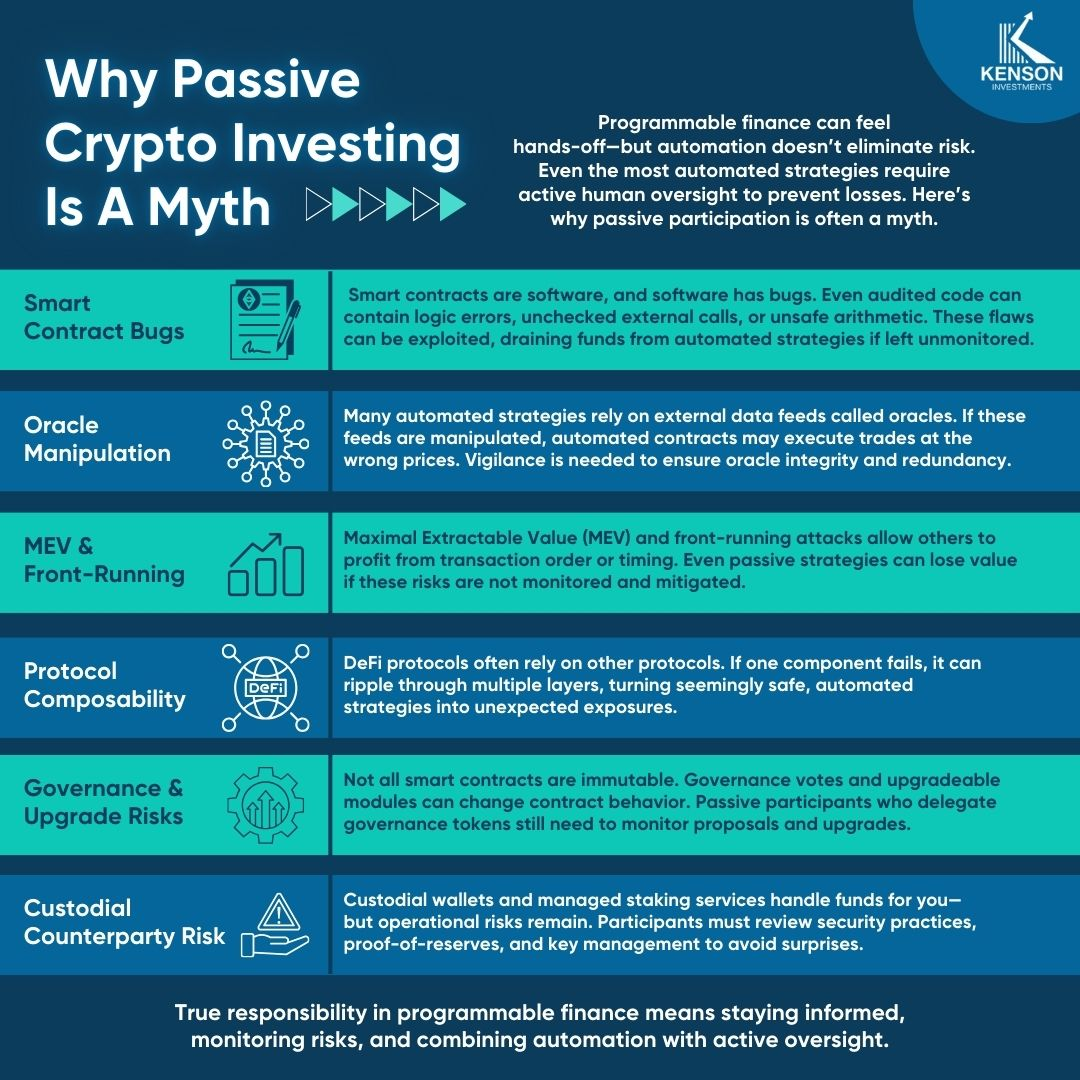
Smart contracts are software. They can contain the same classes of bugs and logic errors as any other program—plus domain-specific pitfalls such as unchecked external calls, improper access controls, and unsafe arithmetic. Those weaknesses have led to repeated protocol losses and drains; auditing and patching require ongoing human work, not set-it-and-forget-it faith. Security research and vulnerability tracking show this remains a persistent problem for decentralized protocols.
2. Oracle manipulation and flash-loan attacks
Many automated strategies depend on external price feeds (“oracles”). Sophisticated attacks combine flash loans—instant, no-collateral borrow-and-return transactions—with price-manipulation techniques to trick a contract into making bad decisions during a single atomic transaction.
Those exploits are intrinsically time-sensitive and exploit composability; preventing them requires active monitoring of oracle design choices, price-feed redundancy, and emergency controls. OWASP and academic analyses document how flash-loan vectors remain a leading source of protocol risk.
3. Maximal Extractable Value (MEV) and transactional front-running
“Passive” long-term logic can be undermined at the transaction level. MEV—formerly called miner extractable value—describes the economic opportunities that reorder, include, or exclude transactions in a block.
Front-running, sandwich attacks, and block manipulations can extract value from automated strategies, reducing yields or introducing unexpected slippage. Regulatory and research bodies have raised attention to MEV as a structural constraint on how “passive” on-chain execution actually plays out.
4. Composability and systemic coupling
DeFi protocols often build on, and into, one another: a lending market may use a DEX for price discovery; a yield vault may route through several protocols to optimize performance.
That composability magnifies risk: a vulnerability in one underlying building block can propagate, turning multiple seemingly separate “passive” positions into a single correlated exposure.
Empirical research shows that large liquidity events and strategic attacks can ripple across composable stacks, underscoring why participants need to track the health of the whole system, not just the top-level product.

5. Governance, upgradability and centralized control points
Not all smart contracts are immutable; many include upgrade mechanisms or rely on governance processes. “Passive” holders who delegate tokens to governance actors or lock funds in upgradable contracts depend on the competence and incentives of other actors.
Governance votes can change contract behavior; upgradeable modules can be altered to add or remove functionality. These governance dynamics create a human-responsibility layer: knowing who controls upgrades, how votes are conducted, and what safeguards exist is essential to managing risk.
6. Custodial counterparty and operational exposures
When services claim to do everything for you—custodial wallets, managed staking, or custodial yield—participants face traditional counterparty risk.
“Passive” involvement with a custodian exchanges on-chain control for operational convenience, but it brings back the classic need for oversight: vetting the custodian’s security, custody segregation, key-management practices, and contractual protections. That oversight is not passive; due diligence and periodic review remain necessary.
Behavioral Pitfalls and Cognitive Bias in Passive Crypto Participation
Even when participants follow protocols and monitor technical risk factors, human behavior introduces its own set of vulnerabilities. Many passive crypto investing myths stem not just from a misunderstanding of automation but from cognitive biases that subtly influence decision-making. Recognizing these behavioral pitfalls is part of responsible participation in programmable finance.
Overconfidence in Automation
Participants often overestimate the reliability of code or the protective power of audits. Believing that “if it’s automated, it must be safe” leads to under-monitoring and complacency. Overconfidence can delay detection of unusual events, from flash-loan attacks to governance changes, and increase the likelihood of avoidable losses.
Herding and Social Influence
DeFi forums, social channels, and token communities amplify herd behavior. Even “hands-off” participants can be swayed to move capital, delegate governance tokens, or shift allocations based on trending narratives. Herding can exacerbate liquidity stress, amplify protocol vulnerabilities, or create cascading effects in composable systems.
Confirmation Bias
Investors may focus on positive performance signals while ignoring warning signs, such as anomalous oracle updates, governance disputes, or unusual liquidity patterns. Confirmation bias can lull participants into assuming automated strategies are performing as intended, even when risk accumulates beneath the surface.
Actionable Countermeasures
Mitigating these behavioral risks requires structured habits: maintain a defined monitoring schedule, document and review unusual activity, and create thresholds that trigger deeper investigation or withdrawal.
Combining behavioral awareness with technical oversight ensures that “passive” participation does not devolve into reactive crisis management.
By acknowledging that human judgment interacts with automation, participants can approach programmable finance with realistic expectations. The blend of technical vigilance and behavioral awareness transforms passive crypto myths into actionable, responsible strategies.

What Responsible Oversight Actually Requires
“Responsibility” in programmable finance is not a single checklist item; it’s a steady set of practices that reduce exposure to automated-system failures:
- Understand the mechanism, not just the headline yield.Read the contract design, oracle sources, and treasury mechanics. Know how funds can be moved or locked. Public documentation and protocol code are parts of that due diligence.
- Check dependency maps and exposure.If a product integrates multiple protocols, treat that exposure as a network and inventory the weakest links. Composability multiplies risk; mapping dependencies reveals concentration and correlated failure scenarios.
- Prefer transparent, time-locked governance changes.Time locks, multisignature controls, and clear upgrade paths make unexpected changes less likely to occur without notice. Governance processes should be auditable and understandable.
- Monitor for unusual on-chain activity.Flash-loan patterns, sudden liquidity withdrawals, or abnormal oracle updates are signals that automated systems could be under attack. Active monitoring detects these patterns faster than passive monitoring.
- Use layered safeguards.Audits and bug bounties help but are not perfect. Complement them with insurance options, circuit breakers, and withdrawal limits where appropriate to limit exposure when a problem emerges.
- Re-assess custodial arrangements frequently.Custodial convenience should be balanced with transparency about key custody, proof of reserves, and operational resilience. Periodic re-evaluation reduces counterparty blind spots.
These practices are about reducing surprises and preserving optionality. They are not guarantees of safety; they are ways to turn a naive “passive” stance into an informed, managed posture.
How To Think About “Passivity” In A Practical Way
Treat passive participation as a relative term: some strategies legitimately require less daily attention than active trading, but all require periodic stewardship. The level of oversight should scale with complexity and exposure.
Simple, well-understood primitives with small allocations can be monitored less intensely than complex, highly composable strategies that route across multiple protocols. The goal is not perfect protection, which is impossible, but sensible stewardship that acknowledges automation’s limits.
Keep Oversight Simple And Consistent
For individuals seeking to navigate programmable finance responsibly, understanding the nuances of automated systems is essential. At Kenson Investments, our focus is on providing educational resources and insights into digital asset ecosystems, including blockchain protocols, crypto asset derivatives, and the operational dynamics of programmable finance.
Our digital asset consultants provide clarity on how automation interacts with market conditions, governance, and risk exposure, helping participants make informed decisions about their digital asset strategies. By leveraging these resources, participants can engage confidently, balancing automation with the oversight needed to manage exposure effectively.
Join us to explore our educational materials and tools to enhance your awareness of programmable finance systems and the responsibilities they entail. Knowledge, vigilance, and strategic engagement remain the cornerstone of responsible participation—even in a world of automation.
Disclaimer: The information provided on this page is for educational and informational purposes only and should not be construed as financial advice. Crypto currency assets involve inherent risks, and past performance is not indicative of future results. Always conduct thorough research and consult with a qualified financial advisor before making investment decisions.
“The crypto currency and digital asset space is an emerging asset class that has not yet been regulated by the SEC and the US Federal Government. None of the information provided by Kenson LLC should be considered as financial investment advice. Please consult your Registered Financial Advisor for guidance. Kenson LLC does not offer any products regulated by the SEC, including equities, registered securities, ETFs, stocks, bonds, or equivalents.”