










When people think about successful crypto participation, they often assume the ability to think long-term is an innate trait—something reserved for the naturally patient or disciplined. But recent research in behavioral economics, neuroscience, and cognitive science suggests that patience and strategic foresight are not innate traits—they are skills cultivated through deliberate systems, habits, and constraints. This reframing has significant implications for anyone engaged in long-term crypto planning, showing that disciplined strategies can be learned, practiced, and optimized.
Why Long-Term Thinking Feels Hard
Many investors struggle to maintain a consistent approach in volatile markets. Crypto, in particular, amplifies the challenge: markets operate 24/7, information spreads instantly, and sudden price swings trigger emotional reactions.
When people describe themselves as “impatient” or “short-term,” they are often reacting to an environment that constantly rewards attention shifts and immediate responses, not a fixed personality deficit.
From a cognitive perspective, human brains are wired for temporal discounting: the tendency to prioritize immediate rewards over delayed benefits. This is why it feels harder to stick to a long-term plan at the moment, even if the strategy is sound. Recognizing that this response is universal helps remove self-blame and reframes long-term thinking as a trainable skill.
Systems and Constraints Build Patience
Instead of relying on innate temperament, long-term thinkers often rely on systems and constraints that shape behavior. In crypto, these can include:
- Pre-defined allocation rules:Setting a target percentage for staking, yield farming, or holding avoids ad-hoc trading decisions.
- Scheduled rebalancing:Automating periodic adjustments ensures consistency without emotional interference.
- Withdrawal limits or time locks:Mechanisms that physically prevent impulsive moves reinforce disciplined behavior.
- Checklists and monitoring routines:Structured review processes reduce the influence of panic or hype.
These systems function like a training environment: they guide decision-making, reduce cognitive load, and gradually make patience automatic. Over time, adherence to these systems strengthens executive control—the cognitive faculty responsible for resisting impulses and maintaining focus on long-term objectives.
Habits That Reinforce Long-Term Crypto Planning
Beyond structural constraints, daily habits are critical for reinforcing long-term thinking. Habits externalize discipline, making patience a predictable outcome of repeated routines rather than a moment-to-moment struggle. Key habits for effective crypto planning include:
- Regular portfolio reviewsat predetermined intervals, rather than responding to every market move.
- Journaling decisionsand outcomes to track reasoning and spot patterns of emotional reaction.
- Information diet control:Limiting exposure to sensationalized news or social media hype reduces reactive behavior.
- Scenario planning:Preparing for market volatility with predefined “if-then” responses reduces stress-driven decision-making.
Habits like these are behavioral scaffolds. They convert abstract principles—patience, discipline, foresight—into repeatable processes that can be strengthened and refined.
Metrics and Feedback Loops as Training Tools
Technical skill development relies on metrics and feedback loops, and long-term crypto planning is no different. Investors who treat patience as a skill measure it, analyze it, and adjust accordingly:
- Performance tracking vs. behavior tracking:Instead of focusing only on price performance, track adherence to your long-term plan. Did you sell impulsively? Did you maintain allocation targets?
- Behavioral KPIs:Metrics like “number of impulsive trades avoided” or “percentage of assets remaining in target allocation” turn abstract discipline into quantifiable progress.
- Post-mortem analysis:After market volatility, reviewing decisions objectively helps refine systems, rules, and habits for the next cycle.
Feedback loops transform long-term thinking from a vague aspiration into a trainable competency. The more precise the tracking, the faster skills develop.
Environmental Design Shapes Decisions
Another crucial factor in long-term skill development is environmental design. People often overestimate the importance of willpower and underestimate the influence of context. In crypto planning, environmental design includes:
- Interface choices:Using wallets and dashboards that hide short-term price fluctuations reduces temptation to act impulsively.
- Social environment:Engaging in communities that emphasize research and process over hype reinforces rational behavior.
- Tooling constraints:Setting stop-loss rules, delegation mechanisms, or staking periods creates friction against reactive decisions.
Environment is not destiny, but it scaffolds behavior. By designing surroundings to support long-term planning, participants cultivate patience with less reliance on moment-to-moment self-control.

Cognitive Mechanics Behind Long-Term Planning
Even with habits, systems, and constraints in place, human cognition can introduce challenges. Understanding the mechanics behind these challenges helps participants design structures that reinforce long-term planning:
Overcoming Hyperbolic Discounting
Humans naturally overweight immediate rewards compared to distant ones—a phenomenon known as hyperbolic discounting. In crypto, the lure of short-term gains or trending tokens can easily overshadow systematic, long-term strategies. Systems that pre-commit resources or automate contributions help counteract this bias by removing impulsive choice from the moment.
Managing Loss Aversion
Participants tend to feel losses more acutely than equivalent gains, leading to early exits or reactive rebalancing. Structured systems, clear rules for intervention, and pre-defined thresholds reduce the emotional impact of temporary losses, making long-term planning less psychologically taxing.
Harnessing Feedback Loops
Long-term planning requires timely and relevant feedback. Participants can implement monitoring dashboards, alerts, and periodic assessments to identify deviations without overreacting to noise. By distinguishing signal from noise, systems reinforce discipline as a repeatable skill rather than a personality trait.
Systems Thinking in Crypto Planning
Long-term planning in crypto requires seeing the system as a whole, not just individual assets or trades. Systems thinking includes:
- Understanding protocol interactions:Recognizing dependencies, risk exposures, and emergent behaviors in DeFi or blockchain ecosystems.
- Scenario modeling:Simulating different market conditions and how your system of allocations and rules responds.
- Stress-testing constraints:Periodically reviewing rules, limits, and locks to ensure they still support long-term goals under unexpected conditions.
Systems thinking trains participants to anticipate outcomes, respond consistently, and maintain discipline even under stress—key aspects of skillful long-term planning.
Overcoming Cognitive Bias in Long-Term Planning
Even when systems and habits are in place, cognitive biases can still disrupt long-term thinking. Skillful participants actively manage these biases:
- Loss aversion:Recognizing that the emotional impact of losses is amplified and separating it from rational allocation decisions.
- Recency bias:Avoiding overreaction to short-term events by anchoring decisions to long-term objectives.
- Herd mentality:Evaluating social pressure critically, rather than letting trending narratives dictate actions.
- Optimism bias:Maintaining realistic expectations and adjusting systems to reflect potential volatility.
By identifying these biases and embedding countermeasures in systems and habits, participants transform patience from a trait into a replicable, trainable skill.
Applying Technical Long-Term Thinking to Crypto
Structured Delegation and Governance
Even “hands-off” participation in programmable finance is not entirely passive. Delegating governance or using automated strategies should be approached with clear rules for review and intervention. Systems that define when to vote, when to delegate, and how to respond to protocol changes transform governance from a reactive task into a deliberate, long-term skill.
Portfolio Design as a Skill
Long-term crypto planning depends on disciplined portfolio design, not instinct. This involves:
- Establishing strategic allocationsrather than chasing trends.
- Evaluating protocol dependencies and composability risks.
- Setting thresholds for rebalancingbased on pre-determined rules, not emotions.
These practices reinforce patience and prevent participants from being derailed by volatility.
Risk Management and Active Oversight
Automated strategies are efficient but vulnerable to bugs, oracle manipulation, MEV, and flash-loan attacks. Long-term thinking in crypto requires participants to implement structured oversight practices:
- Regularly review smart contract health and audit reports.
- Map dependencies across composable protocols.
- Monitor governance proposals and upgrade paths.
- Observe custodial arrangements and operational safeguards.
This type of technical vigilance ensures that patience is supported by active systems, not just hope or temperament.
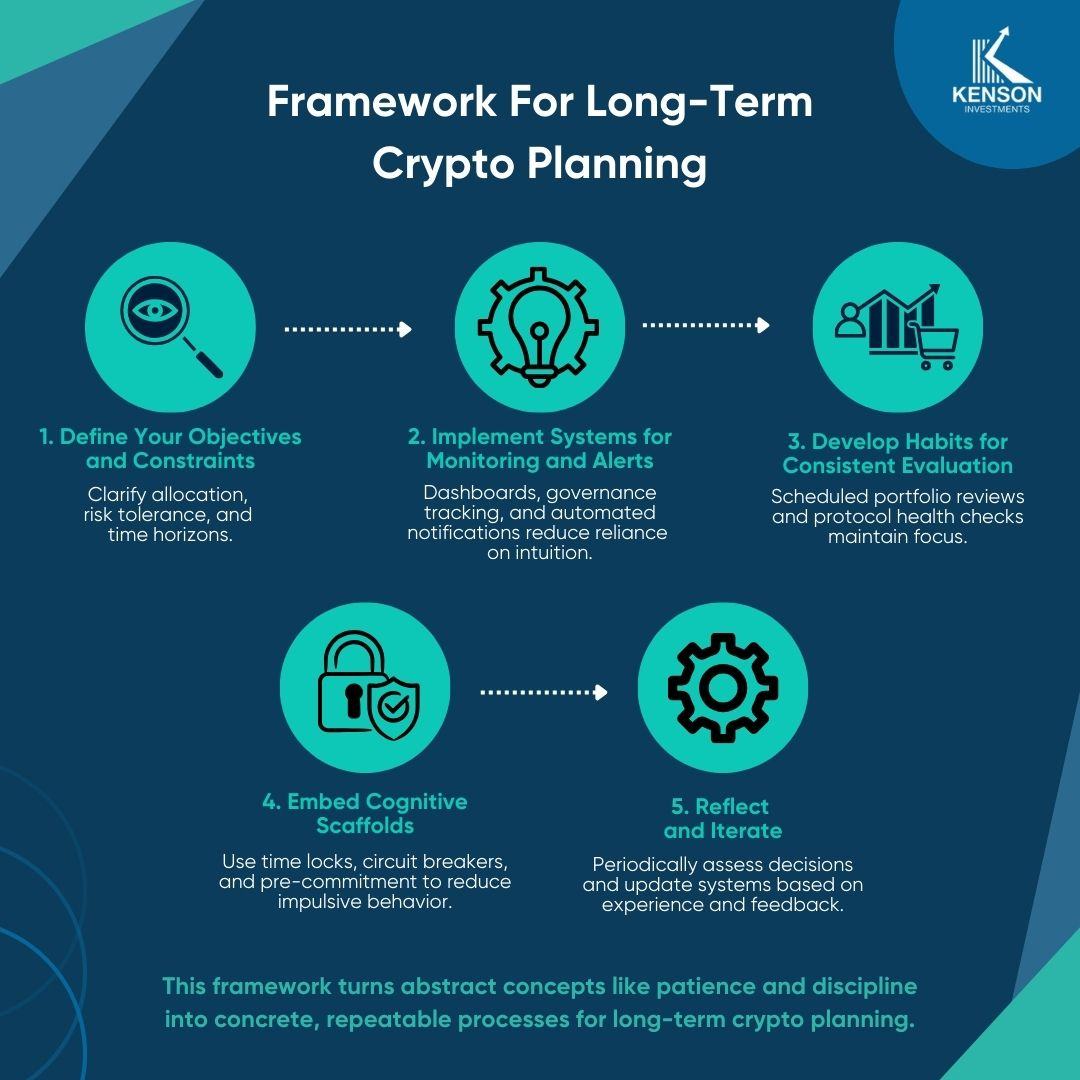
Develop Long-Term Planning as a Skill with Kenson Investments
Long-term crypto planning is not about temperament—it’s a technical skill you can cultivate. By designing systems, building habits, and embedding constraints, you can approach programmable finance with structured discipline and reduce the impact of volatility, behavioral biases, and systemic risk.
Kenson Investments offers educational resources and structured frameworks that help participants develop actionable, repeatable skills for long-term planning. Our digital asset consultants can guide you in creating oversight routines, tracking protocol dependencies, and applying disciplined portfolio design. These tools transform abstract concepts like patience into measurable practices.
For practical guidance on implementing long-term crypto planning strategies, or to develop a systemized approach to programmable finance, join the Kenson Investments tribe today.
Disclaimer: The information provided on this page is for educational and informational purposes only and should not be construed as financial advice. Crypto currency assets involve inherent risks, and past performance is not indicative of future results. Always conduct thorough research and consult with a qualified financial advisor before making investment decisions.
“The crypto currency and digital asset space is an emerging asset class that has not yet been regulated by the SEC and the US Federal Government. None of the information provided by Kenson LLC should be considered as financial investment advice. Please consult your Registered Financial Advisor for guidance. Kenson LLC does not offer any products regulated by the SEC, including equities, registered securities, ETFs, stocks, bonds, or equivalents.”



