











Automation has become central to digital asset market operations. Orders route faster, execution is more consistent, and large systems can react without waiting for manual intervention. That efficiency is valuable. It reduces delay, lowers friction, and supports scale.
But automation also changes how flexibility works inside a market. Once decisions are encoded into systems, the range of acceptable responses becomes narrower. A process designed to execute efficiently may struggle to adapt when conditions shift in ways the model did not anticipate.
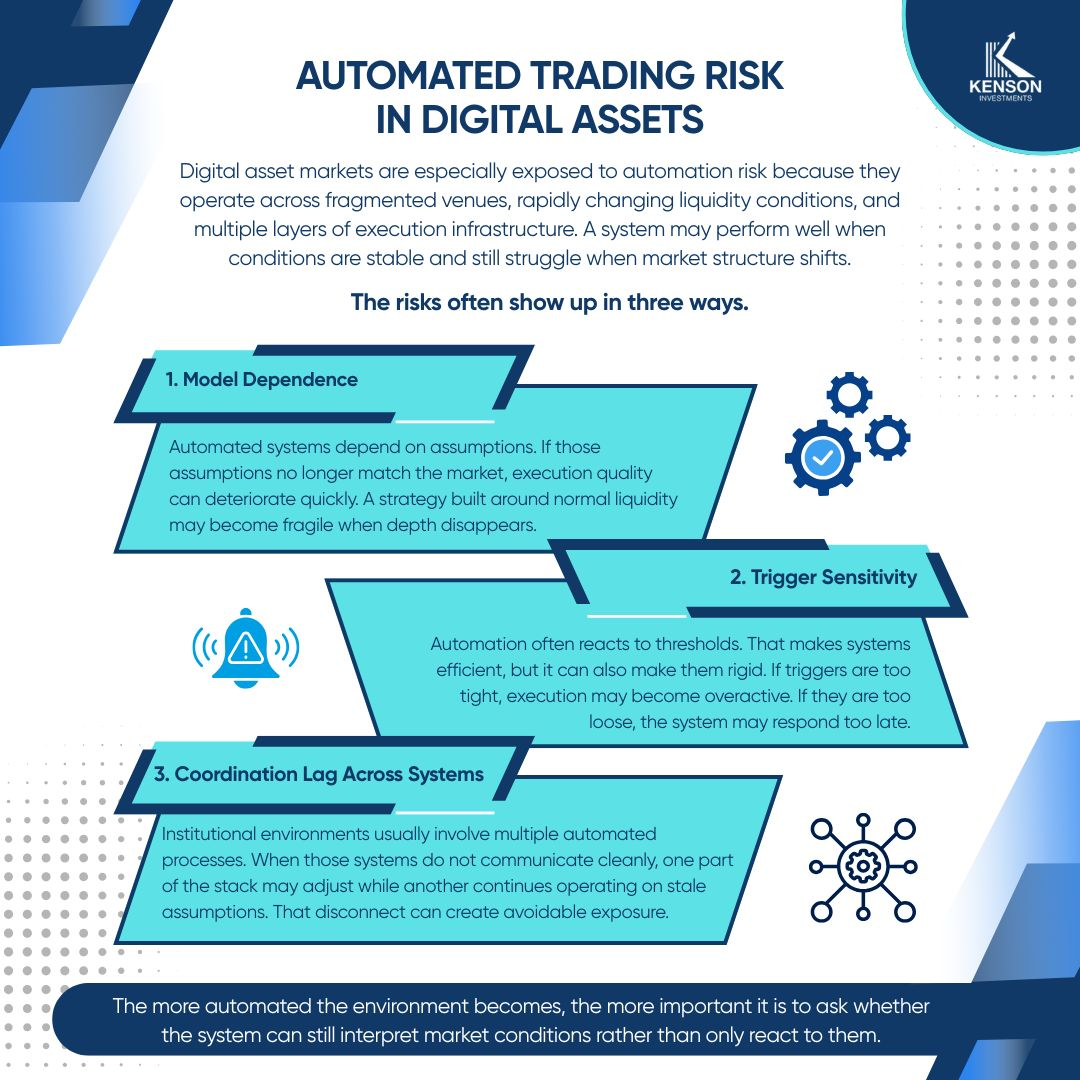
That is where automated trading risk digital assets becomes a practical concern. The issue is not whether automation works in normal conditions. The issue is whether it preserves enough discretion to manage stress, ambiguity, and unusual market behavior. For institutions, that is the real test of institutional execution control.
Automation can support disciplined execution. It can also lock institutions into patterns that are difficult to adjust quickly. When markets move too fast, a system optimized for consistency may not be flexible enough to respond with judgment.
Where Flexibility Gets Lost
Flexibility is often reduced in small ways that are easy to overlook. A rule set becomes tighter. A threshold becomes fixed. A workflow becomes more dependent on machine logic than on human interpretation. None of these changes appear harmful on their own. Together, they can make a market operation less adaptive.
This is especially visible in environments where automated systems manage:
- Order routing
- Rebalancing triggers
- Liquidity adjustments
- Margin responses
- Risk thresholds
Each of these functions can improve speed. Each can also reduce room for discretion.
If a system is built to act immediately when a parameter is crossed, it may do so even when the broader context suggests restraint. That is the tradeoff. Automation is not just a tool for efficiency. It is a framework that defines which responses are permitted and which responses are not.
Human Oversight Still Carries Structural Value
Automation is strongest when it operates inside a framework that includes human oversight. That does not mean manual intervention should replace machine execution. It means human judgment remains necessary for interpreting conditions that rules alone cannot capture.
Human oversight contributes three things that automation cannot fully replicate.
It adds context. Machines can identify patterns, but people can evaluate whether those patterns matter in the current environment.
It adds discretion. Not every rule should fire automatically. Some decisions require restraint, especially when volatility is driven by temporary dislocation rather than true deterioration.
It adds accountability. When systems make decisions without review, institutions can lose visibility into why those decisions were made.
This matters because flexibility is not the same as inconsistency. A well-governed process can be disciplined and adaptive at the same time. The goal is not to slow automation down. The goal is to preserve room for execution control when conditions require it.
The Tradeoff Between Consistency and Adaptability
Institutions automate because they want consistency. That is reasonable. Consistency reduces error, standardizes process, and improves speed. But consistency becomes a liability when it hardens into inflexibility.
The tension is simple:
- More automation usually means more predictable execution.
- More predictability usually means fewer discretionary adjustments.
- Fewer discretionary adjustments can reduce adaptability under stress.
That tension is not a flaw in automation. It is the nature of it.
For institutions, the question becomes how much consistency is enough before flexibility starts to disappear. In some parts of the stack, strict automation is appropriate. In others, especially where liquidity can shift suddenly, rigid rules may create more risk than they remove.
This is why execution control cannot be reduced to system performance alone. It must also include the ability to override, pause, review, or reweight decisions when market behavior no longer matches assumptions.
Signs That Automation Is Over-Controlling Operations
When automated systems become too dominant, several signs tend to appear. These signs do not always indicate failure, but they do show that flexibility may be weakening.
- Responses become overly standardized even when conditions change
- Risk actions trigger in a narrow, repetitive way
- Teams rely on system outputs without questioning the underlying assumptions
- Exceptions take too long to process because workflows are too rigid
- Execution continues even when context suggests a pause would be wiser
These patterns matter because they show how control can shift from governance to mechanism. That shift is efficient until the market moves in ways the mechanism was not built to handle.
At that point, institutions can discover that their most automated systems are also their least adaptable.
Institutional Execution Control Requires Tiered Authority
The strongest institutional environments are not fully automated or fully manual. They use tiered execution control. That means different types of decisions sit at different levels of authority.
- Routine, low-risk actions can be automated.
- Conditional actions can require system alerts and secondary review.
- High-risk responses can remain reserved for human approval.
This layered structure helps institutions maintain speed without surrendering flexibility. It also prevents one automated rule from governing every scenario.
A practical execution framework usually includes:
- Predefined automation boundaries
- Human escalation paths
- Override authority for exceptional conditions
- Continuous monitoring of system behavior
- Regular testing of whether automated responses still fit market reality
That approach keeps automation useful without making it absolute.

Automation and Control in Digital Asset Markets: The Kenson Perspective
At Kenson Investments, automation in digital asset markets is treated as a governed execution layer rather than a simple speed enhancement tool. It must remain aligned with market structure, liquidity behavior, and institutional risk tolerance. The focus is not only on whether systems perform in stable conditions, but whether they remain reliable when market conditions shift unexpectedly. Engaging a specialized Digital asset strategy consulting firm or utilizing Blockchain asset consulting can help institutions navigate these operational complexities. Kenson’s approach to institutional execution control is built on three principles. First, automation must operate within defined risk architecture, including exposure limits, liquidity assumptions under stress, escalation triggers, and hard stops when market structure breaks down. This prevents systems from extending beyond their intended risk boundaries. Second, execution must remain interpretable under stress. Digital asset management consultants at Kenson Investments evaluate whether decision triggers, risk signals, and system outputs remain understandable during volatility, and whether human operators can intervene quickly when needed. Working alongside a dedicated Digital asset management consultant ensures these parameters are continuously monitored. Third, human oversight is a structural component, not a fallback. It is embedded through approval layers, real-time monitoring, intervention authority during liquidity disruption, and periodic reassessment of automation logic. Consultants at our digital asset strategy consulting firm frame automation risk by assessing liquidity responsiveness, execution predictability, risk visibility, and operational adaptability when conditions diverge from assumptions. The goal is not speed alone, but preserved control integrity. Integrating DeFi Finance consulting services further strengthens this risk framework across decentralized environments. Kenson Investments focuses on preserving that balance. Register now to get started. At Kensons, our objective is not to slow automation, but to ensure it remains compatible with institutional execution control, risk governance, and real-time market adaptability.
Disclaimer: The information provided on this page is for educational and informational purposes only and should not be construed as financial advice. Crypto currency assets involve inherent risks, and past performance is not indicative of future results. Always conduct thorough research and consult with a qualified financial advisor before making investment decisions.
“The crypto currency and digital asset space is an emerging asset class that has not yet been regulated by the SEC and the US Federal Government. None of the information provided by Kenson LLC should be considered as financial investment advice. Please consult your Registered Financial Advisor for guidance. Kenson LLC does not offer any products regulated by the SEC, including equities, registered securities, ETFs, stocks, bonds, or equivalents.”



