









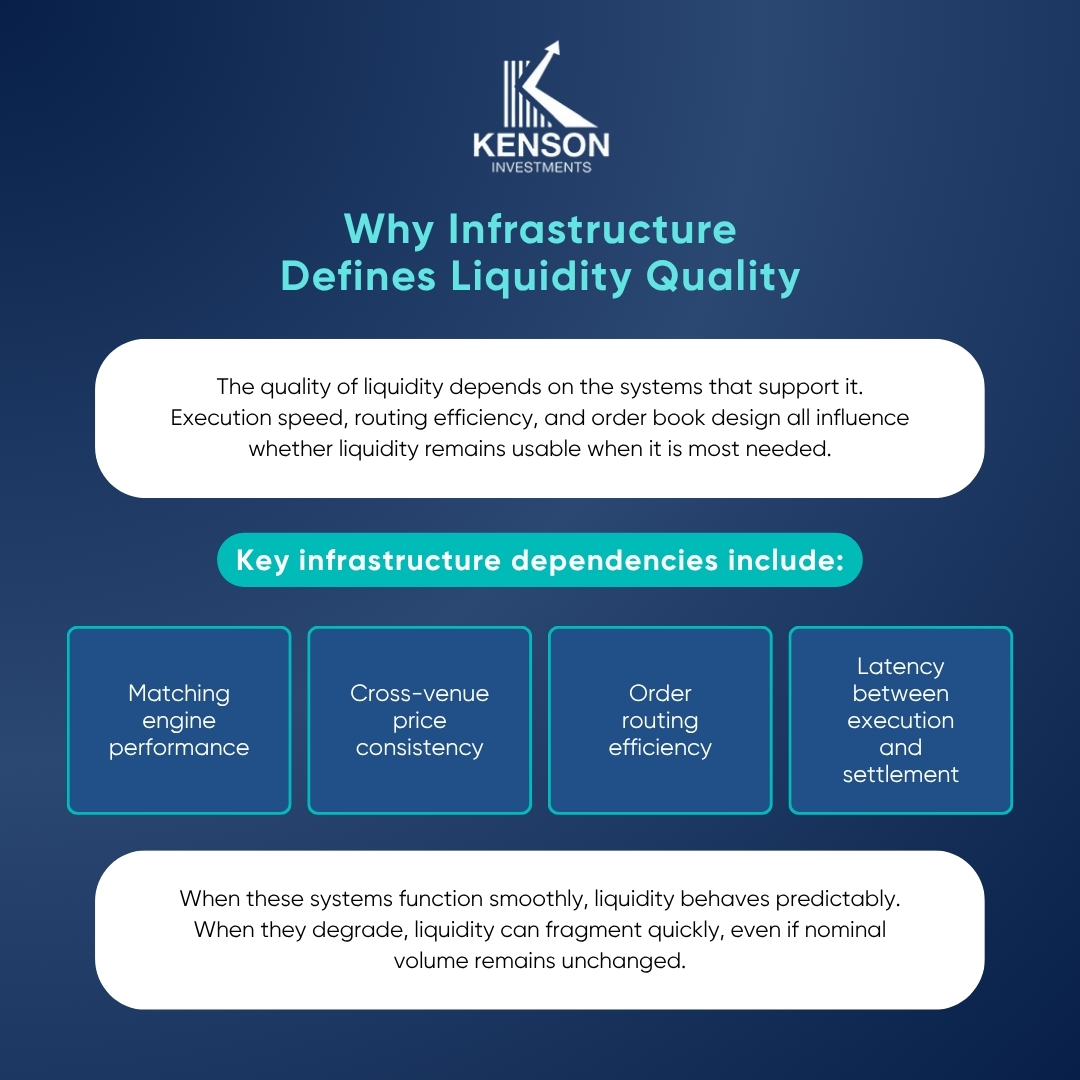
Liquidity is often discussed as if it exists on its own, separate from the systems that create, route, and settle it. In practice, liquidity only behaves as reliably as the infrastructure that supports it. For institutional investors, that distinction matters because visible trading activity can give the impression of stability even when the underlying plumbing is fragile.
Liquidity provision systems, collateral frameworks, and settlement architecture work together to determine whether markets can absorb trades, support borrowing, and clear positions without disruption.
When these layers are resilient, liquidity signals are more meaningful. When they are strained, the same signals can become misleading, reflecting temporary activity rather than durable market capacity.
This is why institutional evaluation of infrastructure resilience is essential. A market may appear liquid at the surface while relying on narrow collateral pathways, concentrated settlement dependencies, or fragile provider behavior beneath it. In those conditions, a spike in volume does not necessarily indicate strength. It may simply reflect a temporary compression of risk that disappears under stress.
For digital asset management consultants at Kenson Investments, the question is not whether liquidity is present. The question is whether the infrastructure behind it can support capital consistently, especially when markets become more demanding. That is where market stability is actually defined.
Liquidity Provision Systems as the First Layer of Stability
Liquidity provision systems sit at the front line of market functionality. They determine how easily assets can be bought, sold, or transferred without causing disproportionate price impact. In digital asset markets, these systems are distributed across centralized exchanges, decentralized protocols, and hybrid venues, each contributing differently to overall stability.
At a structural level, liquidity provision is not just about available volume—it is about continuity of execution under varying conditions. Markets that appear liquid during normal activity can behave very differently when participation shifts or order flow becomes uneven.
Where Liquidity Actually Comes From
Liquidity is created through a combination of participants and mechanisms:
- Market makers providing continuous bid-ask presence
- Automated liquidity pools in decentralized systems
- Institutional participants allocating capital across venues
- Arbitrage flows linking fragmented markets
Each of these components contributes to perceived stability. However, their reliability depends on how well they are supported by underlying infrastructure.
Fragility Hidden in Liquidity Distribution
Liquidity is often unevenly distributed across venues and assets. This creates structural dependencies that are not always visible at the surface level.
- Some assets rely heavily on a small number of liquidity providers
- Certain venues concentrate execution flow disproportionately
- Deeper liquidity may exist only under specific market conditions
This uneven structure means that liquidity can appear robust while remaining structurally concentrated. When conditions shift, that concentration becomes a vulnerability rather than a strength.
Collateral Frameworks and Their Role in Liquidity Stability
Liquidity does not exist independently of leverage and credit creation. In digital asset markets, collateral frameworks determine how much liquidity can be extended, how it is backed, and how quickly it can contract when conditions change. These systems act as the financial support structure beneath visible market activity.
While liquidity provision systems define how orders are matched, collateral frameworks define how much market activity is financially sustainable at any point in time. This distinction is critical for institutional evaluation because liquidity can appear abundant while remaining heavily dependent on leveraged collateral conditions.
Collateral as the Constraint on Liquidity Expansion
Collateral determines the upper bound of liquidity expansion across trading, lending, and derivatives markets. When collateral is abundant and stable, liquidity can scale efficiently. When it becomes constrained or volatile, liquidity capacity tightens quickly.
Key structural functions include:
- Supporting leveraged positions in trading systems
- Enabling lending markets through overcollateralization
- Backing derivatives exposure across platforms
- Providing liquidation buffers during volatility
Each of these functions links liquidity directly to collateral health.
The Leverage Effect on Market Stability
Collateral frameworks amplify or dampen liquidity depending on leverage conditions. When leverage increases, liquidity often appears deeper due to expanded participation. However, this depth is conditional—it depends on the continued stability of collateral values.
This creates a structural tension:
- Higher leverage increases apparent liquidity
- Lower collateral values reduce effective liquidity
- Rapid revaluation can compress both simultaneously
In this environment, liquidity is not only a function of participation but also of collateral confidence across the system.
Collateral Chains and Hidden Dependencies
Modern digital markets increasingly operate through interconnected collateral chains. Assets used in one protocol may be rehypothecated or reused in another, creating layered exposure across systems.
This introduces structural dependencies such as:
- Shared collateral backing multiple liquidity venues
- Cross-protocol exposure to the same underlying assets
- Indirect leverage loops across platforms
These connections mean that collateral stress in one area can reduce liquidity availability elsewhere, even if those markets appear unrelated on the surface.
Institutional Interpretation of Collateral Strength
From an institutional perspective, collateral is not assessed only by quantity but by behavior under stress. Key considerations include:
- Stability of collateral valuation during volatility
- Speed and predictability of liquidation mechanisms
- Depth of markets absorbing collateral exits
- Degree of concentration in collateral usage
These factors determine whether collateral supports liquidity resilience or introduces systemic fragility.
Settlement Architecture and Execution Continuity
Settlement architecture is the final layer that determines whether liquidity and collateral systems translate into completed transactions. While liquidity provision enables trading and collateral frameworks to support leverage, settlement systems ensure that obligations are finalized and capital is correctly transferred across participants.
In digital asset markets, settlement is often fragmented across exchanges, blockchains, custodial systems, and cross-protocol environments. This fragmentation introduces variability in execution timing, finality, and operational certainty. For institutions, these variables directly influence how liquidity signals are interpreted.

Where Execution Risk Actually Emerges
Execution risk does not only arise from price movement. It often originates in the settlement layer, where delays or inconsistencies can distort the perception of market stability.
Common structural points of friction include:
- Delayed finality in blockchain settlement systems
- Mismatches between trade execution and asset transfer timing
- Cross-platform reconciliation gaps
- Dependency on intermediaries for clearing or custody
These issues do not always appear in volume or price data, but they directly affect whether liquidity can be reliably accessed and exited.
Settlement Speed vs Settlement Certainty
A key institutional distinction is between speed and certainty. High-speed systems may improve execution efficiency, but without deterministic finality, they can introduce ambiguity in risk exposure.
- Faster settlement reduces exposure duration
- Certain settlement reduces counterparty ambiguity
- Uncertain systems increase hidden operational risk
When certainty is lacking, liquidity becomes less predictable, even if transaction throughput remains high.
Mini Insight: Liquidity Is Only Real After Settlement
Liquidity is often measured at the point of execution, but its true validity is only confirmed after settlement is complete. Until that point, exposure remains open to timing, reconciliation, and counterparty dependencies.
This means liquidity signals are only as reliable as the settlement systems validating them.
Infrastructure Fragmentation and Market Interpretation
In fragmented settlement environments, identical liquidity conditions can produce different risk outcomes depending on where execution occurs. This creates challenges for interpretation:
- A trade executed on one venue may settle instantly
- The same trade elsewhere may involve delays or reconciliation risk
- Cross-venue differences distort perceived liquidity strength
As a result, liquidity cannot be evaluated independently of settlement architecture. It must be interpreted alongside execution pathways and finality mechanisms.
Align Capital With Infrastructure That Supports Real Liquidity
At Kenson Investments, liquidity is not evaluated as an isolated market signal. It is interpreted as the outcome of a multi-layered infrastructure system composed of liquidity provision mechanisms, collateral frameworks, and settlement architecture.
Each layer contributes differently to market stability, and each must function cohesively for liquidity to be considered structurally reliable.
Rather than focusing on surface-level indicators such as trading volume or short-term spreads, the emphasis is placed on whether liquidity is supported by durable infrastructure under varying conditions. This includes how capital is provisioned, how exposure is backed, and how transactions are finalized across fragmented systems.
Structural Evaluation Over Surface Signals
Institutional risk evaluation requires separating visible liquidity from functional liquidity. What appears active in the market may still be constrained by hidden dependencies across collateral chains or settlement delays.
Kenson’s framework assesses liquidity through structural dimensions:
- Provision layer integrity– Are liquidity sources stable and diversified, or concentrated and reactive?
- Collateral resilience– Does the system maintain backing strength during volatility and leverage cycles?
- Settlement certainty– Are trades finalized consistently across venues and conditions?
This layered approach ensures that liquidity is not interpreted in isolation but within the full operational architecture that supports it.
Engage with our digital asset management consultants to align your strategy with infrastructure-driven liquidity evaluation, where market stability is defined not by perception, but by structural capability.
Disclaimer: The information provided on this page is for educational and informational purposes only and should not be construed as financial advice. Crypto currency assets involve inherent risks, and past performance is not indicative of future results. Always conduct thorough research and consult with a qualified financial advisor before making investment decisions.
“The crypto currency and digital asset space is an emerging asset class that has not yet been regulated by the SEC and the US Federal Government. None of the information provided by Kenson LLC should be considered as financial investment advice. Please consult your Registered Financial Advisor for guidance. Kenson LLC does not offer any products regulated by the SEC, including equities, registered securities, ETFs, stocks, bonds, or equivalents.”