









Collateral has always been central to financial trust, but the way it is observed and evaluated is undergoing a structural shift. In traditional markets, collateral assessment relied on periodic disclosures, balance sheet reporting, and credit-based frameworks that offered only a delayed view of exposure. Confidence was built on snapshots rather than continuous observation.
In digital asset markets, this model is being replaced by systems that allow collateral positions to be verified in real time. Blockchain-based infrastructure enables direct visibility into asset holdings, smart contract locks, and movement of funds across wallets and protocols. As a result, institutions are no longer dependent solely on representations of collateral—they can observe it directly as it evolves.
This transition is reshaping the foundations of counterparty confidence. Risk is no longer defined only by what is reported, but by what is continuously observable. However, this does not eliminate uncertainty; instead, it changes its form. The focus shifts from whether collateral exists to how reliably it can be tracked, interpreted, and validated across interconnected systems.
As markets expand across multiple chains, platforms, and custody layers, collateral visibility becomes more than an informational advantage. It becomes a structural component of trust, influencing how institutions evaluate exposure, price risk, and engage with counterparties in real time.
What is Collateral Visibility in Financial Systems
Collateral visibility refers to how clearly and accurately market participants can observe the assets pledged to secure financial obligations. In traditional systems, collateral information is often fragmented across custodians, internal ledgers, audits, and periodic disclosures. This creates delays and information asymmetry, which can increase uncertainty during volatile market conditions.
In contrast, digital financial infrastructure—particularly blockchain-based systems—enables continuous or near-real-time visibility into collateral positions. Assets can be tokenized, recorded onchain, and verified through transparent ledger systems. This creates a shared source of truth that multiple participants can independently audit.
Key dimensions of collateral visibility include:
- Asset transparency: knowing what assets back a position or obligation
- Valuation clarity: understanding real-time collateral value changes
- Liquidity visibility: assessing how quickly collateral can be liquidated
- Encumbrance tracking: identifying whether assets are already pledged elsewhere
- Verification accessibility: ability for third parties to independently confirm collateral status
When these dimensions are visible, uncertainty decreases and trust increases across the financial network.
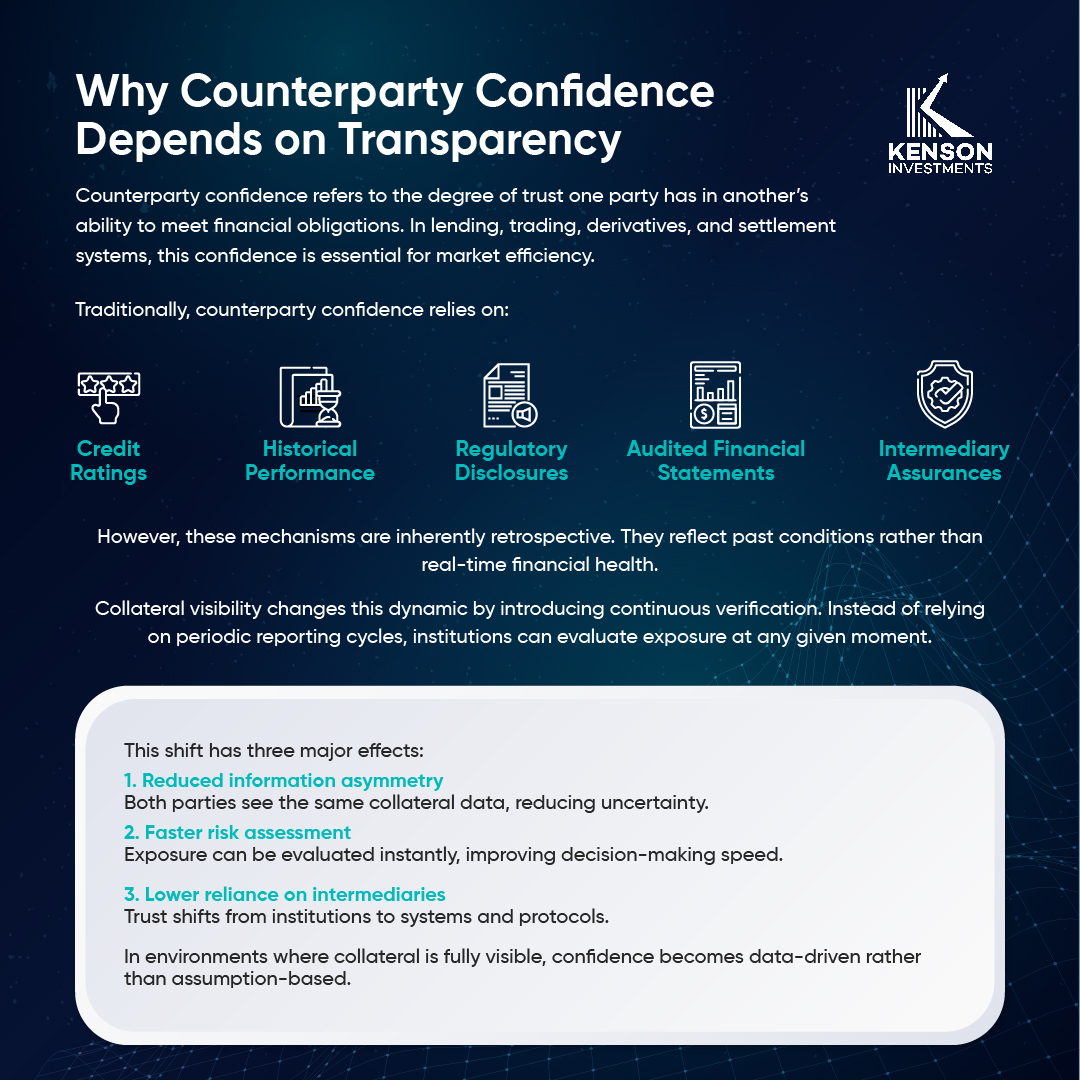
The Role of Onchain Verification Mechanisms
Blockchain systems such as Ethereum have introduced a new paradigm for financial transparency. Onchain verification allows collateral assets to be recorded and validated on a distributed ledger that is accessible to all participants.
Instead of relying on private reconciliation processes, institutions can verify:
- Asset ownership
- Collateral lock-up status
- Smart contract enforcement rules
- Real-time margin requirements
- Liquidation thresholds
This is particularly powerful in decentralized finance ecosystems, where smart contracts automatically enforce collateral rules without human intervention.
For example, lending protocols can require overcollateralization, and the system itself ensures compliance. If collateral value falls below a threshold, liquidation can occur automatically according to predefined rules. This reduces counterparty disputes and minimizes execution delays.
The result is a system where trust is embedded in code rather than negotiated through institutional relationships.
How Collateral Transparency Reduces Perceived Risk
Risk perception in financial markets is often driven by uncertainty rather than actual exposure. When institutions cannot clearly see collateral positions, they tend to price in additional risk premiums.
Collateral visibility reduces this uncertainty in several ways:
1. Improved Asset Quality Assessment
Institutions can evaluate not only the value of collateral but also its composition. High-quality, liquid collateral increases confidence, while volatile or illiquid assets are quickly identified.
2. Real-Time Risk Monitoring
Instead of waiting for end-of-day or end-of-month reports, participants can continuously monitor collateral health. This reduces surprise failures and margin shocks.
3. Early Warning Signals
Transparent systems make it easier to detect weakening collateral positions before they become critical, allowing for proactive risk management.
4. Reduced Contagion Risk
When exposure is visible across interconnected institutions, systemic risk can be identified earlier, limiting cascading failures.
In essence, visibility transforms risk from a hidden variable into a measurable and manageable metric.
Institutional Adoption and Market Evolution
Traditional financial institutions are increasingly exploring digital infrastructure that enhances collateral transparency. Custodians, clearinghouses, and trading platforms are integrating real-time reporting tools and tokenized asset systems.
A major driver of this shift is the growing interest in tokenized financial markets and digital settlement layers. These systems allow assets to exist both as legal claims and digital representations, enabling synchronized visibility across multiple participants.
Institutions such as asset managers, prime brokers, and liquidity providers are particularly focused on:
- Reducing settlement risk
- Improving margin efficiency
- Enhancing cross-border collateral mobility
- Increasing operational transparency
As markets become more interconnected, collateral visibility is no longer optional—it becomes a competitive advantage.
The Impact on Counterparty Relationships
In traditional finance, counterparty relationships are often built over years of repeated interaction, legal agreements, and trust frameworks. While these remain important, collateral visibility introduces a new layer of trust architecture.
With transparent collateral systems:
- New counterparties can interact with reduced onboarding friction
- Existing relationships become more efficient and data-driven
- Trust is reinforced by verifiable financial states rather than subjective assessment
This reduces dependency on long trust-building cycles and allows institutions to engage more dynamically across markets.
In decentralized systems, this is even more pronounced. Smart contracts and transparent reserves eliminate the need for bilateral trust assumptions entirely. Instead, trust is distributed across protocol rules and verifiable data.
The Role of Transparent Reserve Structures
One of the most important applications of collateral visibility is in reserve-backed systems. Transparent reserves allow participants to verify that issued liabilities are fully backed by real assets.
This concept has gained attention in both centralized and decentralized markets. When reserve data is publicly accessible or cryptographically verifiable, confidence in the issuing entity increases significantly.
Benefits include:
- Higher market credibility
- Reduced redemption uncertainty
- Lower systemic risk
- Increased investor participation
In environments where reserves are opaque, speculation and uncertainty can destabilize confidence quickly. Transparency acts as a stabilizing force.
Challenges and Limitations of Full Visibility
While collateral visibility offers significant benefits, it is not without challenges.
1. Privacy Concerns
Full transparency may expose sensitive trading strategies or institutional positions.
2. Data Standardization
Different systems may represent collateral differently, making cross-platform interpretation difficult.
3. Oracle and Data Integrity Risks
If external data feeds are inaccurate or manipulated, visibility becomes misleading.
4. Scalability Constraints
Real-time verification of large-scale collateral systems requires significant computational infrastructure.
These challenges suggest that while full transparency is ideal in theory, practical implementations often require a balance between visibility and privacy.

The Future of Collateral Visibility in Financial Markets
The future of collateral management is likely to be shaped by hybrid systems that combine traditional financial infrastructure with blockchain-based verification layers.
We can expect several trends to emerge:
- Increased tokenization of real-world assets
- Expansion of onchain collateral tracking systems
- Greater use of automated risk monitoring tools
- Integration of transparency layers into traditional banking systems
- Development of standardized collateral reporting protocols
Networks are also playing a role in bridging offchain and onchain data, enabling more accurate and reliable collateral verification across systems.
As these technologies mature, collateral visibility will likely become a baseline expectation rather than an innovation.
Preparing for the Next Era of On-Chain Risk Visibility
As markets continue to evolve toward transparency-driven infrastructure, institutions that prioritize collateral visibility and real-time verification frameworks will be better positioned to manage exposure, reduce friction, and strengthen long-term counterparties relationships.
For organizations exploring structured approaches to digital asset risk, governance, and institutional-grade strategy design, Kenson Investments provides insights into disciplined capital allocation frameworks and evolving digital market structures that align with modern transparency standards.
Learn more about how institutional strategies are adapting to always-on digital markets with our blockchain asset investments consultants.
Disclaimer: The information provided on this page is for educational and informational purposes only and should not be construed as financial advice. Crypto currency assets involve inherent risks, and past performance is not indicative of future results. Always conduct thorough research and consult with a qualified financial advisor before making investment decisions.
“The crypto currency and digital asset space is an emerging asset class that has not yet been regulated by the SEC and the US Federal Government. None of the information provided by Kenson LLC should be considered as financial investment advice. Please consult your Registered Financial Advisor for guidance. Kenson LLC does not offer any products regulated by the SEC, including equities, registered securities, ETFs, stocks, bonds, or equivalents.”