



In digital asset management, risk is not a concept to address after the fact—it is a discipline applied before capital ever moves. High-net-worth investors and institutional allocators understand that post-trade corrections cannot reliably prevent losses.
In fast-moving, programmable markets, pre-trade risk controls are essential to ensuring exposure aligns with strategy, operational policies, and compliance standards.
Pre-trade risk controls shift the focus upstream, embedding safeguards into every trade, transfer, or market interaction. These controls are not about predicting price movements or generating outsized gains—they exist to protect investor capital, manage operational risk, and maintain disciplined exposure across volatile markets.
Embedding Pre-Trade Risk Controls
Pre-trade risk controls are the mechanisms that prevent errors, misallocations, and breaches of policy before a transaction occurs. Unlike post-trade reviews, which identify mistakes after capital is at risk, these controls act as a proactive layer of protection.
For example, digital asset consultants implement controls that validate transaction size against risk limits, check counterparties, verify wallet addresses, and ensure compliance with internal governance standards. By moving the checkpoint upstream, institutions reduce the likelihood of errors and prevent costly operational incidents.
Key elements of pre-trade risk control include:
- Transaction validation:Ensuring all orders conform to portfolio guidelines, risk thresholds, and authorized exposure levels.
- Counterparty and venue verification:Confirming the legitimacy and reliability of counterparties or platforms to reduce execution risk.
- Automated alerts:Flagging orders that exceed pre-set risk parameters for review before execution.
- Policy enforcement:Embedding internal governance and compliance rules directly into trading platforms or execution workflows.
Each of these elements demonstrates that operational discipline is integrated, not optional, creating a structured framework where capital cannot move without passing a defined set of safeguards.
Why Upstream Controls Are Critical in Digital Asset Markets
Digital assets are inherently volatile, with market conditions capable of shifting within minutes. Traditional post-trade risk management—checking positions or reconciling accounts after execution—is reactive and often insufficient.
Mistakes such as incorrect wallet addresses, oversized allocations, or technical failures can occur faster than corrective measures can be applied.
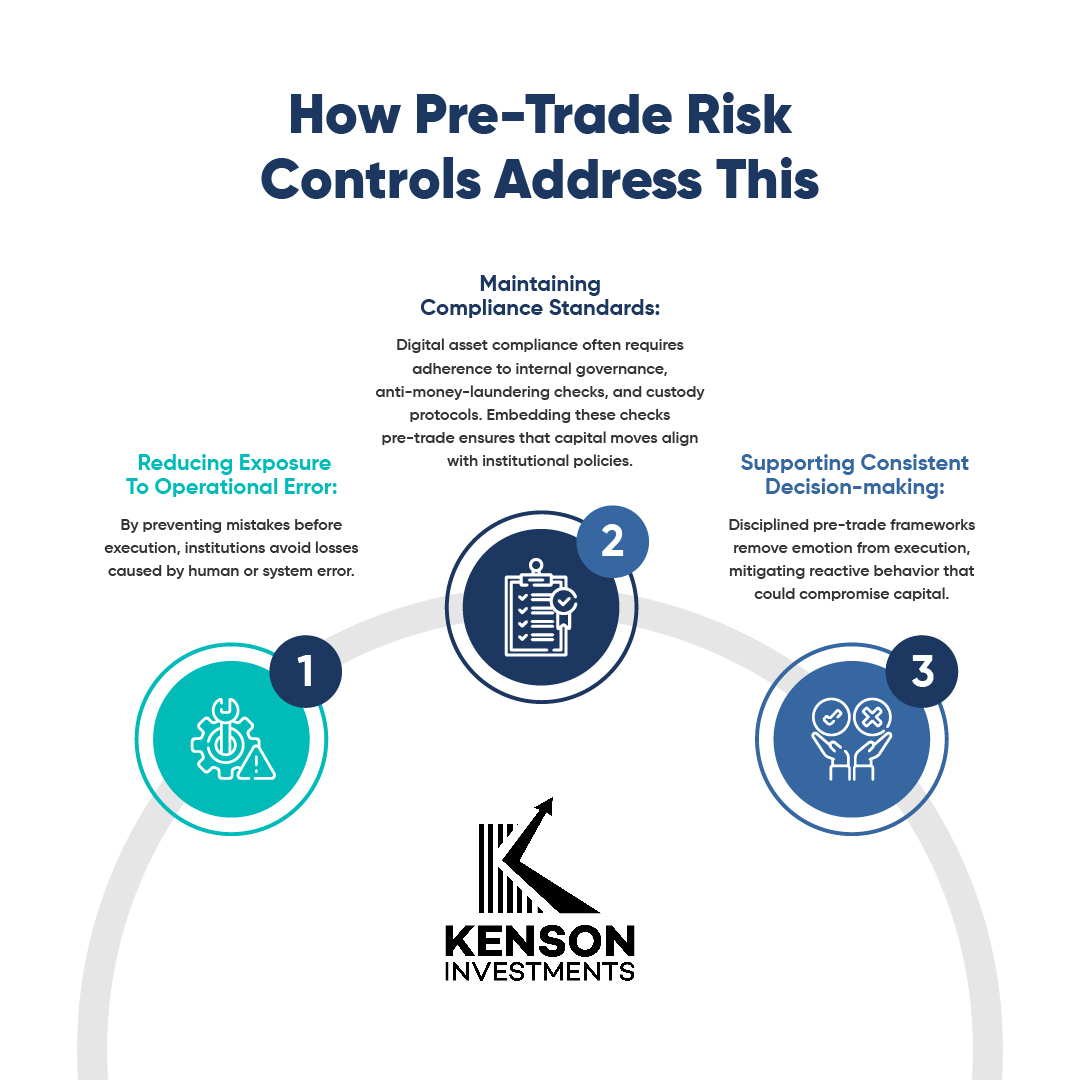
By emphasizing upstream controls, institutions shift from a corrective mindset to a preventive posture, which aligns with Kenson’s philosophy of measured, risk-aware digital asset management.
Operational Risk Management in Digital Assets
Operational risk in digital assets can arise from many sources: incorrect execution, software vulnerabilities, misconfigured smart contracts, or even human error. Pre-trade controls act as preventative barriers, reducing the likelihood that these errors translate into losses.
Some of the most effective pre-trade mechanisms include:
- Smart contract verification:Ensuring code governing programmable transactions behaves as intended, avoiding execution errors.
- Exposure reconciliation:Pre-trade systems automatically confirm that the intended position aligns with strategy and existing holdings.
- Liquidity checks:Automated validation that the market can absorb the trade without unintended slippage or market impact.
Pre-trade risk controls convert operational risk from a reactive concern into a proactive shield. Capital moves only when it aligns with established risk parameters, governance policies, and compliance standards.
The Role of Digital Asset Compliance
Compliance is now an integral to pre-trade frameworks. Digital asset compliance standards ensure that every transaction adheres to legal, regulatory, and internal governance requirements before execution. While digital assets remain largely unregulated, institutions implementing these controls reduce operational and reputational risks significantly.
- Audit trails:Pre-trade validation generates immutable records, documenting who authorized transactions, the rationale, and the controls applied.
- Segregated accounts:Compliance standards often require segregation of operational and client-controlled funds to prevent misallocation.
- Regulatory alignment checks:Even in unregulated markets, institutions can ensure adherence to best practices, internal policies, and any applicable tax or reporting obligations.
By embedding digital asset compliance directly into operational workflows, pre-trade risk controls maintain discipline, safeguard capital, and demonstrate to investors that the institution treats operational integrity as paramount.
Automation as a Risk Management Tool
Programmable markets enable risk management to be built into every step of execution. Automation ensures that pre-trade controls are applied consistently, reducing reliance on manual checks and limiting the opportunity for human error.
- Rule-based engines:Trades can be automatically blocked or flagged if they violate pre-set operational rules.
- Real-time alerts:Any deviation from approved exposure or procedural checks triggers immediate notification for review.
- Scenario simulations:Automated systems can run “what-if” analyses before execution, estimating potential outcomes and stress points.
Automation does not replace human oversight—it complements it, ensuring that capital deployment is disciplined, controlled, and consistent. For institutional investors, this approach prioritizes predictability over speculation.
Integrating Pre-Trade Controls into Governance
Effective risk governance embeds pre-trade controls into the institution’s broader operational framework. Governance structures define the rules, responsibilities, and escalation procedures associated with each transaction.
- Defined risk appetite:Establishing exposure thresholds and procedural limits allows institutions to act decisively while maintaining capital protection.
- Approval hierarchies:Multi-layered authorization structures ensure transactions are reviewed and verified before execution.
- Continuous monitoring:Even after pre-trade approval, positions are continuously monitored to detect anomalies or unintended deviations.
When governance is combined with pre-trade controls, discipline becomes operational, not just aspirational. Capital moves only within the framework of established rules, minimizing risk and enhancing investor confidence.
Operational Risk Management Benefits
Embedding pre-trade risk controls provides several tangible benefits for institutional digital asset portfolios:
- Capital protection:Preventing errors before execution directly reduces potential losses.
- Regulatory alignment:While digital assets are an emerging class, internal compliance with policies demonstrates a commitment to best practices and governance.
- Process consistency:Standardized pre-trade workflows reduce reliance on individual judgment, creating predictable outcomes even during market volatility.
- Reduced operational friction:By handling verification, validation, and compliance checks upstream, execution becomes smoother and more reliable.
In essence, operational discipline minimizes avoidable risk, leaving managers free to focus on strategy and asset allocation rather than remediation.

Why Post-Trade Checks Are Not Enough
Relying on post-trade checks places institutions in a reactive position. Delays in identifying mistakes or compliance violations can result in:
- Loss of digital assets due to misrouted transactions
- Breaches of internal exposure limits
- Errors in reconciliation that require time-intensive correction
- Reduced investor confidence due to avoidable operational failures
Pre-trade risk controls shift the focus upstream, addressing potential failures before capital is exposed.
The Kensons Approach to Pre-Trade Risk Management
At Kenson Investments, pre-trade risk controls are embedded into every step of digital asset management. By focusing on pre-trade controls rather than post-trade remediation, our digital asset management consultants ensure that capital moves only when all risk and compliance requirements are satisfied. This reinforces disciplined execution and long-term capital preservation. Our approach spans blockchain and digital asset consulting, digital asset investment solutions, and guidance on stablecoins for investment, ensuring every client has access to a trusted cryptocurrency investment consultant at every stage of execution.
Strengthen Your Pre-Trade Framework Now – Call 1.800.970.2506 to connect with a digital asset specialist today to review your pre-trade risk strategy and align execution protocols with best-in-class operational discipline.
Disclaimer: The information provided on this page is for educational and informational purposes only and should not be construed as financial advice. Crypto currency assets involve inherent risks, and past performance is not indicative of future results. Always conduct thorough research and consult with a qualified financial advisor before making investment decisions.
“The crypto currency and digital asset space is an emerging asset class that has not yet been regulated by the SEC and the US Federal Government. None of the information provided by Kenson LLC should be considered as financial investment advice. Please consult your Registered Financial Advisor for guidance. Kenson LLC does not offer any products regulated by the SEC, including equities, registered securities, ETFs, stocks, bonds, or equivalents.”