









Digital assets were designed to allow individuals to hold and control value without relying on traditional intermediaries, a shift that has increased the importance of Digital assets consulting in helping individuals understand structural risk differences. This structural shift removes layers of institutional oversight that have historically absorbed errors, reversed transactions, or mitigated operational failures.
As a result, ownership without intermediaries fundamentally changes how mistakes occur, how quickly they escalate, and whether recovery is possible at all.
Recent data from blockchain analytics firms and custodial service providers highlights a growing awareness gap. As more individuals engage directly with self-custodied digital assets, the margin for error narrows. Small operational missteps that might be corrected in intermediated finance can become irreversible when ownership is direct.
How Intermediated Finance Absorbs Operational Errors
Traditional financial systems rely on intermediaries such as banks, custodians, clearinghouses, and payment processors. These entities perform multiple risk-buffering functions, many of which are invisible to end users.
When an incorrect transaction is initiated in a bank-managed account, several safeguards may exist:
- Delayed settlement windows
- Manual review processes
- Fraud detection systems
- Customer service escalation paths
- Regulatory dispute frameworks
According to Federal Reserve data, a significant percentage of erroneous wire transfers are either halted or partially recovered due to intermediary intervention. While not guaranteed, institutional systems often provide time-based friction that limits how quickly mistakes become permanent.
These protections are built into account-based ownership models where control is shared between the account holder and the institution.
Direct Ownership Removes Error Buffers
Self-custodied digital assets operate under a different model. Ownership is established through cryptographic keys rather than accounts. Control is absolute, but so is responsibility.
Once a transaction is broadcast to a blockchain and confirmed, it becomes immutable. There is no central authority capable of reversing it. This design supports transparency and censorship resistance, but it also means that self-custody responsibility extends beyond basic security into operational precision.
Blockchain analytics platforms report that billions in digital asset value remain permanently inaccessible due to:
- Lost private keys
- Incorrect wallet addresses
- Unsupported network transfers
- Improper storage practices
These outcomes are not typically caused by malicious activity. Most losses stem from small procedural errors that compound rapidly.
Direct Ownership Removes the Safety Net
Self-custodied digital assets operate under a different framework. Ownership is determined by control of cryptographic keys, not by account records held by an institution. Transactions are executed on public blockchains and, once confirmed, cannot be altered or reversed by a third party.
This design eliminates reliance on intermediaries, but it also removes institutional error correction. A misplaced key, an incorrect address, or a misunderstood transaction setting does not trigger a review process. The system executes exactly what is submitted.
In this environment, small operational mistakes are not paused or filtered. They settle permanently.

Error Tolerance Shrinks Under Self-Custody
In self-custodied systems, error tolerance is significantly lower. A single action—performed once—can have lasting consequences.
Examples of common operational risks include:
- Sending assets to an incompatible or incorrect blockchain address
- Losing access credentials without a recovery method
- Misconfiguring transaction parameters
- Interacting with unfamiliar smart contracts without understanding permissions
Each of these actions may appear minor at the moment of execution. However, because there is no intermediary with authority to intervene, the margin for correction narrows dramatically.
This is a defining characteristic of digital asset ownership risk: finality replaces discretion, reinforcing the need for structured Blockchain asset consulting when navigating direct control environments.
Compounding Through Irreversibility
In traditional finance, compounding is often discussed in the context of growth. In self-custodied digital asset systems, compounding also applies to errors.
A small operational oversight can trigger a chain of secondary consequences. Loss of access may prevent timely portfolio rebalancing. A mistaken transfer may eliminate liquidity needed for other obligations. A misunderstood permission setting may expose additional assets unintentionally.
Because errors cannot be unwound, subsequent decisions must be made under altered conditions. Over time, the impact of the original mistake grows—not because of market movement alone, but because the user’s options have narrowed.
Responsibility Shifts From Institutions to Individuals
Self-custody responsibility is not limited to holding assets. It includes:
- Secure key management
- Understanding transaction mechanics
- Evaluating on-chain interactions
- Maintaining accurate records
In intermediated systems, many of these functions are abstracted away. Statements are generated automatically. Errors are flagged. Compliance teams monitor anomalies.
With direct ownership, these responsibilities converge at the individual level. There is no default monitoring layer. The blockchain records activity, but interpretation and response depend entirely on the owner.
This concentration of responsibility increases precision requirements. Actions must be correct the first time.
Recovery Paths Are Narrow and Time-Sensitive
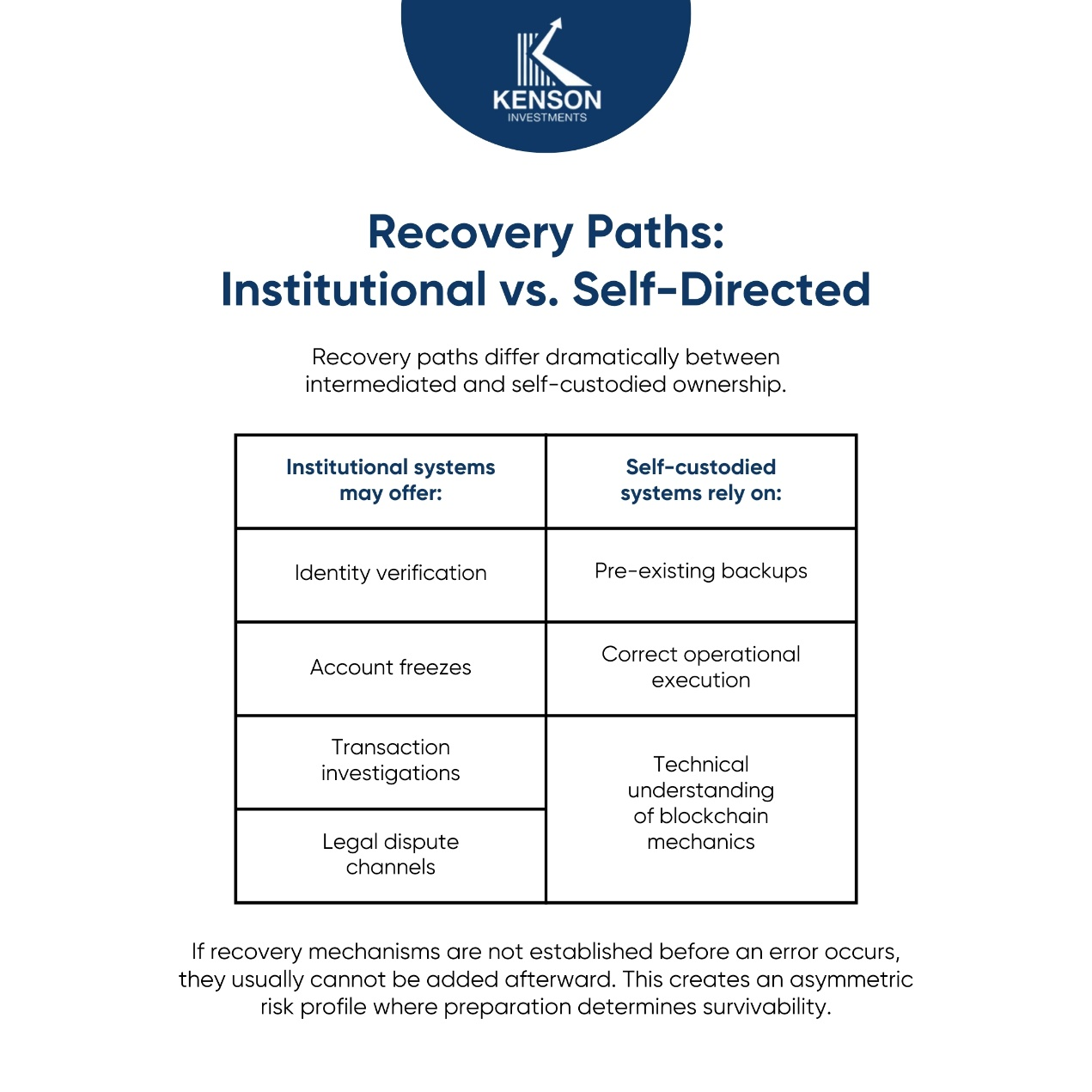
Another defining difference between intermediated finance and self-custody lies in recovery paths.
In traditional systems, recovery is often procedural. Even if resolution takes time, it remains possible because authority is centralized.
In self-custodied systems, recovery—when it exists at all—is technical rather than procedural. It may depend on:
- Possession of backup credentials
- Preconfigured recovery mechanisms
- Compatibility between networks or platforms
If these conditions are not met in advance, recovery options may be nonexistent. The absence of a fallback authority means preparation must occur before an issue arises.
Operational Knowledge Becomes a Risk Variable
Market volatility is commonly cited when discussing digital assets, but operational understanding is an equally significant variable.
Two individuals may hold identical assets and experience vastly different outcomes depending on:
- How transactions are executed
- How access credentials are stored
- How permissions are managed
- How records are maintained
This divergence does not require market movement. It stems from execution quality.
In self-custodied environments, operational discipline directly affects outcomes. Minor lapses can escalate without warning.
Why Small Errors Escalate Faster
Several structural factors explain why mistakes compound more rapidly without intermediaries:
Final settlement
Blockchain transactions are designed to be immutable. This removes ambiguity but also removes discretion.
No centralized arbitration
There is no authority empowered to pause or reverse actions after execution.
Technical abstraction
Interfaces may simplify actions visually while masking underlying complexity, increasing the chance of misinterpretation.
Delayed awareness
Errors are sometimes discovered only after confirmation, when remediation is no longer possible.
Together, these factors compress the timeline between action and consequence.
Operational Complexity Is Often Underestimated
Self-custody is frequently described as “owning your assets,” but ownership in cryptographic systems involves ongoing operational tasks.
These include:
- Secure key generation
- Offline storage management
- Software updates
- Network compatibility checks
- Transaction fee calibration
Each task introduces its own risk surface. Unlike traditional accounts, these risks do not diminish over time. They remain active for as long as ownership persists.
This ongoing complexity explains why digital asset ownership risk increases with time if operational discipline is not maintained.
How Compounding Errors Affect Long-Term Outcomes
Long-term outcomes in self-custodied systems are heavily influenced by early operational habits.
Small decisions made at the start — such as backup methods or transaction verification routines — have outsized effects later. Because errors cannot be rolled back, early discipline acts as a compounding safeguard.
Blockchain security research indicates that users with structured operational processes experience significantly fewer loss events over extended periods.
The absence of intermediaries means that consistency replaces correction as the primary risk control.
Transparency Without Protection
Public blockchains offer transparency through open ledgers. Every transaction is recorded and verifiable. However, transparency does not equate to protection.
Visibility allows users to see what has occurred, not to change it. This distinction is critical. While traditional systems often combine transparency with corrective authority, self-custodied systems separate the two.
Understanding this distinction is central to managing self-custody responsibility, particularly when incorporating Digital asset consulting for compliance into operational decision-making.

Education as Risk Mitigation
Because intermediaries do not absorb errors, education becomes a primary risk control. Knowing how systems function is not optional; it is foundational.
Key areas of understanding include:
- Address formats and network compatibility
- Transaction finality and confirmation mechanics
- Permission structures in smart contracts
- Secure credential storage practices
Education does not eliminate risk, but it reduces the likelihood of unforced errors.
The Psychological Shift of Direct Control
Ownership without intermediaries also changes decision-making behavior. The awareness that actions are final can increase caution, but it can also introduce hesitation or overcorrection.
Unlike traditional platforms where support channels exist, self-custody requires confidence grounded in knowledge. Uncertainty itself becomes a form of risk if it leads to rushed or reactive actions.
This psychological dimension reinforces why operational clarity matters as much as market awareness.
System Design Reflects Responsibility Allocation
The design of blockchain systems reflects a philosophical tradeoff: autonomy in exchange for accountability.
Intermediated systems prioritize protection through oversight. Self-custodied systems prioritize control through decentralization. Neither model is inherently superior, but they demand different competencies.
Understanding where responsibility resides is essential before engaging with direct ownership structures.
Kenson Investments: Helping You Navigate Digital Asset Ownership With Clarity
At Kenson Investments, the focus remains on education and general market insights related to digital assets and blockchain-based ownership structures. Direct ownership introduces unique operational considerations that differ significantly from traditional financial systems, particularly in how errors occur and compound over time.
Our digital asset management consultants provide resources designed to help individuals better understand digital asset ownership risk and the responsibilities associated with self-custody, reflecting the broader role of a digital asset management consultant in long-term operational planning.
To learn more about how ownership structures influence responsibility and risk awareness, join the tribe and access the educational materials available through Kenson Investments.
Disclaimer: The information provided on this page is for educational and informational purposes only and should not be construed as financial advice. Crypto currency assets involve inherent risks, and past performance is not indicative of future results. Always conduct thorough research and consult with a qualified financial advisor before making investment decisions.
“The crypto currency and digital asset space is an emerging asset class that has not yet been regulated by the SEC and the US Federal Government. None of the information provided by Kenson LLC should be considered as financial investment advice. Please consult your Registered Financial Advisor for guidance. Kenson LLC does not offer any products regulated by the SEC, including equities, registered securities, ETFs, stocks, bonds, or equivalents.”