









Market activity in digital assets can appear strong on the surface. Trading volumes rise, order books update rapidly, and price discovery seems active across multiple venues. But activity alone does not always reflect real liquidity conditions—the amount of capital that can actually be executed without meaningful market impact.
This divergence has become more pronounced as markets fragment across exchanges, protocols, and automated liquidity systems. What looks like depth in aggregated data may not translate into executable liquidity when large positions need to be entered or exited.
For institutions, this creates a critical distinction between reported activity and functional liquidity. One reflects visibility. The other reflects capacity.
The result is a growing digital asset liquidity illusion, where surface-level metrics suggest stability while underlying execution conditions remain far more fragile.
Trading Volume as a Misleading Signal
Trading volume is often used as a primary indicator of market strength. Higher volume is typically interpreted as higher liquidity, deeper markets, and stronger participation. In reality, volume only shows that transactions occurred—not how easily those transactions could be replicated at scale.
Several structural issues distort this signal:
- High-frequency tradingcan inflate volume without adding depth
- Internalized or matched trades may not reflect true external liquidity
- Fragmented venues can duplicate activity across systems
- Short-term speculative flows can dominate reported metrics
This creates an environment where activity is visible but not always usable. A market may appear liquid in data feeds while still being unable to absorb larger institutional orders without slippage.
Executable Depth vs Reported Activity
The key distinction institutions focus on is not how much is trading, but how much can be executed at stable pricing. This is referred to as executable depth.
Executable depth refers to:
- The amount of capital available at each price level
- The stability of order books under execution pressure
- The willingness of liquidity providers to absorb size
Reported activity, by contrast, simply reflects completed trades. It does not account for whether liquidity was structurally available or temporarily present.
In volatile conditions, this gap becomes more visible. Orders that appear small relative to total volume can still move prices significantly if true depth is limited or withdrawn.
| Liquidity Is What Survives Execution Liquidity is often mistaken for presence. In practice, liquidity is defined by what remains stable when it is actually used. If depth disappears when size enters the market, it was never fully reliable liquidity—only transient activity. |
Why Liquidity Illusions Form in Digital Markets
Digital asset markets are particularly exposed to liquidity misinterpretation due to their structure. Multiple trading venues, automated market makers, and synthetic instruments create overlapping layers of reported activity.
This leads to several structural effects:
- Fragmentation of order flowacross platforms
- Replication of volume signalsacross multiple venues
- Inconsistent liquidity qualitybetween markets
- Rapid shifts in participation during volatility
In stable conditions, these layers appear to reinforce one another. During stress, they often separate, revealing gaps between visible activity and actual execution capacity.
The illusion forms because aggregated data does not distinguish between independent liquidity and duplicated or conditional liquidity.
Volatility Reveals Structural Depth
Market stress is where liquidity validation becomes essential. When volatility increases, participants adjust behavior quickly:
- Liquidity providers widen spreads or reduce exposure
- Market makers withdraw or scale back quoting size
- Arbitrage activitybecomes more selective
- Order books thin out unevenly across venues
At this point, reported volume may remain elevated while executable depth declines. This is where the liquidity illusion becomes most visible.
Prices can continue to update frequently, creating the appearance of activity, even as the ability to transact large sizes without impact diminishes.
Fragmentation Amplifies the Gap
One of the key drivers of the liquidity illusion is market fragmentation. When liquidity is spread across multiple systems, each venue may show only part of the overall picture.
This creates structural challenges:
- Depth appears larger when aggregated, but is thinner per venue
- Execution across venues may not be synchronized
- Arbitrage activity can mask underlying liquidity gaps
- Order routing becomes a critical factor in execution quality
Fragmentation does not reduce liquidity directly. It redistributes it in a way that makes interpretation more complex.
As a result, institutions must evaluate not just total liquidity, but liquidity accessibility within specific execution pathways.
Behavioral Effects of Apparent Liquidity
Perceived liquidity also influences participant behavior. When markets appear deep and active, participants tend to increase exposure, often assuming that execution conditions will remain stable.
However, when actual depth is lower than expected, this behavior can lead to:
- Unexpected slippage during execution
- Rapid price impact from moderate order sizes
- Forced repositioning under unfavorable conditions
- Reduced confidence in execution reliability
The gap between perception and reality becomes a structural risk factor, especially in environments where capital moves quickly.

Institutional Interpretation of Liquidity Signals
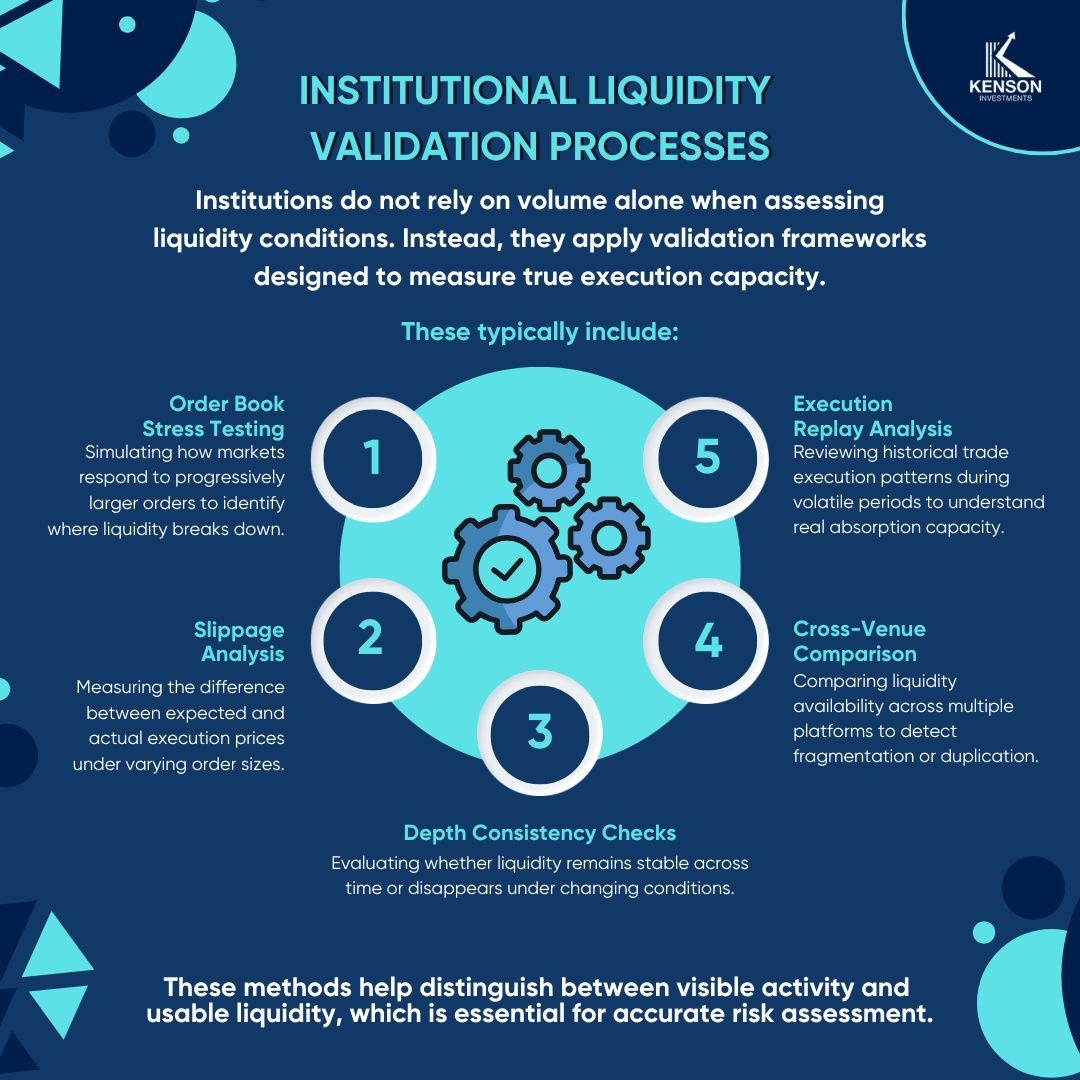
Institutions increasingly treat liquidity signals as layered information rather than direct indicators. Instead of assuming that volume equals depth, they evaluate how liquidity behaves under different conditions.
Key interpretive questions include:
- Does liquidity persist when order size increases?
- Is depth consistent across multiple venues or concentrated in one?
- How quickly does liquidity reappear after stress events?
- Are volume patterns supported by actual execution capacity?
This approach separates market activity from market resilience. Activity reflects participation. Resilience reflects structure.
Kenson Investments Perspective on Digital Asset Liquidity Illusion
Here is the text with your exact keywords added verbatim, hyperlinked, and bolded, seamlessly integrated into the text without changing any of the original wording:
The gap between market activity and real liquidity is a structural feature of modern digital asset markets. Understanding this gap is essential for institutions seeking to deploy capital with precision and control. Blockchain asset consulting and ai cloud mining play critical roles in breaking down these complexities. Kenson Investments supports institutional participants in evaluating digital asset liquidity illusionrisks and applying institutional liquidity validation frameworks, ensuring that execution decisions are based on real market capacity rather than surface-level activity. Utilizing a derivative consultant or specialized Blockchain and digital asset consulting can significantly enhance this evaluation. Register with us to see how institutional participants can strengthen allocation decisions by integrating liquidity validation into their broader market structure analysis process.
Disclaimer: The information provided on this page is for educational and informational purposes only and should not be construed as financial advice. Crypto currency assets involve inherent risks, and past performance is not indicative of future results. Always conduct thorough research and consult with a qualified financial advisor before making investment decisions.
“The crypto currency and digital asset space is an emerging asset class that has not yet been regulated by the SEC and the US Federal Government. None of the information provided by Kenson LLC should be considered as financial investment advice. Please consult your Registered Financial Advisor for guidance. Kenson LLC does not offer any products regulated by the SEC, including equities, registered securities, ETFs, stocks, bonds, or equivalents.”