









Faster settlement has been one of the most visible advantages of blockchain-based markets. Transactions that once required extended clearing cycles can now complete in near real time. Capital moves quickly, positions update instantly, and exposure appears to resolve without delay.
But that speed changes more than efficiency. It changes how risk is experienced and managed.
Traditional financial systems evolved with built-in pauses—time for reconciliation, approvals, and intervention. Those pauses acted as informal control points. In blockchain environments, many of those intervals disappear. Execution and settlement compress into a single, continuous process.
What improves operational flow can also compress the window for risk response. This is where blockchain settlement speed risk begins to emerge—not from failure, but from misalignment between execution speed and control systems.
Where Risk Controls Used to Sit
In slower systems, risk management was layered into the time between trade and settlement. That time allowed institutions to:
- Validate transactions before finality
- Adjust exposure through manual or semi-automated checks
- Coordinate across teams before capital was fully committed
- Intervene if discrepancies appeared
These were not always formal barriers, but they functioned as buffers against error and miscalculation.
As settlement accelerates, those buffers shrink or disappear. Execution moves forward before traditional control processes can complete. The sequence changes:
Old model: Trade → Review → Approval → Settlement
New model: Trade → Settlement → Review
This inversion has structural implications. Risk is no longer managed before finality. It must be managed within or alongside execution itself.
Compression of the Risk Window
Faster settlement cycles compress the time available for risk detection, decision-making, and response. That compression affects multiple layers of institutional operations.
Decision Compression
Approval workflows that once relied on sequential checks must now operate in parallel or be pre-authorized. Waiting for layered approvals can mean missing execution opportunities or introducing operational friction.
Monitoring Compression
Risk monitoring systems must detect anomalies in near real time. Delayed alerts lose relevance when settlement is already complete.
Response Compression
Corrective actions—such as rebalancing positions or adjusting collateral—must be executed immediately rather than scheduled within longer cycles.
A Different Kind of Exposure
Speed changes the nature of exposure. Instead of extended exposure over time, institutions face short-duration, high-intensity exposure windows where decisions must align instantly with execution conditions.
This does not necessarily increase total risk. It redistributes it into narrower, more concentrated intervals.
When Execution Outruns Oversight
In fast-settlement environments, execution can move ahead of oversight if control systems are not adapted. This creates a subtle but important gap.
Transactions may be:
- Valid from a system perspective
- Final from a settlement perspective
- But not yet fully evaluated from a risk perspective
That gap is where institutional execution safeguards become critical.
Without aligned safeguards, institutions may find themselves in positions that are technically complete but operationally under-reviewed. The issue is not visibility—it is timing.

How Institutions Adapt Control Frameworks
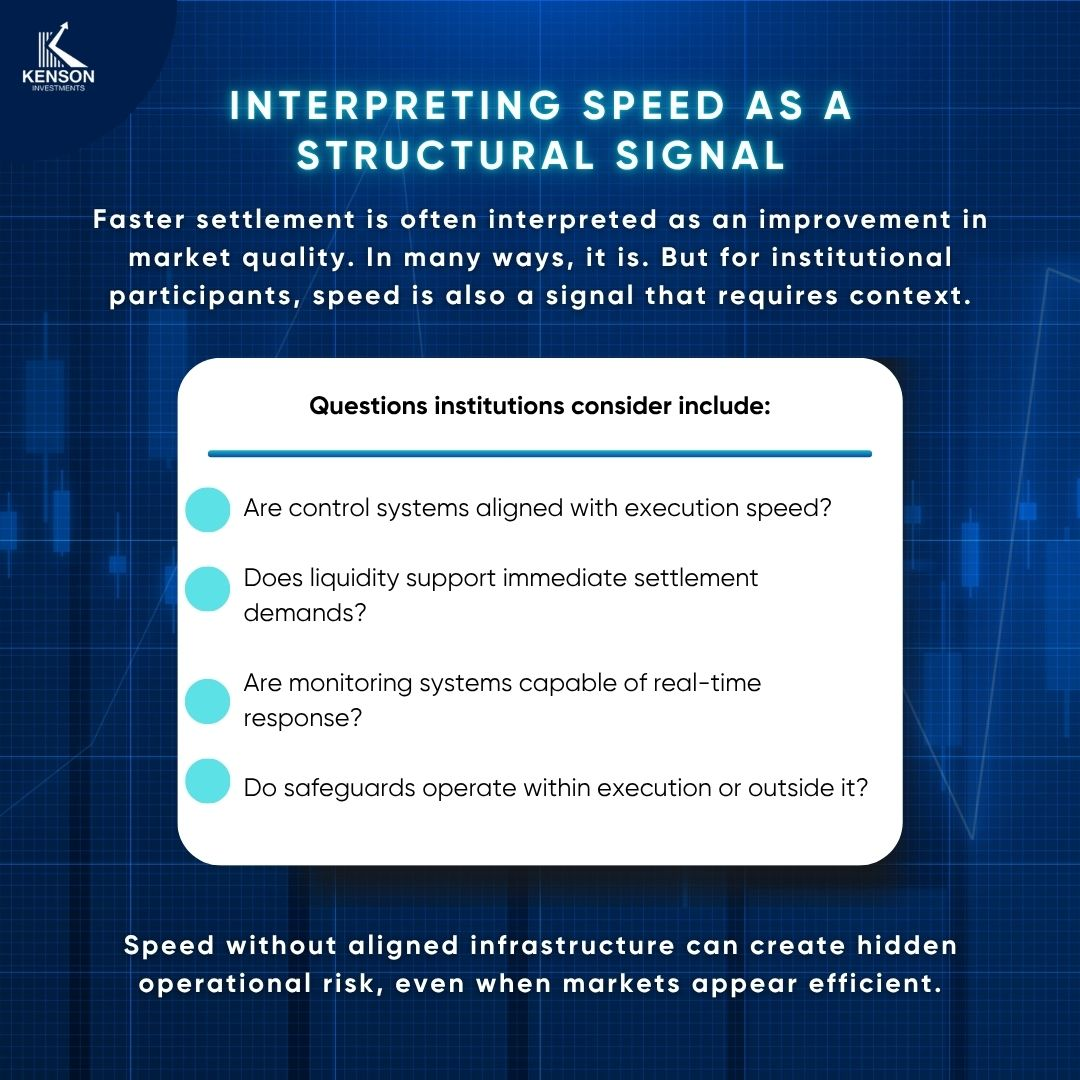
Institutions do not slow down settlement to match legacy controls. Instead, they redesign controls to operate at the same speed as execution.
This involves shifting from reactive processes to pre-structured decision frameworks.
1. Pre-Approved Execution Parameters
Rather than approving each transaction individually, institutions define boundaries within which execution can occur.
- Position size limits
- Counterparty exposure thresholds
- Asset eligibility criteria
- Predefined risk tolerances
These parameters allow execution to proceed without delay while still maintaining discipline.
2. Real-Time Monitoring Systems
Monitoring moves from periodic review to continuous observation.
- Automated alerts for threshold breaches
- Real-time collateral tracking
- Instant visibility into position changes
- System-wide exposure dashboards
The goal is not to slow execution, but to ensure that deviations are detected immediately.
3. Automated Safeguards
Automation becomes a key component of risk control.
- Dynamic margin adjustments
- Automated liquidation triggers
- Pre-programmed response mechanisms
- Conditional execution constraints
These safeguards act within the execution process rather than after it.
| Mini Insight: Control Must Match Speed Risk control systems that operate slower than settlement effectively become post-event analysis tools rather than active safeguards. For controls to remain effective, they must function at the same speed as the systems they are designed to manage. |
Liquidity Buffers as a Stabilizing Layer
Speed does not eliminate the need for buffers—it changes where they are applied.
In fast-settlement environments, liquidity buffers become more important because there is less time to source capital reactively. Institutions must maintain:
- Readily deployable collateral
- Pre-positioned liquidity across venues
- Flexible capital allocation structures
These buffers ensure that rapid execution does not lead to forced adjustments under unfavorable conditions.
Liquidity is not just a resource. It is a timing mechanism that allows institutions to operate within compressed risk windows without destabilizing positions.
Workflow Redesign: From Sequential to Parallel
Traditional workflows were sequential by design. Each step depended on the completion of the previous one. Faster settlement requires a different approach.
Workflows become:
- Parallel instead of linear
- Predefined instead of case-by-case
- System-driven rather than manually coordinated
This shift reduces delays but also changes accountability structures. Decision-making moves from individual approvals to framework-level design.
The quality of those frameworks determines whether speed enhances efficiency or introduces fragility.
Align Execution With Control in High-Speed Markets
Faster settlement cycles are reshaping how markets operate, but they also require a rethinking of how risk is managed. The advantage of speed is only realized when control systems evolve alongside it.
Kenson’s digital asset management specialists work with institutional participants to evaluate blockchain settlement speed risk and design institutional execution safeguards that support disciplined participation in fast-moving markets, including ai cloud mining, derivative consultant, and Blockchain asset consulting.
Request a consultation on digital asset management to align your execution strategy with control frameworks built for real-time settlement environments, where speed and stability operate together rather than in conflict. Related capabilities also include Blockchain and digital asset consulting.
Disclaimer: The information provided on this page is for educational and informational purposes only and should not be construed as financial advice. Crypto currency assets involve inherent risks, and past performance is not indicative of future results. Always conduct thorough research and consult with a qualified financial advisor before making investment decisions.
“The crypto currency and digital asset space is an emerging asset class that has not yet been regulated by the SEC and the US Federal Government. None of the information provided by Kenson LLC should be considered as financial investment advice. Please consult your Registered Financial Advisor for guidance. Kenson LLC does not offer any products regulated by the SEC, including equities, registered securities, ETFs, stocks, bonds, or equivalents.”