









Capital does not spread evenly. It clusters—around assets with deeper liquidity, platforms with better execution, and systems that appear operationally reliable. In digital markets, that clustering happens quickly and at scale. What begins as efficiency—capital gravitating to the best venues—can evolve into structural concentration that reshapes risk across the system.
The shift is subtle. Concentration does not look like instability at first. It often coincides with tighter spreads, deeper books, and stronger participation. But the same forces that create efficiency also create dependency. When a large share of market activity relies on a narrow set of assets or platforms, stability becomes conditional on those nodes remaining intact.
For institutions, the issue is not whether concentration exists. It is whether that concentration introduces systemic exposure that is not immediately visible in price or volume data. This is where digital asset capital concentration risk becomes a central concern within institutional market structure analysis.
How Concentration Forms in Digital Markets
Capital concentration is not random. It follows incentives, access, and perceived safety.
- Liquidity gravity:Capital moves toward assets with deeper order books and lower execution costs.
- Platform preference:Venues with reliable uptime, custody, and settlement attract disproportionate flow.
- Collateral compatibility:Assets widely accepted as collateral accumulate more capital because they unlock additional use cases.
- Operational simplicity:Fewer integrations and clearer workflows pull capital toward standardized environments.
Individually, these drivers are rational. Collectively, they concentrate exposure.
Over time, a feedback loop emerges:
more capital → better liquidity → stronger perception of safety → even more capital.
This loop can stabilize markets in normal conditions. It can also amplify fragility when conditions change.
Concentration Changes the Nature of Liquidity
Liquidity is often interpreted as a buffer against risk. In concentrated systems, that interpretation needs adjustment.
When a large share of liquidity sits in a few assets or platforms, it behaves differently:
- Depth becomes conditionalon the continued presence of the same capital pools.
- Spread stabilitydepends on a limited set of liquidity providers.
- Execution qualitycan degrade quickly if those providers withdraw or reprice.
This does not mean liquidity disappears. It means liquidity becomes dependent on fewer actors and locations. The market may look deep, but that depth is less diversified than it appears.
A useful distinction:
- Distributed liquidityabsorbs shocks through multiple independent sources.
- Concentrated liquiditytransmits shocks because the same sources are affected simultaneously.
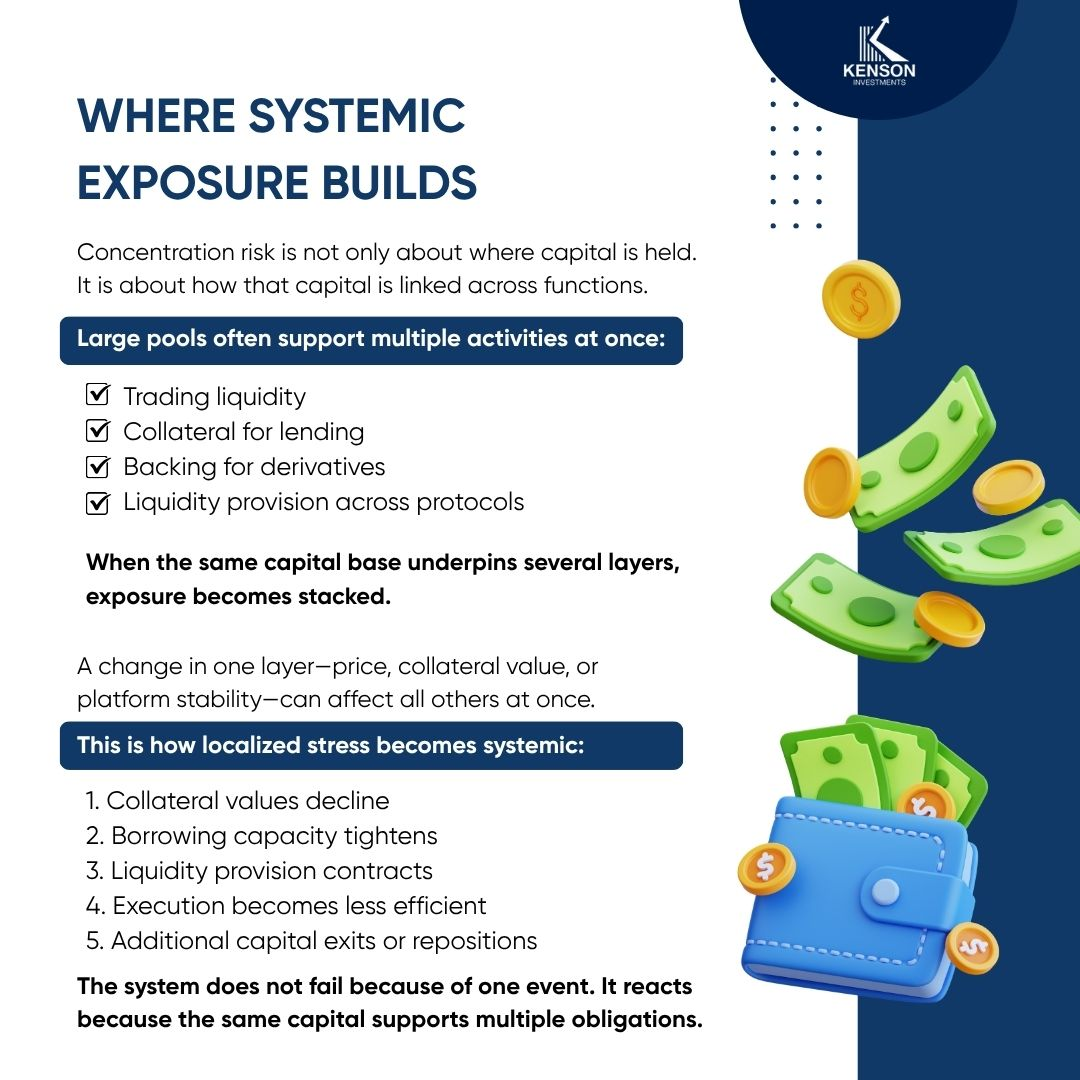
Platform-Level Concentration
Digital markets are particularly sensitive to platform concentration. A small number of venues often handle a large share of trading volume, custody, or settlement activity.
This creates several structural dependencies:
- Execution dependency:Trades rely on the availability and performance of a few systems.
- Custody dependency:Asset safety is tied to limited custodial infrastructures.
- Operational dependency:Downtime or disruption at a single venue can affect multiple market segments.
Even when alternatives exist, switching between platforms is not always immediate or frictionless—especially under stress. That means concentration at the platform level can translate directly into market-wide operational risk.
Asset-Level Concentration
Certain assets become central because they serve multiple roles—trading pairs, collateral, liquidity anchors, or settlement instruments.
This concentration has two key effects:
- Market sensitivity increases:Price movements in core assets influence a wide range of positions.
- Correlation rises:Different parts of the market begin to move together because they depend on the same underlying assets.
As a result, diversification across assets may be less effective than it appears. If multiple positions rely on the same collateral base or liquidity anchor, they are not truly independent.
Behavioral Effects of Concentrated Capital
Concentration influences how participants behave, especially during changing conditions.
When capital is widely distributed, reactions to market signals tend to be staggered. In concentrated systems, reactions become more synchronized.
- Large participants adjust positions at similar thresholds
- Liquidity providers respond to the same signals
- Collateral-driven adjustments occur simultaneously
This synchronization increases the speed at which conditions change. What might have been a gradual adjustment becomes a rapid shift in liquidity and pricing.
Behavioral alignment is not coordinated. It is structural—driven by shared exposure and similar incentives.
Institutional Monitoring of Concentration Risk
Institutions do not attempt to eliminate concentration. In many cases, concentration is unavoidable due to liquidity realities. Instead, the focus is on measuring and managing thresholds.
Key areas of monitoring include:
Exposure Distribution
How much capital is allocated to individual assets, platforms, or counterparties relative to total portfolio size.
Collateral Overlap
Whether the same assets are being used across multiple positions, increasing indirect exposure.
Liquidity Source Diversity
The number and independence of liquidity providers supporting execution.
Platform Dependency
The extent to which operations rely on a limited number of venues or infrastructures.
Correlation Under Stress
How assets and positions behave when market conditions change, not just during stable periods.
Practical Threshold Thinking
Institutions often define internal limits, such as:
- Maximum exposure to a single asset or collateral type
- Maximum reliance on a single platform
- Minimum diversification across liquidity sources
These thresholds are not static rules. They are dynamic controls that adjust based on market conditions and infrastructure reliability.
Diversification in a Concentrated Environment
Diversification remains a core tool, but its application changes in tokenized markets.
True diversification requires more than holding different assets. It involves:
- Using assets with independent liquidity profiles
- Allocating across multiple execution venues
- Avoiding reliance on a single collateral framework
- Maintaining flexibility to shift capital without friction
The goal is not to avoid concentration entirely. It is to ensure that no single point of concentration can dictate overall portfolio behavior.

Interpreting Concentration as a Market Signal
Concentration is not only a risk factor. It is also a signal.
Rising concentration may indicate:
- Increased institutional participation
- Preference for specific infrastructure
- Stronger liquidity conditions in select areas
At the same time, it may signal:
- Reduced diversification
- Growing systemic dependency
- Higher sensitivity to localized disruptions
Institutional analysis treats concentration as a dual signal—reflecting both efficiency and vulnerability. The challenge is determining which side is dominant under current conditions.
The Kenson Perspective on Structural Concentration Risk
At Kenson Investments, capital concentration is evaluated as a structural feature of market behavior rather than an anomaly. The focus is on understanding how concentration shapes liquidity, execution, and systemic exposure across interconnected systems.
The evaluation framework emphasizes:
- Distribution over size– Where capital sits matters more than how much exists
- Interconnection over isolation– Exposure is assessed across linked functions, not individual positions
- Behavior under stress– Concentration is tested through how systems respond when conditions shift
This approach ensures that capital allocation reflects not just opportunity, but the structural implications of concentration within the market environment.
Align Capital With Balanced Market Structures
Capital concentration is becoming a defining feature of digital asset markets. It supports efficiency, but it also introduces dependencies that can reshape risk when conditions change. Blockchain asset consulting and ai cloud mining are key areas to watch as this space evolves. Kenson Investments works with institutional participants to evaluate digital asset capital concentration risk through disciplined market structure analysis, helping ensure that exposure is distributed in a way that supports resilience rather than amplifying vulnerability. Our derivative consultant services and Blockchain and digital asset consulting strategies focus on navigating these exact dynamics. Work with our digital asset management consultants to assess concentration thresholds, collateral overlap, and liquidity dependencies across digital asset markets with disciplined structure analysis.
Disclaimer: The information provided on this page is for educational and informational purposes only and should not be construed as financial advice. Crypto currency assets involve inherent risks, and past performance is not indicative of future results. Always conduct thorough research and consult with a qualified financial advisor before making investment decisions.
“The crypto currency and digital asset space is an emerging asset class that has not yet been regulated by the SEC and the US Federal Government. None of the information provided by Kenson LLC should be considered as financial investment advice. Please consult your Registered Financial Advisor for guidance. Kenson LLC does not offer any products regulated by the SEC, including equities, registered securities, ETFs, stocks, bonds, or equivalents.”