









In institutional markets, capital allocation is not a reaction. It is a process built on structured evaluation. Before any meaningful deployment occurs, systems are assessed for one foundational requirement: reliability.
In blockchain-based environments, this requirement becomes even more critical. Unlike traditional financial systems with centralized oversight and standardized infrastructure, blockchain networks distribute execution, validation, and settlement across decentralized participants. That design improves transparency and resilience in some areas, but it also introduces variability in performance.
For institutions, that variability must be measured. Blockchain network reliability becomes a primary input into institutional allocation criteria, influencing whether capital enters a system at all, how much is deployed, and under what conditions exposure is maintained.
Reliability is not a background feature. It is a gating condition. If a network cannot demonstrate consistent operational performance, other strengths—liquidity, innovation, yield—become secondary.
What Reliability Actually Means in Blockchain Systems
Network reliability is often reduced to uptime percentages, but institutional evaluation goes deeper. Reliability refers to the consistent ability of a network to process, validate, and finalize transactions under varying conditions.
This includes:
- Continuous block production without interruption
- Stable validator participation and consensus integrity
- Predictable transaction finality times
- Resistance to congestion-related degradation
- Recovery performance after disruptions
Each of these components contributes to whether a network can support capital deployment at scale. A system that performs well during normal conditions but struggles under load is not considered fully reliable from an institutional perspective.
Reliability is not measured by ideal performance. It is measured by behavior under stress.
Why Uptime Alone Is Not Enough
Uptime is often used as a shorthand indicator of reliability. While it provides a useful signal, it does not capture the full operational reality of a blockchain network.
A network can maintain high uptime while still experiencing:
- Delayed transaction finality
- Validator centralization risks
- Partial service degradation
- Temporary consensus instability
- Increased transaction failure rates during congestion
From an institutional standpoint, these issues matter as much as downtime itself. Capital is sensitive not just to whether a network is online, but to whether it performs predictably under load.
A system that is technically “available” but operationally inconsistent introduces uncertainty into execution and settlement workflows. That uncertainty affects allocation decisions directly.
Validator Stability as a Structural Signal
Validator behavior is one of the most important components of blockchain network reliability. Validators are responsible for confirming transactions and maintaining consensus. Their stability directly affects network performance.
Institutions evaluate validator structures based on:
- Distribution of validator participation
- Historical uptime of validator sets
- Concentration of validation power
- Responsiveness during high-volume periods
- Historical instances of downtime or misbehavior
A highly centralized or unstable validator set introduces structural risk. Even if the network appears functional, dependency on a limited set of validators can create hidden fragility.
Validator stability is not just a technical detail. It is a structural indicator of whether the network can sustain capital at scale.
But Reliability Is a Collective Property
No single node determines network reliability. It emerges from the behavior of the entire validator ecosystem. Weakness at scale is what institutions monitor, not isolated performance.

Failure History Shapes Future Allocation
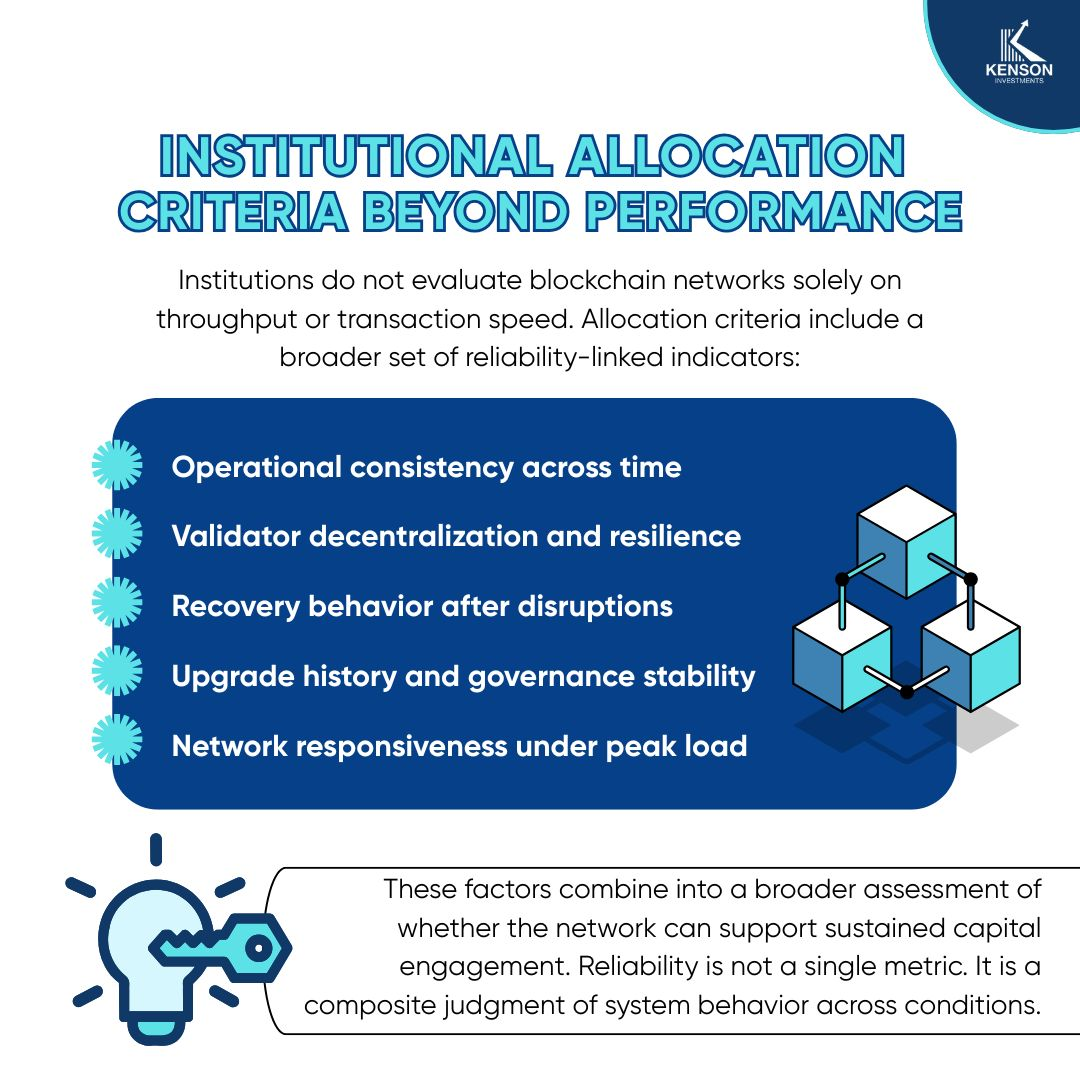
Historical performance plays a significant role in institutional allocation criteria. Networks are not evaluated only on current conditions, but on how they behaved during past stress events.
Key elements of failure history include:
- Frequency and duration of outages
- Network recovery time after disruptions
- Severity of congestion events
- Past consensus failures or reorganizations
- Impact of upgrades or protocol changes on stability
This historical record becomes a reference point for future risk assessment. A network that has experienced instability may still be usable, but capital deployment decisions will reflect that history through tighter constraints or reduced exposure.
Institutions do not assume past failures will repeat. They assume failure patterns reveal structural sensitivity.
How Reliability Affects Allocation Decisions
Reliability directly influences how capital is allocated across blockchain networks. It is not a binary yes-or-no factor. It shapes the size, duration, and conditions of participation.
Common allocation adjustments include:
- Smaller initial capital deployment into newer or less proven networks
- Increased collateral requirements when reliability is uncertain
- Reduced exposure during periods of known operational stress
- Preference for networks with consistent historical performance
- Diversification across multiple networks to reduce single-point dependency
These adjustments are not reactive. They are structural safeguards built into allocation frameworks.
The more critical the application—settlement, custody, liquidity provisioning—the more important reliability becomes.
Reliability Under Stress Conditions
Stress conditions reveal the true behavior of blockchain networks. These may include:
- Sudden spikes in transaction volume
- Market volatility triggering rapid execution demand
- Network congestion events
- Validator downtime or instability
- Protocol upgrades or governance transitions
In these moments, reliability is tested in real time. Networks that perform smoothly under normal conditions may experience delays, fee spikes, or partial degradation when stressed.
Institutions pay close attention to how networks behave during these periods because stress reveals operational limits that are not visible in stable environments.
A network that maintains consistent performance under stress is significantly more attractive for capital allocation than one that only performs well in equilibrium.
Why Reliability Precedes Liquidity and Yield
In many cases, liquidity and yield opportunities attract attention first. However, institutional frameworks prioritize reliability before any other factor.
The logic is straightforward:
- Liquidity is only usable if the network functions reliably
- Yield is only meaningful if settlement is consistent
- Execution only matters if finality is stable
Without reliability, other metrics lose practical value. A high-yield environment with unstable infrastructure introduces risks that can outweigh potential returns.
This ordering reflects how institutions think about allocation. Functionality comes before opportunity.
Align Capital With Reliable Network Infrastructure
Capital allocation in blockchain markets begins with one question: can the network be relied on when conditions change? Blockchain asset consulting and tailored DeFi finance consulting services are essential for evaluating these infrastructure dynamics. If the answer is unclear, exposure is limited. If the answer is consistent, allocation scales. Kenson Investments supports institutional participants in evaluatingblockchain network reliability and institutional allocation criteria, helping ensure that capital is deployed into systems capable of sustaining performance under real market conditions. Consulting with an experienced digital asset management consultant can provide the technical depth required for these assessments. In digital asset markets, reliability is not optional. It is the structure that allows every other market function to exist. Register with our digital asset strategy consulting firm for more information.
Disclaimer: The information provided on this page is for educational and informational purposes only and should not be construed as financial advice. Crypto currency assets involve inherent risks, and past performance is not indicative of future results. Always conduct thorough research and consult with a qualified financial advisor before making investment decisions.
“The crypto currency and digital asset space is an emerging asset class that has not yet been regulated by the SEC and the US Federal Government. None of the information provided by Kenson LLC should be considered as financial investment advice. Please consult your Registered Financial Advisor for guidance. Kenson LLC does not offer any products regulated by the SEC, including equities, registered securities, ETFs, stocks, bonds, or equivalents.”