









Tokenized markets have changed the way capital moves across digital asset venues and financial systems. What once required multiple manual steps, layered approvals, and slower settlement processes can now happen across connected platforms with fewer operational barriers. That shift does not simply improve convenience. It changes how capital is distributed, how quickly liquidity relocates, and how market behavior responds when conditions tighten or improve.
For institutional participants, the important question is not whether capital can move faster. It is how that speed affects the structure of the market itself. When capital becomes more mobile, liquidity is no longer fixed to a single venue or instrument.
It can migrate between exchanges, lending protocols, tokenized funds, and settlement environments in response to yield, risk, and execution conditions. That mobility creates efficiency, but it also makes liquidity more responsive to incentives and more sensitive to stress.
This is why tokenized markets must be evaluated as infrastructure, not just as asset wrappers. They alter the mechanics of capital movement in ways that influence price formation, trading depth, and participant behavior. For institutions, that means liquidity signals must be read in context. A market may appear active, but if capital can leave quickly, that activity may not translate into durable support.
Tokenization Reduces Friction, Not Risk
Tokenized markets reduce the operational barriers that traditionally slowed capital movement. Assets can be represented digitally, transferred across venues more efficiently, and integrated into systems that support trading, lending, and custody with less manual intervention. That does not eliminate risk. It changes how risk travels.
In traditional systems, capital movement often depended on slower reconciliation cycles, separate account structures, and more limited interoperability between market segments. Tokenized infrastructure compresses those steps.
Capital can now move with greater speed across platforms that share common standards or connected settlement rails. This creates an environment where money is more responsive to yield changes, spread opportunities, and collateral conditions.
The practical result is a market structure in which capital is more fluid and less anchored.
That matters because:
- Capital can leave underperforming venues more quickly.
- Liquidity can concentrate in a smaller number of attractive markets.
- Short-term incentives can redirect capital faster than long-term fundamentals can stabilize it.
- Execution quality becomes more dependent on infrastructure reliability.
For institutions, the benefit is obvious. Capital efficiency improves. Rebalancing becomes easier. Access broadens. But the same features also mean liquidity can be more temporary than it appears. Tokenized markets reward speed, and speed often magnifies the importance of structure.
Faster Capital Mobility Changes Liquidity Distribution
When capital moves more quickly, liquidity does not stay evenly spread across the market. It tends to cluster where conditions are most favorable. That may include venues with better execution, stronger incentives, deeper order books, or more favorable collateral terms. As a result, tokenized markets often produce uneven liquidity distribution across time, platforms, and instruments.
This redistribution happens in layers.
Capital follows the best immediate conditions
Participants seeking better yield or tighter execution often move capital rapidly toward the most efficient venue. That creates short-term concentration, which may strengthen one market while weakening another.
Liquidity becomes more selective
In tokenized environments, capital may remain accessible only where infrastructure is efficient enough to absorb it. That means liquidity is less about total market size and more about where capital is willing to settle at a given moment.
Market depth becomes dynamic
Depth can improve rapidly when incentives are strong, then thin just as quickly when conditions change. This creates a market environment where liquidity is present but not always persistent.
The institutional implication is significant. A market that can attract capital quickly can also lose it quickly. Liquidity distribution becomes a function of relative attractiveness, not fixed presence. That means investors need to evaluate not just whether liquidity exists, but whether it is likely to remain when conditions shift.

Capital Movement Patterns Reveal Market Behavior
Tokenized markets do more than move capital efficiently. They expose the behavior of participants more clearly. Because transfers, allocations, and redemptions occur across digital infrastructure, institutional observers can identify how capital reacts to changing signals.
That creates a new kind of market intelligence.
When capital flows into a tokenized venue, it may indicate confidence in execution, governance, or yield. When it exits quickly, it may signal uncertainty around liquidity quality, operational friction, or incentive misalignment. These patterns matter because they show how participants prioritize speed, access, and flexibility.
Some common movement patterns include:
- Capital rotating toward higher-yield venues during stable conditions.
- Liquidity migrating toward better settlement or custody environments.
- Funds leaving protocols when collateral assumptions weaken.
- Allocations concentrating in markets with lower execution friction.
These are not random shifts. They reveal how participants interpret structural quality. In tokenized markets, behavior is often more visible because movement itself is easier to observe. For institutions, this creates an advantage, but only if the data is read correctly.
Flow does not always mean conviction. Sometimes it means temporary preference. Sometimes it reflects defensive repositioning. Sometimes it signals a deeper structural migration of capital.
Operational Friction Still Shapes Mobility
Even though tokenized markets reduce barriers, they do not remove friction entirely. Instead, they move friction into new places. Traditional bottlenecks may decline, but new dependencies appear in governance, settlement, interoperability, and custody.
That means capital movement is faster, but not frictionless.
The remaining constraints often include:
- Compatibility between platforms and token standards.
- Settlement finality across different systems.
- Custody arrangements that govern how assets can move.
- Governance rules that affect transferability or redemption.
- Liquidity thresholds that limit effective mobility during stress.
These constraints matter because they determine whether capital mobility is real or only apparent. A tokenized market may look highly connected, but if operational rules make transfers difficult under pressure, the market may still fragment when stressed.
For institutional investors, this is where due diligence becomes essential. The key question is not whether capital can move in normal conditions. It is whether it can move reliably when liquidity is under strain, collateral is under pressure, or execution quality starts to deteriorate.
Structural Effects on Market Behavior
When capital becomes easier to move, market behavior changes. Participants become more responsive to opportunity, but also more sensitive to relative differences between venues and systems. That can improve efficiency, yet it also makes markets more competitive and more reactive.
Tokenized infrastructure encourages a faster feedback loop between signal and action. If execution becomes better elsewhere, capital moves. If collateral quality weakens, capital adjusts. If governance feels uncertain, liquidity can shift away before broader sentiment changes. In that sense, tokenized markets are not just faster. They are more adaptive.
That adaptive quality influences behavior in several ways:
- Price differences are arbitraged more quickly.
- Underperforming venues may lose capital faster.
- Incentive programs may attract or repel liquidity within short cycles.
- Participants may prioritize portability over commitment.
This creates a market where liquidity is more conditional and where capital allocation decisions are revisited more often. Institutions that rely on static assumptions about market depth or capital stability may misread these shifts. Tokenized markets reward continuous assessment.
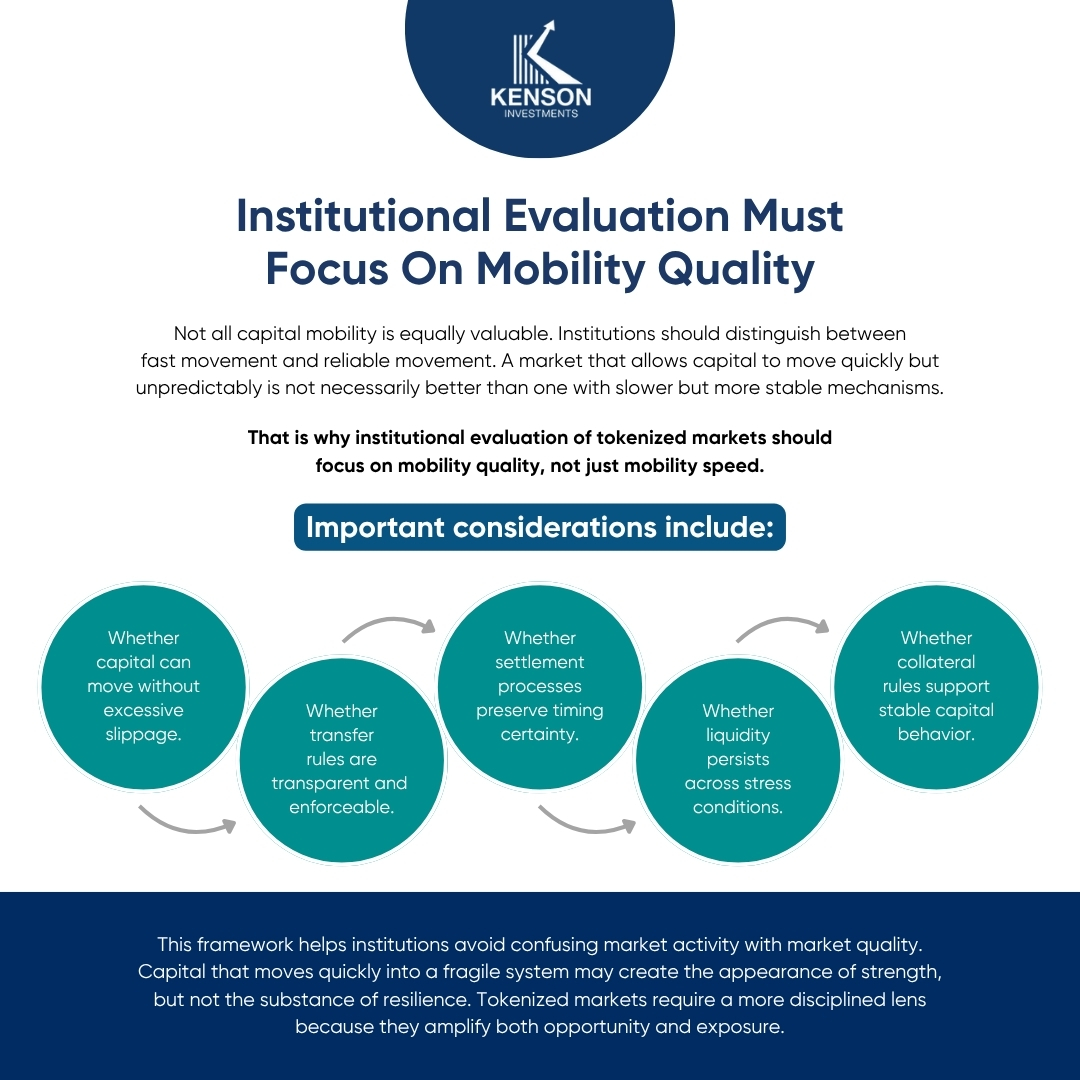
The Kenson Perspective on Capital Movement and Liquidity Structure
At Kenson Investments, capital movement is evaluated through the lens of structural reliability. Faster movement across tokenized markets can improve efficiency, but only when the underlying infrastructure supports durable liquidity, predictable settlement, and transparent execution.
The key is to separate accessibility from resilience.
Kenson’s approach focuses on:
- How capital enters and exits across venues.
- Whether liquidity is distributed or overly concentrated.
- How collateral systems support or constrain movement.
- Whether infrastructure quality supports stable participation.
- How participant behavior changes when capital becomes more portable.
This is an insight-driven framework. First, structural conditions are identified. Then their implications for capital movement are assessed. Finally, allocation decisions are made based on whether the market can support disciplined participation under changing conditions.
Tokenized markets do not simply accelerate capital. They change the logic of capital movement itself. That makes infrastructure evaluation central to any serious investment approach.
Align Capital With Infrastructure That Can Support It
Tokenized markets have made capital more mobile, but mobility alone is not a measure of market strength. What matters is whether the systems behind that mobility can support consistent, transparent, and resilient allocation behavior.
Call us now – Digital asset management consultants at Kenson Investments help investors evaluate how tokenized infrastructure affects liquidity distribution, market behavior, and capital flow patterns. The goal is not to chase movement, but to understand the structure behind it and allocate accordingly.
For institutional participants, that distinction is essential. Capital that moves efficiently is useful. Capital that moves efficiently through resilient systems is stronger.
Disclaimer: The information provided on this page is for educational and informational purposes only and should not be construed as financial advice. Crypto currency assets involve inherent risks, and past performance is not indicative of future results. Always conduct thorough research and consult with a qualified financial advisor before making investment decisions.
“The crypto currency and digital asset space is an emerging asset class that has not yet been regulated by the SEC and the US Federal Government. None of the information provided by Kenson LLC should be considered as financial investment advice. Please consult your Registered Financial Advisor for guidance. Kenson LLC does not offer any products regulated by the SEC, including equities, registered securities, ETFs, stocks, bonds, or equivalents.”